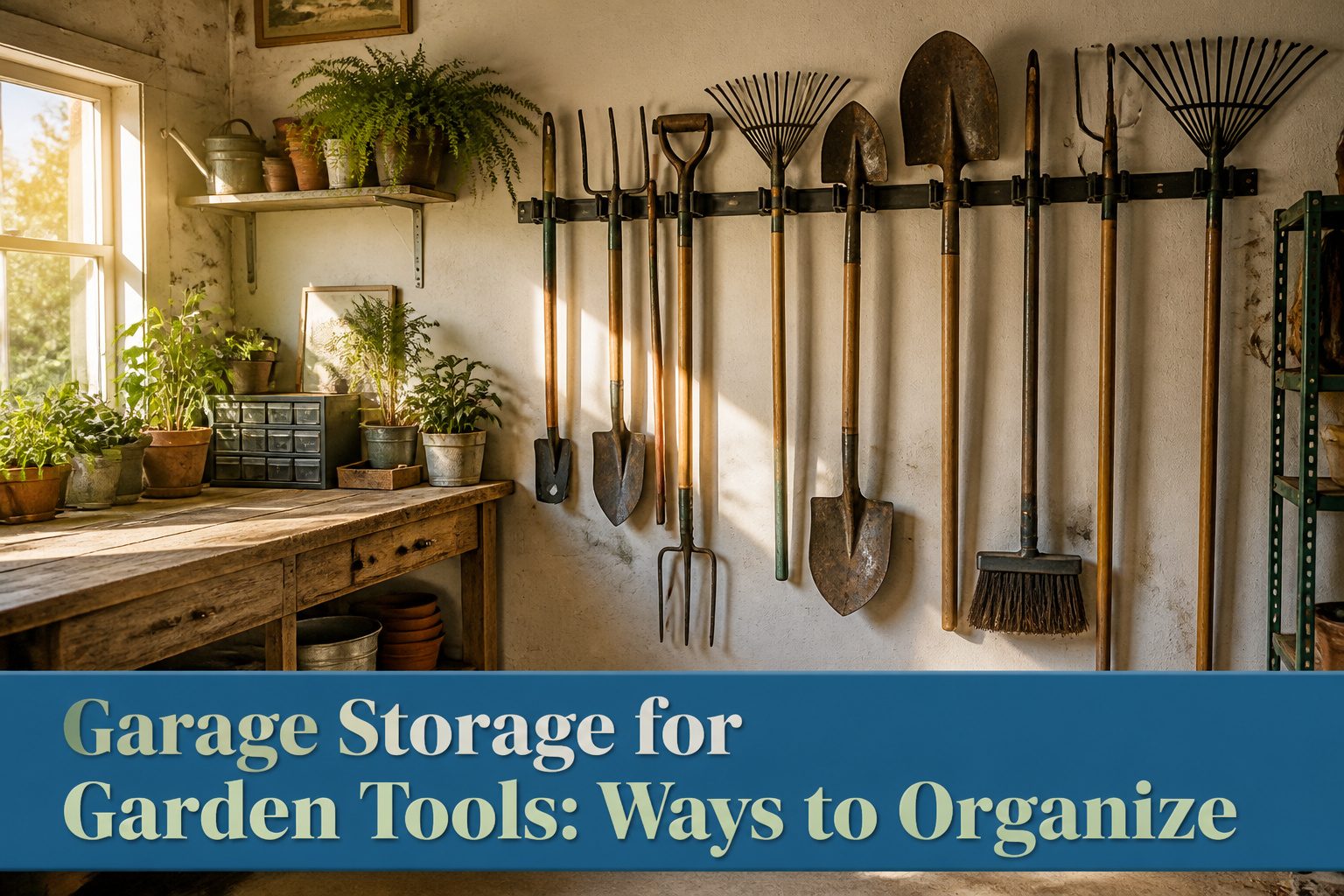
Garage storage for garden tools is the wall-and-ceiling system that keeps long-handled equipment off damp concrete and within reach.
It works only if you match the rack to the actual weight of what you own: the Imillet holder tops out at 50 pounds and under $17, while a steel StoreYourBoard BLAT at $49.99 handles 250 pounds across slots deep enough for a gas edger.
Buy wrong on that spec, and the rack warps or the tools drift back to the corner they came from.
1. Wall-Mounted Tool Racks

Wall-mounted racks are the first place I look when floor space is tight and a garden tool collection is still growing.
A solid steel rack bolted to studs keeps shovels, rakes, and long-handled power tools off the concrete and within arm’s reach.
The StoreYourBoard BLAT Garden Tool Organizer runs $49.99, ships fully assembled, and carries up to 250 pounds across four deep slots. That capacity matters if you own a gas-powered edger or a heavy spade collection that adds up fast.
For lighter loads, the Imillet 2-Pack Mop and Broom Holder costs $16.98 and handles about 50 pounds per rack. The spring-loaded slots grip well enough for everyday hand tools, though each slot tops out around 6 pounds.
I would pick the BLAT for a permanent garage wall where weight is the deciding factor, and accept the trade-off of spending roughly three times as much.
The Imillet pair makes sense only if your tools are strictly lightweight and the budget is the harder ceiling.

All Metal Material: Our garden tool organizer, both backboard and hooks are made of iron, which makes it more durable and solid.And its load-bearing capacity far exceeds other usual ABS material tool hooks. It is deal for various tools like shovel, rakes, bikes, broom, mop, trust that what you get is what you see,any dissatisfaction please contact our customer service team
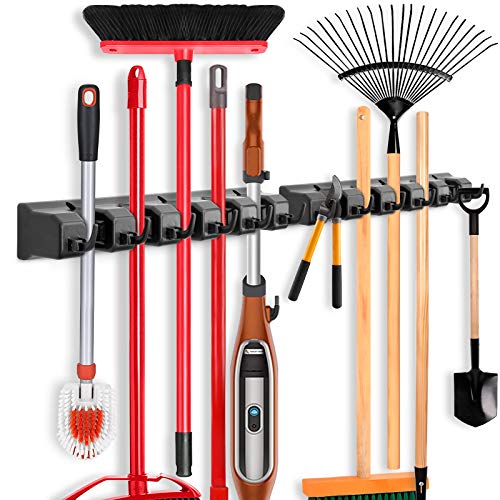
Tidy Your Home: 5 ball slots and 6 hooks design, organize your annoying cleaning tools within small space

DIY Basketball Stand】: This basketball stand can be assembled into different structures according to the requirements of space use, such as DIY assembled into 1/2/3/4 section wall mounted ball rack. Suitable for narrow space, can be installed in bedroom nightstand, living room display rack, ball storage garage, basement, gym and tool room.
2. Slatwall Panel Systems
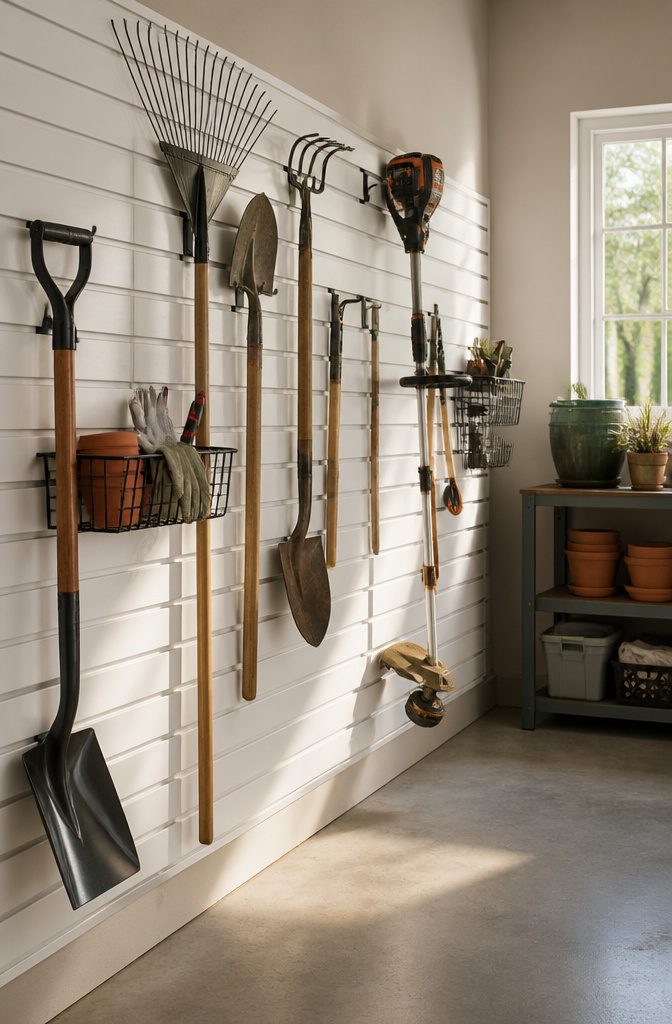
Slatwall panel systems turn a blank garage wall into a surface you can rearrange as your tool collection grows or shrinks.
The Proslat 88102 PVC kit covers 4 feet by 8 feet with ten interlocking panels and holds up to 75 pounds per square foot, which is enough for a full rack of long-handled tools plus a string trimmer or two.
Hooks, baskets, and shelves are sold separately, so you build out only what you actually need.
The real advantage over pegboard is durability and reconfiguration. Move a hook six inches left for a new shovel, swap a basket for a shelf when potting season hits, and the slots take it without new holes or wall damage.
Some systems rate their heavy-duty brackets at 70 pounds, and in practice that means a loaded tool caddy or a full garden hose reel hangs without drama.
Upfront cost is the real hurdle. The Proslat kit alone runs about $200 before you buy a single hook, and a full wall of accessories can push the total past what a set of fixed racks or a basic cabinet costs.
I would spend it only if the garage wall is a long-term workspace and the tool mix changes seasonally.
For a renter with a two-year lease or someone whose garden kit is already complete, the flexibility is wasted money. Buy it when you know you will use the reconfiguration, not because it looks tidy on day one.
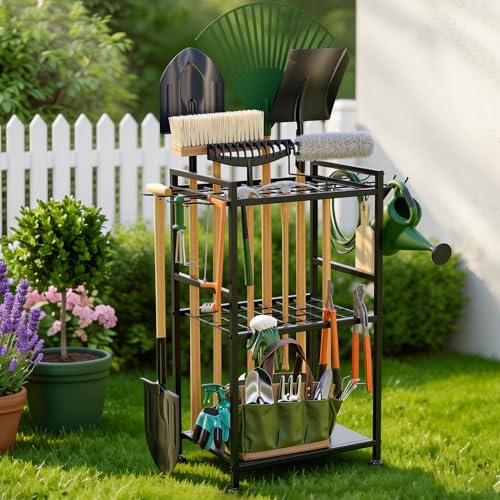
1. 【All-In-One High Density Storage】 Maximize your storage space with this high-capacity garden tool rack. It occupies only 16"×12" compact space yet can hold more than 35 tools. Equipped with 4 side slots and 5 hanging hooks, it easily stores 10 D-grip tools like pruning shears, garden trowels, short shovels and garden hoses. Ideal for tidying up messy spaces perfectly for gardening enthusiasts.

Multifunctional Organization: Say hello to our garden tool organizer with 10 tool slots, purpose-built for gardening tools, keeping all your essential tools in perfect order. It's the go-to choice for both home gardening enthusiasts and professional gardeners!

Generous Storage Capacity: The garden tool storage is equipped with 35 square slots, which are suitable for I-handle tools such as shovel and rake; garden tool rack equipped with 11 hooks, it is easy to hang accessories such as water pipes, pruning shears, axes, etc
3. Garage Cabinetry

Cabinets lock away the equipment that costs real money to replace: electric leaf blowers, hedge trimmers, chainsaws, anything with a motor or a blade.
That security matters more than I used to think. A locked cabinet also keeps gas and oil off the floor where kids might wander through, which turns the storage decision into a safety call, not just an organization one.
The downside is speed. A cabinet door adds a step every time you reach for a trowel or a pair of gloves, and that friction means tools start drifting back to the corner they came from.
I would put daily-use items on open hooks or slatwall and reserve cabinets for the power tools I use twice a month and the chemicals I never want loose.
Floor space is the real cost. A full cabinet run eats wall length that could hold more tools in the open, and the footprint shrinks what you can park inside.
I would only install cabinets if I already had ceiling racks handling the bulky seasonal stuff and wall storage covering the hand tools.
In that layout, the cabinet becomes the secure anchor of the system, not a standalone solution. The cleaner look is a genuine benefit, but it is secondary; buy the cabinet for what it locks away, not for how it photographs.

HEAVY-DUTY GARAGE TOOL ORGANIZER: Revolutionize your garage with this wall-mounted storage hero! Designed to hold shovels, brooms, power tools, and more, it can support up to an impressive 300 lbs.

【STURDY BROOM HOLDER】Made of premium rust-resistant 304 stainless steel, far sturdier than plastic holders. Equipped with 4 slots & 5 hooks, it firmly holds heavy brooms, mops, rakes without bending for long-term household & outdoor use

【Smart Garden Tool Holder】: As a smart tool storage and tools organizer, Sttoraboks garden tool holder features 35 tool slots, delivering generous capacity within a compact footprint. Unique storage holes are engineered to accommodate various tool types and sizes, from gardening and lawn equipment to cleaning supplies. Height-adjustable feet ensure stability even on uneven ground. This yard tool organizer for garage simplifies tool classification, keeping your workspace neat and efficient.
4. Overhead Storage Racks

Overhead racks turn the ceiling into storage you probably are not using.
Industrial-strength steel construction, powder coated against rust, lets these systems hold up to 600 pounds, which is where I would put winter tires, holiday decorations, or anything else that sits untouched for months.
Access gets harder the higher you go. Anything you need weekly belongs at arm’s reach on a wall or in a cabinet, not overhead.
Installation also demands thought: ceiling joist spacing varies, and a rack loaded to capacity needs to anchor into structure, not drywall. I would plan the layout before lifting anything up, because reorganizing 600 pounds overhead is not a one-person weekend task.
For seasonal garden tools, the math works.
A snowblower or dormant pots fit the timeline. Your pruners and hand trowel do not.

DURABLE GARAGE SLAT WALL STORAGE SYSTEMS: Our premium PVC wall organizer are built to withstand harsh conditions and are 30 times more durable than drywall. They are fireproof, waterproof, fade-proof, dry-proof, crack-proof, peel-proof, and have an extra-high weight capacity of up to 75 pounds per square foot. Our slatwall panels can be easily cut to any desired size or combined into larger sections allowing you to perfectly install panels for your entire wall.

4FT x 8FT SLATWALL PANELS: Our durable PVC slat wall panel comes with 8Pcs-4ft x 1ft slatwall panels, offering a finished coverage area of 32 total square feet!Includes 48” side lids and H-trim for a nice, flat slatwall panel joint! Ideal for workshops, garages, tool sheds, gyms, offices, factories, craft rooms, laundry rooms, basements, gardens and more!
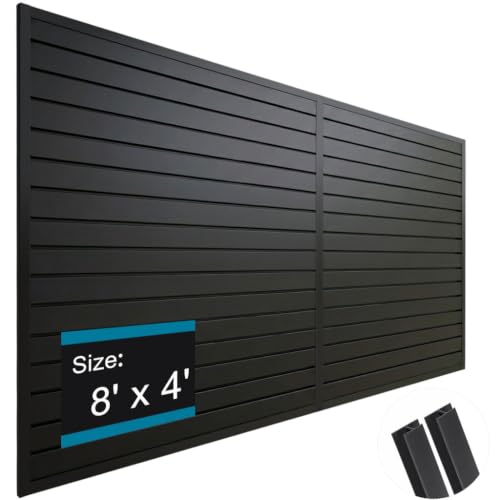
✅【KEEP YOUR SPACE NEAT】Transform your garage with this Slat Wall Paneling that makes full use of wall space. Hang shelves, tools, and accessories easily with interlocking grooves. Keep your garage organized, efficient, and clutter-free while enjoying quick access to everything you need.
5. Corner Tool Towers

Corners in a garage tend to collect nothing but dust and a stray extension cord, which makes them the first place I look when floor space runs short.
A corner tool tower turns that dead zone into vertical storage for long-handled gear.
The Rubbermaid Garage Corner Tool Tower Rack fits roughly thirty tools into a footprint you would otherwise step over, and its plastic build means it will not rot, rust, or dent the way a cheap metal stand might.
At $34.99, it is the kind of buy that pays for itself in cleared floor space alone.
The tower works best when your collection is mostly rakes, shovels, and brooms with straight shafts. Bulky items like spreaders, gas cans, or anything with a wide head throw off the balance or simply will not slot in.
I would skip this option if you own more than a couple of short-handled tools, since the tower is built for length and leaves trowels and hand rakes to rattle around elsewhere.
For a renter or first-home owner with a modest yard and standard long-handled tools, though, it is hard to beat the space-per-dollar ratio.
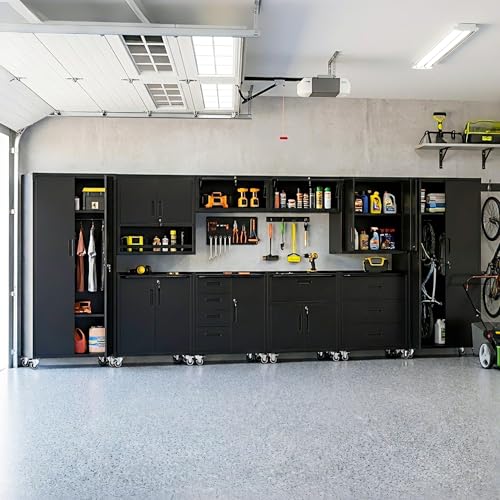
All-in-One Garage Cabinet System:This garage cabinet set with workbench is engineered for the serious DIYer and suburban homeowner, offering a complete garage organization system solution. Our ensemble provides immediate, massive storage capacity to conquer tool chaos and hide away seasonal items, delivering that magazine-worthy garage makeover you've been envisioning. The system arrives ready to organize, designed to maximize every inch of your space efficiently and stylishly.

TALL STORAGE CABINET WITH DOORS AND SHELVES FOR GARAGE ORGANIZATION. Organize lawn gear, hand tools, and more in a 72-inch tall cabinet with doors and shelves that saves floor space instead of eating it up.

The exceptional 9 piece Storage Cabinet Set Includes: Tall cabinet x 2, 2-door base cabinet x 1, 1-drawer 2-door base cabinet x 1, 4-drawer with casters x 1, wall cabinet x 3, Pressed Wooden Board x 1 and features a fully welded steel structure for added support
6. Portable Tool Caddies

A portable caddy wins when you are working across multiple beds or a large yard and want every tool within arm’s reach without walking back to the garage.
The wheeled bucket from Gardener’s Supply Company runs $129.99 and handles both long-handled and hand tools, though I would skip it if your collection runs past a dozen pieces; at that point the weight defeats the purpose and fixed wall storage makes more sense.
For lighter loads, the Fiskars canvas caddy fits over any standard 5-gallon bucket you already own and costs $19.99. Nine deep pockets keep pruners and trowels upright, but the bucket itself adds bulk I would rather not carry up a slope.
The golf bag trick I have seen mentioned handles the same tool count with better balance, since the bag’s shape keeps long handles vertical and the shoulder strap frees both hands.
Weight limits are where my enthusiasm for caddies stops. Anything over 25 pounds belongs on wheels or on the wall; a loaded bucket of wet tools and soil quickly turns into a chore.
I keep a caddy for quick weeding sessions and seasonal cleanup, but for the weekly mow-and-trim routine, fixed storage by the garage door wins every time.

OPTIMIZE YOUR SPACE: garden tool organizer compact design helps you maximize space. Hang tools and equipment to free up valuable floor space in garages, sheds, gardens, and more

Heavy Duty Material: The garage organizer has thickened the racks to prevent deformation, and each hook has been designed to be thicker to withstand greater weight. All welding points of hooks and racks have been upgraded, making the overall structure more robust

【Upgraded Heavy-Duty Material】LBT garden tool storage rack has thickened the hanging board to prevent deformation and firmly fix it to the wall. The diameter of each hook is 9 millimeters, and thicker hooks can withstand greater weight. All hook and hanging plate welding points have been upgraded, and the welding point stability has been increased by 50%, making them more solid.
7. DIY Storage Solutions

A 2-inch diameter PVC pipe cut into 6-inch lengths and screwed to a scrap of 2×4 makes a rack for rakes, shovels, and hoes that costs less than a coffee run.
The pipe grips the handles without hardware, and the whole assembly mounts to studs in twenty minutes.
I would pick this for a wall that already has open space; it fails if your garage has finished drywall you do not want to puncture.
A spare mailbox screwed at waist height works for hand tools, keeping trowels and pruners dry and in one place.
The appeal is the near-zero cost. Time is the real cost: gathering scrap, measuring cuts, and testing fit eats a Saturday morning that a $17 Imillet rack with five slots and six hooks would solve in ten minutes.
Each slot on that rack holds roughly 6 pounds, with a 50-pound total per unit, so it suits lighter long-handled tools but not a full-size splitting maul.
DIY wins when you have the scrap on hand and the tools to cut it.
It does not win when you are buying PVC and brackets new; at that point, the gap in price shrinks to a few dollars and the commercial version finishes cleaner.
I would skip DIY entirely for anyone who has already abandoned one half-built project in the garage. The clutter of good intentions is worse than the clutter of rakes.

MULTIPLE STORAGE OPTIONS: Features 5 slots and 6 hooks supporting up to 7.5 pounds per slot, perfect for organizing various cleaning tools efficiently

STURDY AND DURABLE: This tool storage rack is made of metal and will not deform even if it withstands all the tools in the house for a long time. The surface adopts environmentally friendly spray painting process to prevent rust. Resistant to prolonged use.

1. [Extra heavy duty] metal heavy duty tool cart, can hold 22 heavy duty long handled garden tools, 5 light duty cleaning tools, lots of small tools, maximum weight 300 lbs
Specific Products Worth Considering

The StoreYourBoard BLAT at $49.99 is the rack I would mount first if I had a blank wall and a mix of shovels, rakes, and a trimmer.
It handles long-handled tools in slots rather than hooks, so nothing swings when you drive past.
For a tight corner, the Rubbermaid Corner Tool Tower changes the math entirely. It claims 30 tools in a footprint most racks need twice the wall for, and the plastic build means I would not worry about garage humidity.
The Imillet holder at 50 pounds per rack is overkill for hand tools but makes sense if you are stacking metal edging, a full sprinkler set, or anything that reads heavy on the scale.
The Suncast Resin Vertical Storage Shed at 72 by 25.25 by 32.25 inches is the outlier. It belongs outside the garage proper, on the narrow strip between house and fence where a shed this tall but this thin actually fits.
Its size is just right at 72 inches tall by 25.25 inches deep by 32.25 inches wide. Designed for outdoor tool storage, it’s tall enough to store long-handled tools but has a small enough footprint to fit on the side of a house.
— Bob Vila
That footprint is the point: if your garage is already spoken for, this is how you add storage without pouring concrete or clearing a bay.
| Product | Best For | Material | Price |
|---|---|---|---|
| StoreYourBoard BLAT | Mixed long-handled tools, wall mount | n/a | $49.99 |
| Rubbermaid Corner Tool Tower | Corner space, high tool count | Plastic | n/a |
| Imillet holder | Heavy loads, weight capacity priority | n/a | n/a |
| Suncast Resin Vertical Storage Shed | Outside garage, narrow side yard | All-weather resin | $269.10 |

HEAVY-DUTY GARAGE TOOL ORGANIZER: Revolutionize your garage with this wall-mounted storage hero! Designed to hold shovels, brooms, power tools, and more, it can support up to an impressive 400 lbs.

Organizer Up to 39 Long-Handled Tools:Sttoraboks garden tool organizer has 39 tool slots and 12 side hooks neatly store rakes, brooms, shovels, and more, offering large capacity within a compact size with versatile holes designed to fit tools of various sizes—perfect for garden, lawn, and cleaning equipment.The 0.5mm steel base includes drainage holes for outdoor use and damp environments.

Multi-Tier Tool Storage for Up to 50 Tools: Sttoraboks Garden Tool Organizer features 35 vertical slots and 11 side hooks that neatly store rakes, brooms, shovels, hoes, and more. Its compact frame holds a high volume of tools while keeping everything easily accessible. Designed with multi-sized holes, this tool rack adapts to garden, lawn, or household equipment—perfect for garages, sheds, or patios. The reinforced base tubing ensures exceptional stability and prevents tipping.
Safety for Homes With Children

Sharp tools and garden chemicals left in reach turn a garage into a hazard, and wall-mounted racks alone will not solve that.
A lockable cabinet is the storage solution that actually separates dangerous items from curious hands. Choose racks with locking hooks or wall-mounted brackets that keep tines and blades well above a child’s reach.
I would mount the cabinet high enough that a child cannot climb to it, and I would keep the key on the same ring I use for the house.
Wall-mounted racks still earn their place for everyday hand tools, since they keep long-handled items from falling where small feet walk.
The combination matters more than either piece alone: racks for the tools you grab Saturday morning, a locked cabinet for the pruners, the loppers, and anything in a bottle with a warning label.

DURABLE GARAGE SLAT WALL STORAGE SYSTEMS: Our premium PVC wall organizer are built to withstand harsh conditions and are 30 times more durable than drywall. They are fireproof, waterproof, fade-proof, dry-proof, crack-proof, peel-proof, and have an extra-high weight capacity of up to 75 pounds per square foot. Our slatwall panels can be easily cut to any desired size or combined into larger sections allowing you to perfectly install panels for your entire wall.

MAKE FULL USE OF YOUR SPACE: Unleash the true potential of your garage wall organizer for tools with the garage slat wall panel. By making smart use of vertical wall space, you can revolutionize your garage into a seamlessly organized and efficient area. Bid farewell to a messy garage and welcome a meticulously optimized space that maximizes every inch available. Enjoy effortless access to your tools, equipment, and accessories, all while crafting a visually captivating environment.

4FT x 8FT SLATWALL PANELS: Our durable PVC slat wall panel comes with 8Pcs-4ft x 1ft slatwall panels, offering a finished coverage area of 32 total square feet!Includes 48” side lids and H-trim for a nice, flat slatwall panel joint! Ideal for workshops, garages, tool sheds, gyms, offices, factories, craft rooms, laundry rooms, basements, gardens and more!
What to Consider Before Buying

Durability and weight capacity are where cheap garage storage garden tools setups fall apart first.
The Imillet holder runs under $20 and handles about 6 pounds per slot, 50 pounds total per rack. That works for brooms and hand rakes, but a loaded shovel or steel rake pushes close to the limit.
I would skip it for anything heavier and look for racks built from steel or heavy-gauge aluminum that won’t warp under load.
Wall-mounted racks win back floor space, which matters more than most people realize until they’re stepping over a trowel in February.
Measure your available wall height first, then depth. A long-handled shovel needs vertical clearance; a rack that fits between studs but crowds the ceiling is half-useless.
I like to lay every tool on the garage floor in the arrangement I’d want on the wall, then measure that footprint plus two inches of breathing room.
If the wall is concrete block, budget for masonry anchors; drywall alone won’t hold a loaded rack for long.
Moisture is the hidden cost. Tools left on damp concrete rust faster, so any solution that lifts them off the floor pays back in blade life.
Air circulation around the heads helps too, which is why I prefer open hooks or slots over enclosed bins for garden gear. Open storage collects dust, but I’d rather wipe a handle than grind a rusted edge.

Complete 12-Piece Storage System: Includes 2 lockers, 4 wall cabinets, 2 single-drawer roller cabinets, 2 four-drawer roller cabinets, 2 workbenches measuring 52 inches, 12 pegboards, and 8 shelves to connect the wall cabinets

【3 REMOVABLE SHELVES】The multipurpose vertical storage shed has built in 3-tier shelves, providing ample space to storage your tool and keep your outdoor activities organized. The shelves can be set up or removed according to your needs to creat larger compartment

[Outdoor Storage Cabinet]: This 22 cuft metal storage shed is designed to optimise your outdoor space. It is perfectly suited to storing cleaning tools, gardening tools and some boxes. The design is sleek and modern, blending seamlessly into any garden, backyard or patio, and is both aesthetically pleasing and functional.
Outdoor Storage Options

Outdoor storage makes the most sense when the garage is already doing other jobs, or when the tools themselves are wet and dirty and you would rather not track that inside.
A 72 by 25.25 by 32.25 inch footprint, the dimensions of the Suncast Resin Vertical Storage Shed, fits on the narrow strip between a house wall and a walkway where a garage cabinet never could.
The all-weather resin construction handles water and UV without the maintenance that wood or metal would need, and at $269.10 it costs less than most slatwall or cabinet systems that stay inside.
I would use something like this as a complement, not a replacement: shovels, rakes, and the hose stay in the shed, while pruners and hand tools live on the garage wall where I can reach them in thirty seconds.
Walking outside in bad weather stings, and the shed does not solve the problem of tools that need to dry before they go back in.
For renters or anyone who cannot mount hardware on a garage wall, though, it is a standalone alternative that needs no drilling and moves with you.
DIY Versus Commercial

Most articles on garage storage garden tools treat DIY and commercial racks as separate lanes without stopping to compare what the two actually cost in time and money.
That gap matters, because the choice between them often decides whether a project finishes this Saturday or sits half-done until fall.
A PVC pipe rack built from 2-inch schedule-40 pipe and fittings runs somewhere between the price of a mid-range organizer and a cheap one, depending on what you already own.
Pipe, caps, and a way to cut it square add up fast if you are buying every piece new, though scrap from a previous project changes the math entirely.
The commercial equivalent, a basic wall-mounted hook rack, lands at a fixed price that skips the cutting and the trial fit.
I would pick PVC only when I need a custom width or spacing that off-the-shelf racks do not offer, or when I already have the pipe on hand.
Time is the real divider.
A store-bought rack hangs in twenty minutes. The PVC version takes an afternoon by the time you measure, cut, deburr, and anchor it level.
If your tools are standard long-handled shovels and rakes, commercial wins on speed. If you are storing odd-shaped items, a sod knife, or a hand cultivator with a bent neck, the custom fit of DIY earns back that afternoon.
Frequently Asked Questions
What are the best ways to organize garden tools?
Wall-mounted racks, slatwall panel systems, and portable caddies are the most effective methods.
Wall racks keep long-handled tools off the floor at arm’s reach, slatwall lets you reconfigure hooks and baskets as your collection changes, and caddies work when you need tools mobile across multiple garden beds.
Pick based on whether your priority is fixed storage, flexibility, or portability.
How can I maximize garage storage for garden tools?
Use wall space first, then overhead racks, then cabinetry. Wall-mounted systems like the StoreYourBoard BLAT reclaim floor space that most people do not realize they need until they are stepping over tools in winter.
Overhead racks handle up to 600 pounds of seasonal items you touch twice a year. Cabinets lock away power tools and chemicals, but they cost floor space and add friction to daily access.
What should I consider when buying garage storage solutions?
Durability, weight capacity, and fit against your available wall space. Cheap plastic hooks warp under load; steel or heavy-gauge aluminum holds up.
Measure vertical clearance for long-handled shovels and add two inches of breathing room before buying. If the wall is concrete block, budget for masonry anchors because drywall alone fails under a loaded rack.
What is the best way to store garden tools in a garage?
A wall-mounted steel rack bolted to studs is the best starting point for most collections. The StoreYourBoard BLAT at $49.99 handles 250 pounds across four deep slots, which covers shovels, rakes, and even a gas-powered edger.
Reserve cabinets for power tools and chemicals you want locked away, and keep daily-use hand tools on open hooks where a door does not slow you down.
What is a good garage organizer for lawn tools?
The StoreYourBoard BLAT Garden Tool Organizer at $49.99 is the best single buy for mixed long-handled tools. It ships assembled, carries 250 pounds, and uses slots instead of hooks so nothing swings when you walk past.
For tight corners, the Rubbermaid Corner Tool Tower fits roughly thirty tools into a footprint most wall racks need twice the space for.
What is the best tool storage for a garage?
The best system combines multiple types rather than relying on one.
Mount a steel wall rack for daily long-handled tools, add slatwall if your tool mix changes seasonally, install a locked cabinet for power tools and chemicals, and put overhead racks to work for seasonal items you rarely touch.
No single product handles every tool well.
What are some genius garage storage ideas?
A corner tool tower turns dead garage corners into vertical storage for thirty tools. A spare mailbox screwed at waist height keeps hand tools dry and in one place for near-zero cost.
For narrow side yards where the garage is full, the Suncast Resin Vertical Storage Shed at 72 by 25.25 by 32.25 inches adds storage without drilling into walls.