
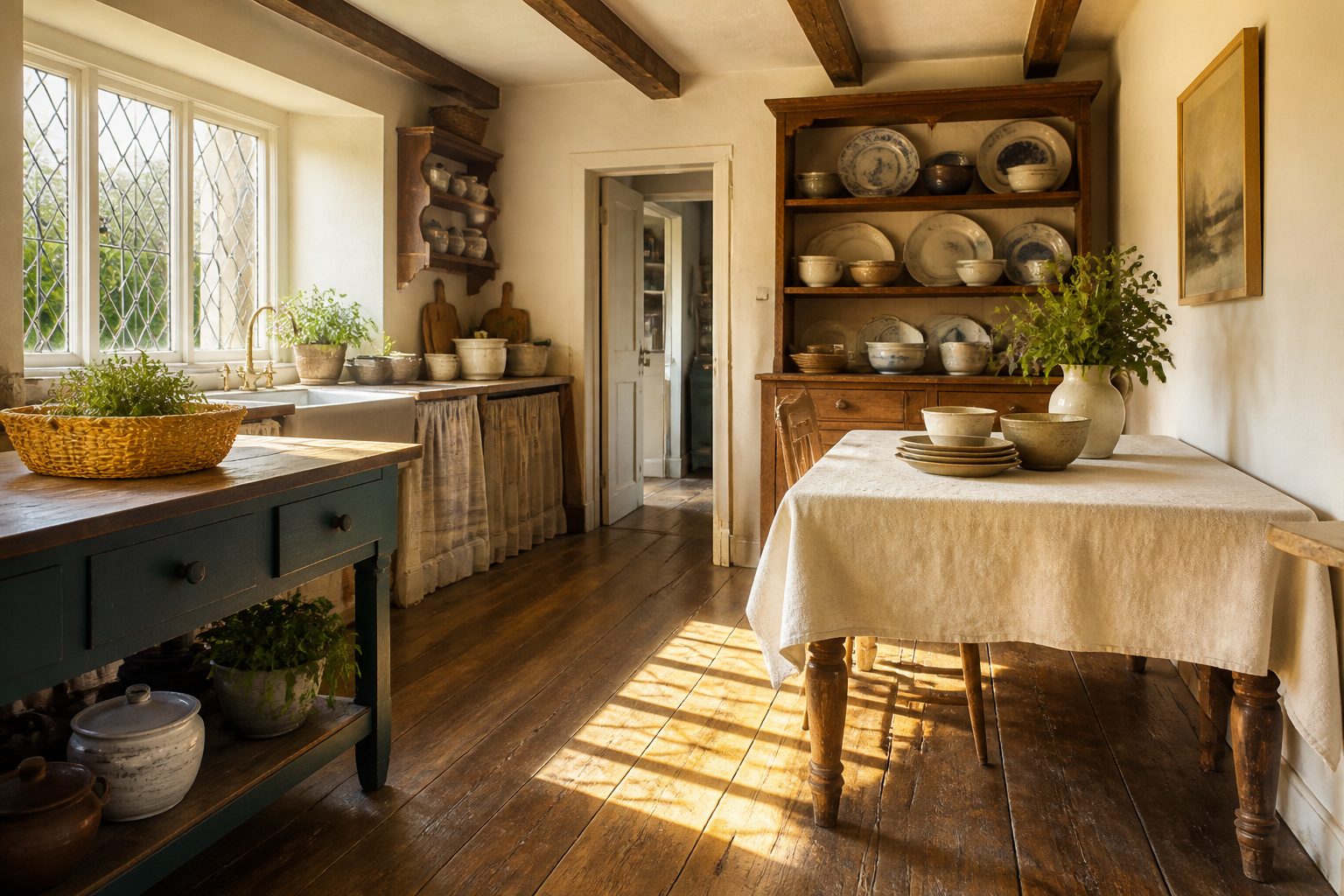
A country kitchen can run from a single skirted sink base to a full unfitted room of freestanding pieces, and the deciding factor is whether you rent or own.
The real cost is not the furniture; it is the clearance. A 36-inch dresser used as an island needs 36 inches on every side or you trap yourself when the oven timer goes off.
That mobility is what separates kitchen style country from a period set piece.
A solid wood table rolls aside for a Thanksgiving buffet line or angles to catch northern light for seed starting in March, while built-in cabinetry dictates circulation and the room cannot breathe.
1. Farmhouse Sink

The apron-front farmhouse sink is the visual anchor most country kitchens build around, and the exposed front panel is what does the work.
It breaks the cabinet line and draws the eye the way a standard undermount sink never manages, which is why builders call it a statement piece even in modest kitchens.
Fireclay gives you that classic white, slightly glossy surface that photographs well and resists staining, though it chips if you drop a heavy cast-iron skillet.
Cast iron with enamel coating runs heavier and quieter, and the enamel can craze over years of hot-water shocks.
Stainless steel is the practical outlier: it costs less, survives abuse, and reads more commercial than rustic, which I would skip for a country look unless the rest of the kitchen is very warm in tone.
Retrofitting one into a standard 36-inch base cabinet runs between a few hundred and a thousand dollars, mostly for the cabinet modification or replacement, not the sink itself.
The front apron needs clearance that standard cabinets do not provide. For smaller kitchens, 30-inch and 33-inch widths are the common options that keep the proportion without swallowing the counter.
A 30-inch single basin fits a cookie sheet flat with room to spare; a 33-inch split basin gives you separation but costs you that uninterrupted work surface I find more useful. I would pick the single basin every time.

【Smooth Front Heavy Duty Fireclay Sink for Kitchen】The front of the farmhouse apron sink 33 Inch is smooth, with a pure white glaze, making the farm sink look gorgeous and easy to clean.It is a heavy-duty fireclay sink weighing over 70 pounds, It is recommended to have two people move together.

【Sleek Front, Heavy Duty Fireclay Sink for Kitchen】The front of the farmhouse apron sink 33 Inch is smooth, with a pure white glaze, making the farm sink look gorgeous and easy to clean.It is a heavy-duty fireclay sink weighing over 80 pounds, It is recommended to have two people move together.
2. Butcher Block Countertops

Wood countertops carry the warmth that makes a country kitchen feel lived-in rather than staged.
Maple and oak are the species you actually find in stock: maple for a smoother, paler surface that stays consistent, oak for more pronounced grain that hides knife marks and water rings better.
Thickness matters more than species for the overall look. A 1.5-inch slab reads as a working surface; 2 inches gives the visual weight that anchors a modern kitchen trying to feel country.
Finish is where I’d make the call. Oil soaks in and lets the wood breathe, which means it also stains if you leave red wine or turmeric sitting.
Varnish seals the surface and buys you forgiveness, but it can read slightly plastic under direct light and you’ll spot-repair rather than refresh the whole counter.
For a kitchen that sees real cooking, I’d take oil-finished maple at 2 inches and re-oil every 6–12 months after a light sanding.
The maintenance is the trade-off: half a day of work once a year in exchange for a surface that heals instead of chipping.

SUPERIOR DURABLE FIRECLAY SINK: TUKTUK white farmhouse sink is a fireclay sink that is a type of luxury ceramic sink made from a high-end quality material of clay, fired at an extremely high temperature, resulting in the apron farm sink for kitchen with a non-porous, durable and heat resistant finish, ensuring TUKTUK 33 inch farmhouse sink long-lasting beauty and easy maintenance. Our fireclay farmhouse sink not only have classic and timeless appearance, but also exceptional durability and resistance to scratches, stains, chipping and fading.

Premium Natural Fireclay Farmhouse Workstation Kitchen Sink: Sarlai white farmhouse sink 33 inch is constructed from natural fireclay, a special white clay that is fired at 2900 °F for extreme resistant to heat,chipping, scratch and discoloration for years of beauty and reliable performance. White fireclay apron front farmhouse kitchen sinks offer superior strength and durability to withstand heavy use.

【White as jade,CUPC Certified】 The white farmhouse sink 24 inch adopts a high - gloss glazed surface process. Its surface is as warm and translucent as jade, combining the transparency of glass with the delicacy of ceramics. The white farm sink adds a touch of high - end aesthetic atmosphere to the kitchen, for Kitchern, Laundry Room. At the same time, all aspects have passed CUPC certification standards, making use more reassuring!
3. Rustic Wooden Table

A rustic wooden table at 30 inches high functions as a prep station you work at seated or on a low stool; push it to 36 inches and it becomes a standing desk for rolling dough or staging platters.
I would pick 30 inches for a kitchen that already has standard counters, since the height difference creates zones rather than competition.
Pine costs less and takes a beating, though it dents if you drop a cast-iron skillet.
Reclaimed wood skips the guilt of new lumber and brings in nail holes and grain variation that reads as earned history rather than applied finish.
For most kitchens, a 48-inch table fills a wall gap without blocking the fridge door swing, while a 60-inch version anchors a medium eat-in space without the commitment of a built-in island.
The real advantage is unfitted mobility. Roll it aside for a Thanksgiving buffet line or angle it to catch northern light for seed starting in March.
Built-in cabinetry dictates circulation; a table lets the room breathe and the cook decide. That flexibility is what separates kitchen style country from a period set piece.

USA Grown Hardwood: Only made from USA grown oak solid wood.

𝐃𝐔𝐑𝐀𝐁𝐋𝐄 𝐒𝐎𝐋𝐈𝐃 𝐖𝐎𝐎𝐃 𝐂𝐑𝐀𝐅𝐓𝐒𝐌𝐀𝐍𝐒𝐇𝐈𝐏: Made from expertly crafted solid hevea wood with a sturdy 1.5-inch thickness. Each butcher block showcases distinctive wood grain and natural strength, adding lasting value to kitchens, dining areas, or workspaces.

USA Grown Hardwood: Only made from USA grown oak solid wood.
4. Open Shelving

Wall-mounted open shelves replace upper cabinets in most country kitchen layouts I would actually build.
A 10-inch shelf depth holds a standard dinner plate with the lip safely inside; anything shallower looks like a ledge and risks a plate on the floor.
Brackets are where the style lands. Iron straps read industrial farmhouse, while a wood corbel with a hand-cut curve feels closer to a cottage kitchen.
I would pick corbels in painted poplar if the room already has beams or trim to match; raw iron works better against painted shiplap where you want the contrast.
What sits on these shelves matters more than the hardware. I would stack white everyday plates, a row of mason jars, and one piece of vintage ironstone.
That fills the eye without becoming a maintenance job. What I would skip: the full spice collection, anything you use once a year, and open storage over the range.
Grease settles on every horizontal surface in a kitchen without a proper hood, and a shelf there turns into a sticky wipe-down twice a week.
If your stove has no ventilation, keep cabinets or a solid backsplash above it and run the open shelving on the remaining walls.

Versatile Storage Solution: This farmhouse kitchen cupboard offers a spacious tabletop, 4 storage compartments, and a large open shelf to keep your essentials and decorations neatly organized. The middle shelf can be removed or adjusted to 3 positions, making it adaptable for different functional needs.

【Store it All in Style】 Featuring a 46''L x 32''W spacious tabletop for plants, vases, and photo frames, along with handy side cabinets for odds and ends. A middle cubby with a 3-level adjustable shelf, while below, there's generous open storage – this console table is ideal for books, storage boxes, or even your coffee machine.

TIMELESS FARMHOUSE ELEGANCE: Measuring 60''W *15.75''D *31.2'' H. Enjoy the rustic elegance of our 60'' buffet cabinet. Its warm replicated oak finish and iron-tone metal lend a touch of farmhouse charm. Paired with 2 classic sliding barn doors and 4 functional drawers, it combines modern flair with farmhouse appeal, effortlessly complementing any home decor.
5. Exposed Rafters
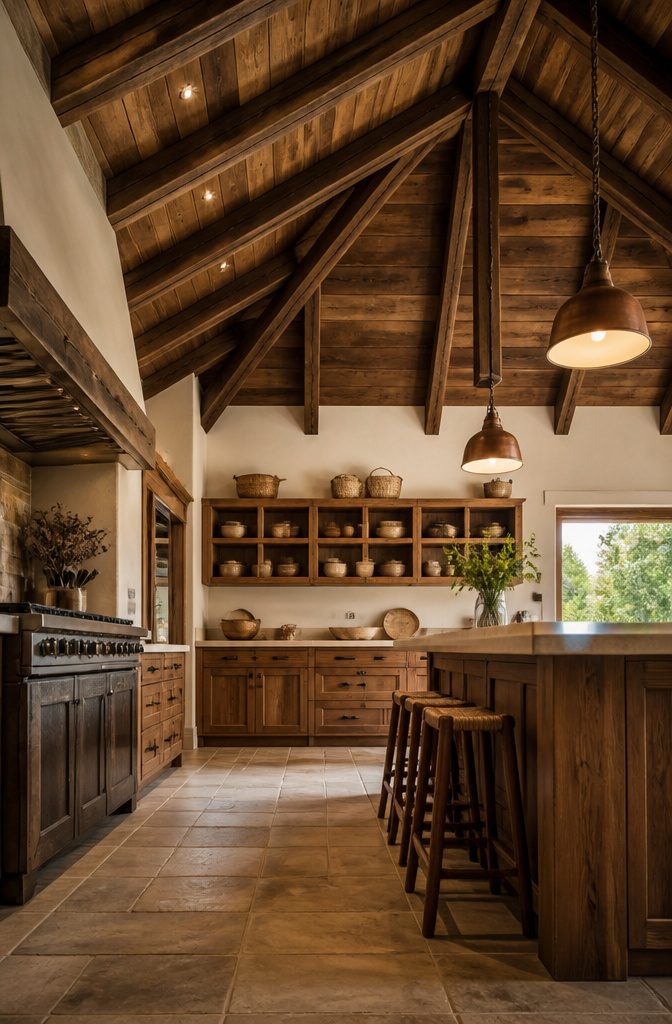
Ceiling structure only reads as country kitchen style when it is actual structure, not theater. Pre-1960 homes with real rafters have the advantage: the wood carries age, nail holes, the slight unevenness of hand work.
Faking that with hollow box beams stapled to drywall costs nearly as much and delivers a stage set. I would spend the money on a better floor instead.
An 8-foot ceiling is the floor for this look.
Below that, beams hang in your sight line and the room shrinks. At 8 feet or above, they draw the eye upward and add the warmth that drywall alone cannot manage.
Staining is the safer choice for country kitchens; paint reads as coastal or modern farmhouse.
Dark walnut or chestnut stain against white walls gives the contrast that makes the whole idea work. Raw pine yellows in a year of cooking grease and daylight.
Lighting shifts when rafters are open.
Pendants need shorter drops or they compete with the beams. Recessed cans sit between rafters, not through them, which means planning the grid before the drywall comes down.
The work costs more than a simple replacement ceiling because you are rerouting electrical and adding insulation above the rafters to keep the room warm.
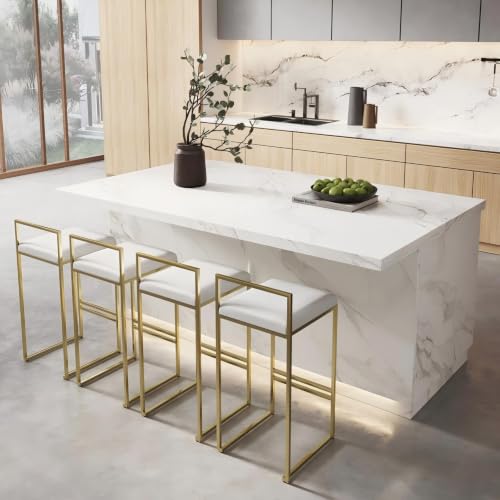
JAPANDI STYLE & LED AMBIENCE: ELEVATE YOUR HOME:Blending minimalist Japanese aesthetics with practical Scandinavian functionality, this modern kitchen island features a sleek uniform finish and clean minimalist lines to upgrade any kitchen decor. Built-in adjustable LED ambient lighting creates a warm, cozy glow for evening cooking, intimate family dinners and holiday gatherings, turning your ordinary kitchen into a stylish and welcoming living space.

Add Style to Your Home: This 3-tier rolling kitchen island is built in a rustic farmhouse style with beautiful white pine and engineered wood, a stylish stainless steel top, 4 smooth casters, and ample storage and shelving.

LARGE WORKSPACE: Features a spacious countertop ideal for meal prep, chopping, mixing, or serving - perfect as a rolling kitchen island, prep station, or extra counter space for kitchens, dining rooms, and craft rooms
6. Earth Tones and Muted Colors

Cream, sage green, and pale yellow read country in a way navy or black accents never quite manage.
Those darker shades have been pushed hard by the farmhouse trend, but they pull a kitchen toward something sharper and more graphic than the softer, muddier palette that defines a true country style.
I would skip them entirely and let the walls and cabinets do the quieter work.
Test paint on the wall that gets the most actual kitchen light, not the one facing the window you wish you had. Morning sun against a north-facing wall can turn the same cream into two completely different colors.
Farrow & Ball’s Pointing and Benjamin Moore’s White Dove are useful reference points to start from; both sit in that warm, slightly aged middle ground that reads lived-in rather than sterile.
I would look at Pointing if the room gets strong daylight and White Dove if the light is flatter or more northern, since the slight yellow in White Dove keeps it from going gray in shadow.
The difference is subtle on a chip, obvious once it covers twelve feet of cabinetry.

【Made of Fine Fireclay】Miuara farmhouse sink is made of fine fireclay fired at extra high temperature above 2600℉ for 26 hours, it’s very hard and sturdy. And the solid core construction makes the fireclay sink drop in superior strengthen and durable to withstand heavy use, which is highly resistant to stain,heat,crack and scratch. Miuara farm sink is classic and gorgeous!

Premium Fireclay Farmhouse Kitchen Sink: Sarlai white farmhouse sink is constructed from natural fireclay, a special clay that is fired at 2400°F for extreme resistance to heat, chipping, scratch, and discoloration. This material creates a durable and reliable foundation for long-term daily kitchen use.

【Made of Fine Fireclay】Miuara farmhouse sink is made of fine fireclay fired at extra high temperature above 2600℉ for 26 hours, it’s very hard and sturdy. And the solid core construction makes the fireclay sink drop in superior strengthen and durable to withstand heavy use, which is highly resistant to stain,heat,crack and scratch. Miuara farm sink is classic and gorgeous!
7. Skirted Lower Cabinets

Fabric panels clipped to a tension rod inside the frame turn any base cabinet into a skirted piece in about twenty minutes.
The look reads cottage or farmhouse depending on the print, and what you actually get for the trouble is hiding plumbing under a sink or masking a cabinet box whose doors have warped past saving.
A yard and a half of mid-weight cotton runs roughly $40; replacement doors for the same opening start near $300 and climb fast.
I would mount the rod, not rely on Velcro. Adhesive strips sag in steam and collect cooking grease, and a skirt only works if it hangs straight.
A thin curtain rod set into the cabinet frame with small brackets lets the panel slide open when you need the trash or the dish soap underneath.
Stop at one or two cabinets. Run fabric across a whole kitchen and the room starts looking like a dressing table, not a working space.
I would use it where the eye already lands on clutter, the sink base or a corner cabinet that holds the recycling bins, and leave the rest alone.
The contrast between skirted and plain cabinets actually strengthens the country effect; uniformity just flattens it.

【Fine Solid Fireclay 36" Farmhouse Sink】TUKTUK solid-fired fireclay white farmhouse sink 36 inch by Italian artisans at extremely high temperature of 2600°F gives exceptional strength and durability. This classic white kitchen sink 36 inch is very hard and very smooth. This farm sink apron front single bowl can withstand the daily use with this heavy duty big kitchen sink undergoes and heat resistant.You won't have to worry about staining, chipping, scratching and cracking.
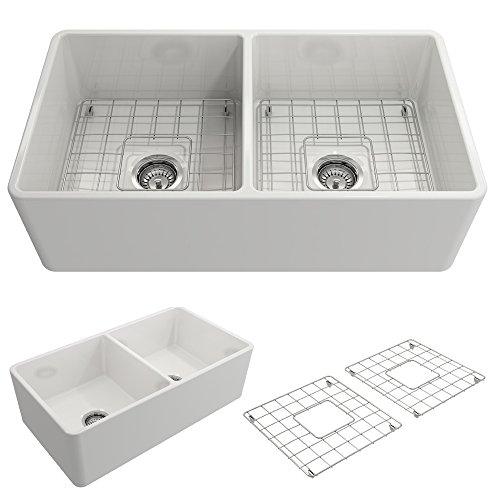
All Bocchi sinks are made of fireclay, which is a type of ceramic that is naturally heat resistant, chip resistant and stain proof

Premium Natural Fireclay Farmhouse Workstation Kitchen Sink: Sarlai white farmhouse sink 33 inch is constructed from natural fireclay, a special white clay that is fired at 2900 °F for extreme resistant to heat,chipping, scratch and discoloration for years of beauty and reliable performance. White fireclay apron front farmhouse kitchen sinks offer superior strength and durability to withstand heavy use.
8. Hanging Pots

A ceiling rack over the cooktop needs 12 inches of clearance to the bottom of the lowest pot, or you will bump lids every time you stir.
That distance also keeps handles from heating more than they should. I would mount on a wall if the ceiling is low; the rack still reads country, and you gain the full height of the room.
For width, 24 inches holds a basic set: two skillets, a sauce pan, and a Dutch oven.
Anything narrower turns into a single-file line that blocks the piece you need. I would hang copper or bare cast iron, the metals that improve with air and use, and keep nonstick in a drawer.
The coating chips if a pan swings against its neighbor, and the matte finish never looks right against aged steel or hammered copper.
Most racks anchor to two ceiling joists, not drywall anchors.
A stud finder saves the first hole, but older ceilings can have joists spaced oddly. I would check the span before buying the rack, since the pretty iron ones rarely adjust.
USA Grown Hardwood: Only made from USA grown oak solid wood.

USA Grown Hardwood: Only made from USA grown cherry solid wood.
USA Grown Hardwood: Only made from USA grown oak solid wood.
9. Tiled Backsplash

A country kitchen backsplash should settle into the background rather than announce itself.
Subway tile in 3×6 or 4×8 does this reliably; the proportions feel familiar in a kitchen style country searchers are trying to build, and the glaze cleans without fuss.
I would order a warm gray grout, not bright white. White grout turns into a grid that fights the calm you are after; warm gray lets the tile read as texture instead of geometry.
For anyone wanting more movement, zellige or handmade tile adds the slight unevenness that reads as age. The surface catches light differently across each piece, which suits a country kitchen more than perfect flatness does.
It costs more and demands a patient installer, so I would limit it to the wall behind the range where you actually look at it.
Standard coverage runs 18 inches from counter to cabinet, enough to catch splashes without climbing the wall.
Behind a range, taking the tile to the hood or ceiling makes practical sense; that is where grease concentrates, and the full wall turns a necessary surface into the room’s quiet pattern.

Distinctive Octagon Design - Refined curves and cut-out frame details transform each drink coaster into a decorative accent. A modern silhouette that elevates coffee tables, kitchen dining tables, desktops, nightstands, and countertops - blending seamlessly into living rooms, home bars, and contemporary interiors, and outdoor patio. A stylish, essential piece for any home

Holds 2 Sticks of Butter: This butter dish with lid measures 6.5"L x 4" W x 3 "H, making it perfect for holding 2 sticks of East Coast or West Coast butter. The heavy ceramic base ensures that the butter dish won't easily slide around during use. You don't have to worry about the butter touching the top of the lid.

High-quality Material: Our indoor and outdoor round tablecloth is made of durable high-quality material, ensuring long-lasting use and excellent performance. Carefully designed, allowing you to use it with confidence without worrying about quality issues. Suitable for 36-44 inch round tables, please measure your table size carefully before purchasing.(Note:standard tolerance of 0.39" - 0.78" is inherent to textile products.)
10. Unfitted Furniture

Built-in cabinetry lines most modern kitchens wall to wall, but the country kitchen style country look often starts when you break that habit.
Freestanding furniture spreads storage across individual pieces that each carry their own history, and the revival of the Hoosier cabinet is the clearest signal of the shift.
Those compact baking stations with their pull-out flour bins and built-in sifters were standard in early twentieth-century kitchens, and reproductions now anchor a room without requiring a single screw into drywall.
A solid wood dresser with the top drawers removed becomes an island that holds mixing bowls and stands at the right height for prep work.
I would verify 36 inches of clearance on all sides before committing to placement; anything tighter traps you in a corner when the oven timer goes off.
The real advantage for renters is that these pieces travel. You own the storage, not the landlord, and that matters when you have already painted cabinets someone else chose.
I would start with one statement piece rather than planning an entire unfitted kitchen.
A single Hoosier or converted dresser establishes the tone, and living with it reveals whether you actually need more. Adding too fast turns the room into a furniture showroom instead of a working kitchen.

Kitchen Island with Charging Station: Do you always need an extra power panel to charge the coffee maker or microwave in your kitchen? Too much trouble! This kitchen island of HOOBRO is equipped with power outlets available for various small kitchen appliances

Kitchen Island with Charging Station: Do you always need an extra power panel to charge the coffee maker or microwave in your kitchen? Too much trouble! This kitchen island of HOOBRO is equipped with power outlets available for various small kitchen appliances
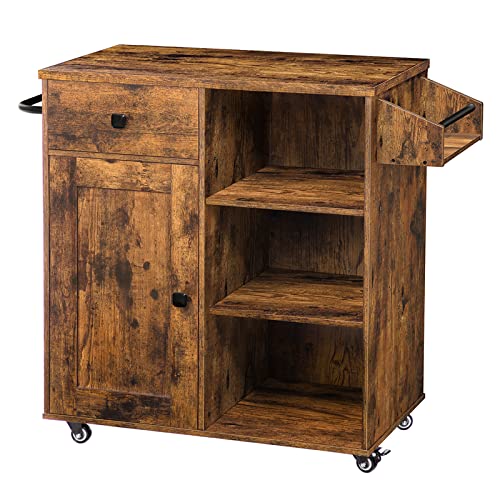
The Ideal Solution for Kitchen Island: This kitchen island is equipped with a drawer, cabinets, and a spice rack, and the inner shelf of the island can be adjusted, which allows you to place more tableware or food. The wide layout space of the countertop is also available for your use to keep the kitchen out of chaos
Rustic Versus Modern Farmhouse

The country kitchen split into two camps somewhere around 2015, and the difference still trips people up.
Rustic country keeps the rough edges: hand-planed beams, soapstone with its nicks and water rings, hardware that looks like it came off a barn door.
Modern farmhouse smooths those same ideas down to something more deliberate. Paint-grade cabinets replace stained wood, the apron sink is fireclay in bright white, and the beams are hollow box beams rather than actual structural timber.
That refinement costs more.
Reclaimed wood with authentic patina runs higher than new pine with a distressed finish, and a collected-over-time look requires either genuine age or skilled fakery. Modern farmhouse lets you buy the aesthetic off the shelf at most big-box stores.
| Rustic Country | Modern Farmhouse | |
|---|---|---|
| Cabinets | Stained wood, inset doors, visible hinges | Painted shaker, soft-close drawers |
| Countertops | Soapstone, raw-edge wood, zinc | Quartz, honed marble, butcher block |
| Hardware | Wrought iron, bin pulls, mismatched | Brushed nickel, matte black, uniform |
| Beams | Hand-hewn, irregular, authentic reclaimed | Box beams, smooth, paintable |
| The tell | Surface wear you did not plan | Clean lines with one "found" piece |
The single detail that tips a room one way or the other is the wear pattern. In rustic country, the counters dent and the floorboards cup; in modern farmhouse, the only "imperfection" is the antique scale you placed on purpose.
I would pick rustic for a forever home where I could let things age, and modern farmhouse for a first kitchen I needed finished by Sunday.
Color Schemes That Read Country
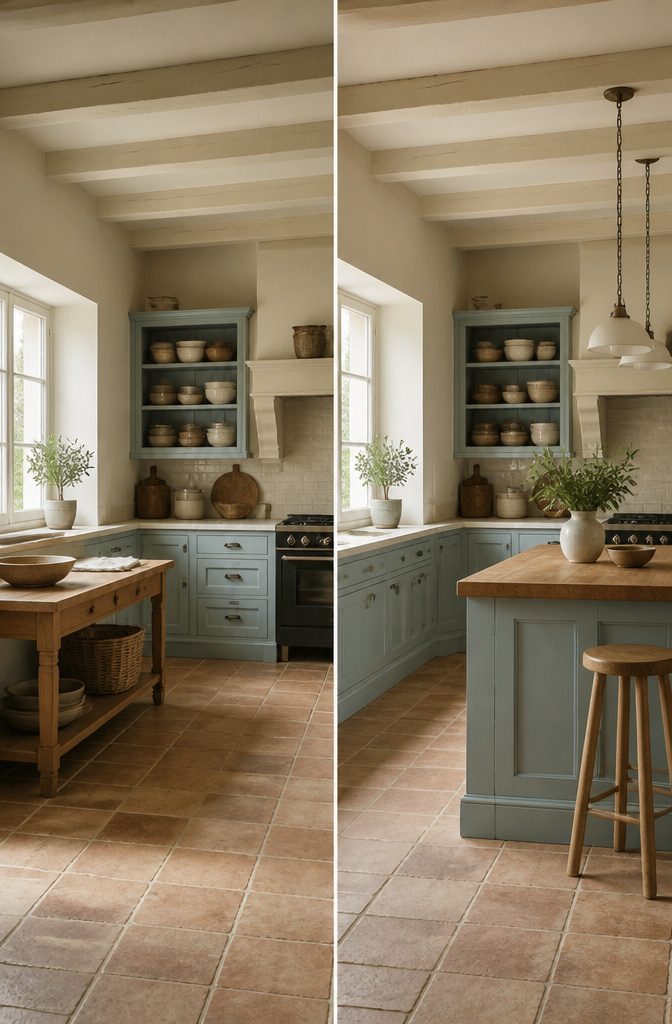
A muted palette in a country kitchen starts with 60 percent warm white or cream on the walls and ceiling, 30 percent a soft sage or dusty blue on cabinets or trim, and 10 percent black or iron for hardware and fixtures.
That formula keeps the room grounded without drifting into pastel territory.
The ceiling matters as much as the walls because country kitchens often have beams, planks, or beadboard overhead.
Painting those the same warm white as the upper walls makes the space feel taller and cleaner, while staining them raw leaves the room feeling heavy and dated.
I would stain exposed beams only if the kitchen gets strong southern light all day; otherwise, paint them to reflect what light you have.
In a kitchen with no natural light, I would push the 60 percent base warmer, toward something like Benjamin Moore White Dove OC-17 or Sherwin-Williams Alabaster SW 7008, and keep the 30 percent accent light, maybe a pale gray-green rather than a true sage.
A dark north-facing room swallows muted colors and turns them muddy.
In a sun-flooded space, I would do the opposite: Sherwin-Williams Accessible Beige SW 7036 or Benjamin Moore Revere Pewter HC-172 for the base, with a deeper cabinet color like Farrow & Ball Green Smoke, because strong light bleaches pale shades by noon and leaves the room feeling blank.
The 10 percent stays the same either way; black iron pulls and a wrought pendant over the sink give country kitchens the contrast they need to read as intentional rather than accidental.
Lighting for Warmth
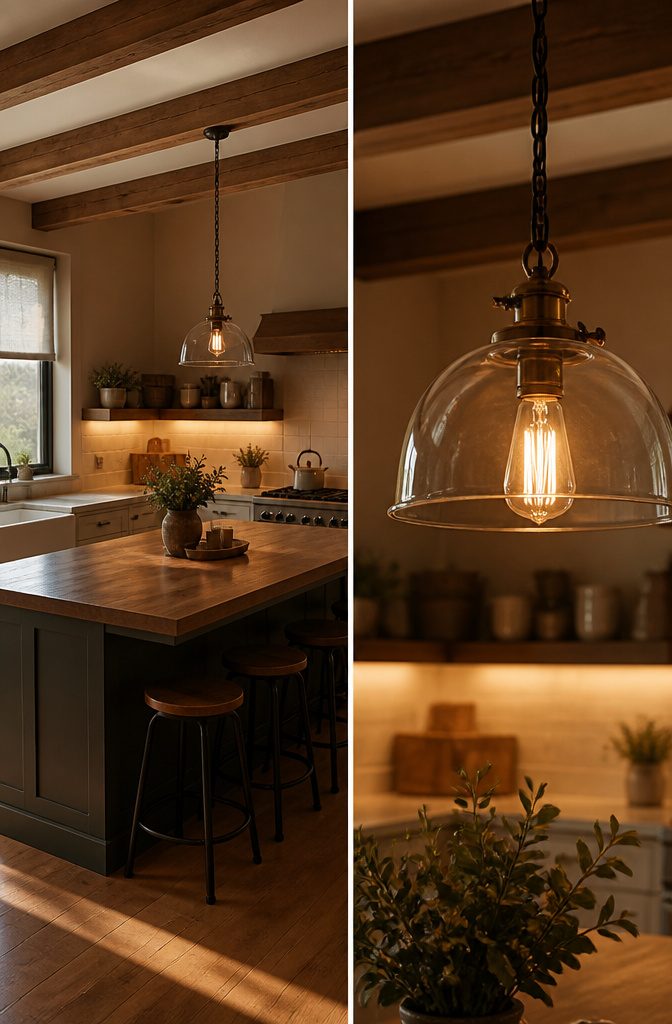
Pendant lights over an island or table need to hang 30–36 inches above the surface to cast light where you work without blocking sightlines across the room.
In a country kitchen, I look for fixtures with clear glass shades and vintage-style filament bulbs that leave the hardware visible, the way a lantern over a farmhouse table reads as furniture rather than utility.
The bulb matters as much as the shade: 2700K is the warm end of the color temperature range, and that amber glow keeps a country kitchen from feeling like a clinic.
I add under-cabinet LED strips for task light at the counters, tucked behind the face frame so you notice the effect, not the source.
Recessed can lights overhead give a flat, even wash that erases shadow and texture, so I would not use them as the primary layer in this style.
They belong in the background, if anywhere, while the pendants do the visual work.
Frequently Asked Questions
What is a country kitchen?
A country kitchen is a warm, lived-in space built around rustic elements like farmhouse sinks, butcher block counters, and natural wood.
It welcomes visible use: open shelving with everyday dishes, pots hung within reach, and surfaces that gain character from age rather than hiding it.
A country kitchen is a working kitchen that feels collected over time, not installed in a weekend.
What materials are best for a country kitchen?
Wood, stone, and worn metals carry the look.
Maple or oak butcher block at 2 inches thick anchors the room visually; fireclay or enameled cast iron for the farmhouse sink gives the classic front apron; and copper or bare cast iron for hanging pots improves with air and handling.
Avoid high-gloss cabinets and too much stainless steel, which read cold against the warmth you are building.
How do I choose colors for a country kitchen?
Start with 60 percent warm white or cream on walls and ceiling, 30 percent soft sage or dusty blue on cabinets or trim, and 10 percent black or iron for hardware.
Test paint on the wall that gets the most actual kitchen light, not your brightest window.
In dim rooms, push warmer with something like Benjamin Moore White Dove; in sun-flooded spaces, go deeper on cabinets so the color does not bleach out by noon.
What are the key features of a country kitchen?
The apron-front farmhouse sink is the usual anchor, followed by butcher block countertops, a rustic wooden table used as flexible prep or dining space, and open shelving with a 10-inch depth to safely hold standard dinner plates.
Exposed real rafters at 8 feet or higher draw the eye upward, and unfitted freestanding pieces like a Hoosier cabinet or converted dresser break the built-in cabinet line that defines modern kitchens.
How can I incorporate open shelving in my kitchen?
Mount shelves at 10 inches deep so plate lips sit safely inside, and choose brackets that match your tone: iron straps for industrial farmhouse, painted wood corbels for cottage.
Stack white everyday plates, a row of mason jars, and one piece of vintage ironstone. Skip open storage directly over an unvented range; grease settles and turns the shelf into a twice-weekly wipe-down job.
How do I make my kitchen look more country?
Replace upper cabinets with open shelving on at least one wall, add a skirted sink base with a yard and a half of mid-weight cotton on a tension rod, and swap recessed can lights for pendant fixtures with clear glass and 2700K filament bulbs.
The single detail that tips a room toward true country versus modern farmhouse is unplanned surface wear: let the butcher block dent and the floorboards cup rather than keeping every finish pristine.
Are country kitchens still in style?
The look has split rather than faded.
Rustic country with hand-planed beams, soapstone counters, and authentic reclaimed wood appeals to homeowners building a forever space. Modern farmhouse, with paint-grade cabinets, bright white fireclay sinks, and hollow box beams, offers a more accessible version that big-box stores stock.
Both remain common search targets and renovation goals, though the rustic side now signals intention and permanence in a way the smoother version does not.