
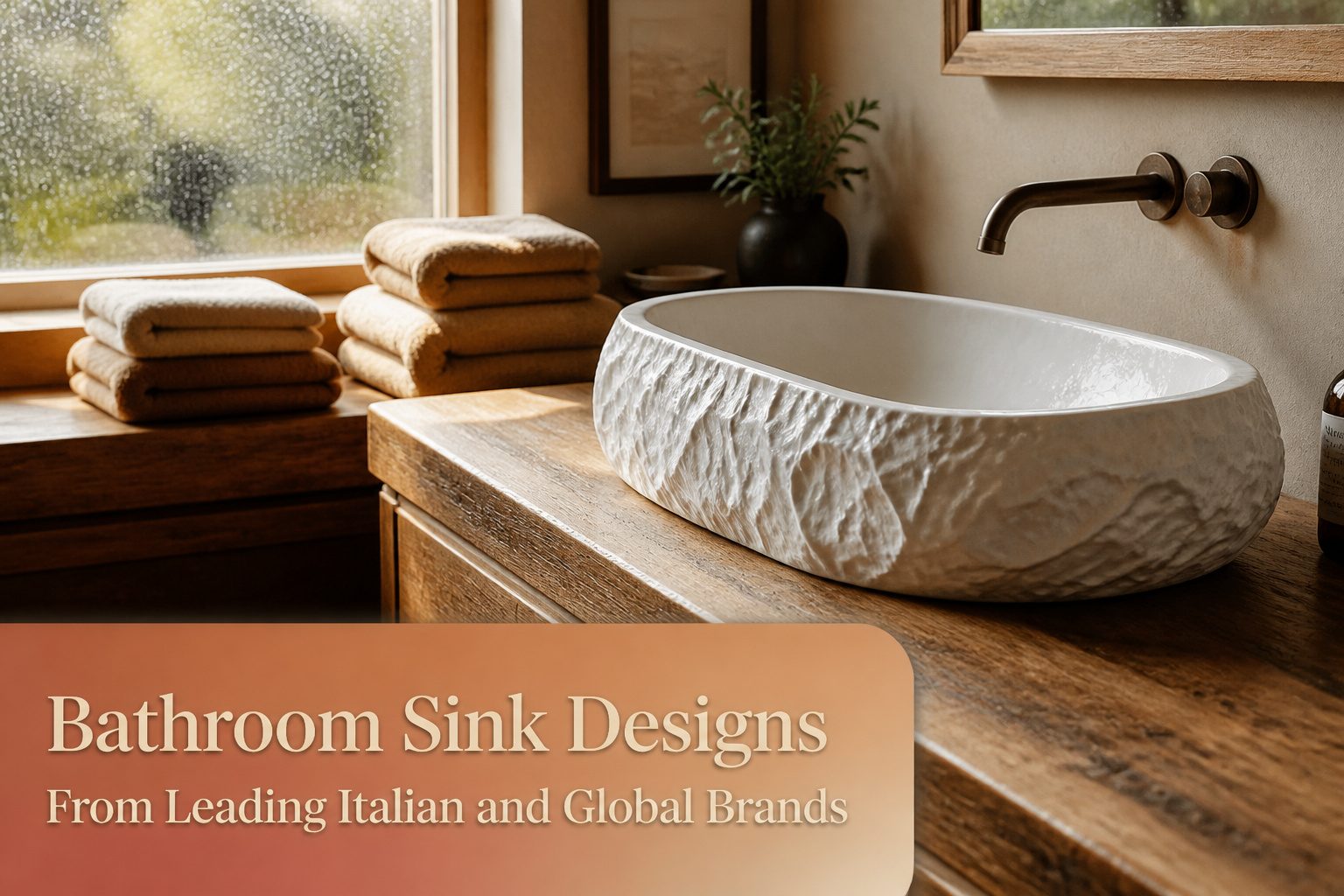
A bathroom sink design worth keeping is the one whose maintenance matches the traffic it will see.
The £16,920 Dawn by Christophe Pillet for Kreoo demands the same care as a sculpture, while the Ohtake starts at £410 and installs over a weekend with nothing more than a cut counter and sealant.
Price separates these eight pieces by an order of magnitude, but the real split is between a sink you wipe and forget and one you maintain like furniture.
1. Lavabo Norma by Elena Salmistraro for Flaminia

The Lavabo Norma reads as a column of glossy plastic with a basin scooped from its top, a single cylinder that does not need a vanity to look finished.
What makes it usable, not just sculptural, is the integrated shelf cast into the rim; your toothbrush and a small dish sit there without demanding counter space or a separate tray.
That changes the math for a tight powder room where every surface competes.
Elena Salmistraro designed it for Flaminia in single- or two-tone finishes, assembled from two pieces so the base and bowl can contrast or stay monochrome.
The form is generous, the lines rounded, and it is clearly meant to stand alone as a statement.
This is where the weekend budget ends. The piece is listed price on request, which in this category signals designer-tier cost and lead times that stretch past any Saturday project.
For a renter or a first-home owner working with a few hundred dollars and two days, the Norma is what you scroll past for inspiration, not what you cart home.
I would spend my money here only if the sink is the entire design, the one splurge that carries the room.

【2-Piece Corner Shelf】 Each corner shelf can be separated or combined freely, making it ideal for various spaces and storage needs. Perfect for use in the bathroom corner shelf or pedestal sink organizer to neatly store toiletries, towels, and essentials. In the kitchen, it functions as a storage for under kitchen sink for holding dishes, condiments, or small appliances. In the bedroom, it works well as a decorative corner shelf or corner shelf with storage for lamps and books. Also suitable for home offices as a small corner bookshelf. The clean, modern design integrates effortlessly into any room while keeping the space organized.

PEDESTAL UNDER SINK ORGANIZER - This conveniently compact bathroom organizer immediately provides space saving storage for any restroom or guest bath with a pedestal sink, to utilize the unused space more efficiently beneath the sink basin.
2. Elitique Project by Falper and Florim

The Elitique Project pairs a Falper cabinet with a Florim basin, and the split between the two makers tells you exactly where each material belongs. The wood stays dry; the porcelain stoneware handles every splash.
In the Minimum collection by Victor Vasiev, a Titanium Flame Dark basin drops into or rests atop joinery that Falper finishes to order, so the seam between wet and dry is the whole design.
Wood this fine demands more care than a solid surface vanity.
I would plan on resealing the cabinet every couple of years, sooner if the bath sees heavy steam, and I would wipe up standing water the same day it appears.
Porcelain stoneware shrugs off most of that worry; it is dense, non-porous, and built for the work. The pairing asks you to treat the two materials differently, which is the trade-off for warmth you cannot get from stone alone.
For a weekend project with a few hundred dollars, this level of maintenance might push me toward something simpler. If the budget stretches and the look is non-negotiable, the Elitique Project justifies the attention.

Ample Storage Space: Features four storage areas, this 30-inch bathroom vanity integrates a ceramic sink, main storage cabinet, and a flexible side storage unit. The configuration includes closed door storage, smooth-gliding drawers, and 3 tier open shelves to systematically organize all bathroom essentials, maximizing space efficiency

Hard-wearing Surface: Crafted from high-grade ceramic, KES bathroom sink is specially designed for impact resistance. It features a stain and scratch-resistant surface to withstand everyday wear and maintain its luster year after year

Best Sleek European inspired modern contemporary classic design,arc beautiful,elegant and generous,excellent technology and fashion aesthetic harmony
3. Dawn by Christophe Pillet for Kreoo
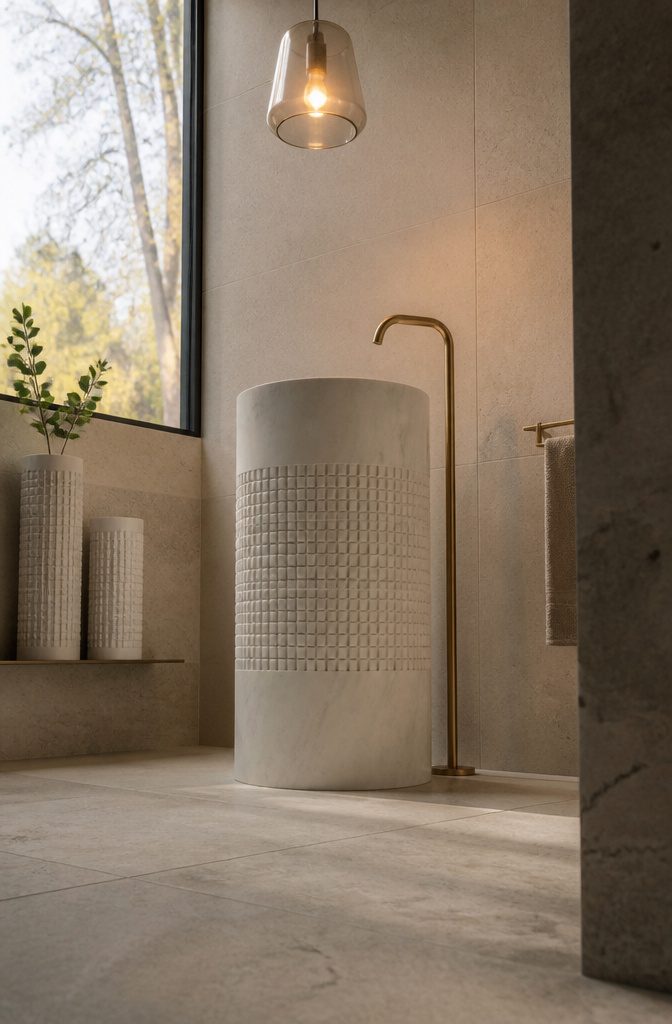
A freestanding sink changes how a bathroom feels because it reads as furniture, not fixture.
The £16,920 price on Dawn by Christophe Pillet for Kreoo puts it firmly in aspirational territory for most of us, but the form itself teaches something worth borrowing at any budget.
Pillet carved a soft, shell-like grid into a solid cylinder of marble, then polished two bands at base and top to catch light against the textured middle.
The result reads as a single sculptural mass rather than a basin dropped onto a pedestal. That visual weight is what gives it presence in a room.
The grid is hand-chiselled, not machined, so the irregularity keeps the eye moving.
Black Nero Marquina and three white marbles, Bianco del Re, Perla, and Carrara, each shift how the shadow pattern reads. Matching Dawn vases extend the language if the budget stretches.
For a weekend project with a few hundred dollars, the lesson is the proportion, not the material. A freestanding piece with vertical emphasis and one contrasting texture against clean planes borrows the same spatial logic.
Stone composite or even a well-shaped ceramic can carry it. What you lose is the permanence of a single carved block, which is most of what the price buys.

Durability:Crafted from high-quality ceramic with superior workmanship, this 21-inch undermount bathroom vessel sink features an extra smooth and glossy polished surface. It effectively resists scratches, ensuring easy cleaning and long-lasting durability.

【Modern Undermount Design for Clean Vanity Look】This rectangular under counter bathroom sink creates a seamless transition between sink and countertop. Ideal for quartz, marble, granite, and solid surface vanity tops. Perfect for modern, contemporary, or minimalist bathrooms.
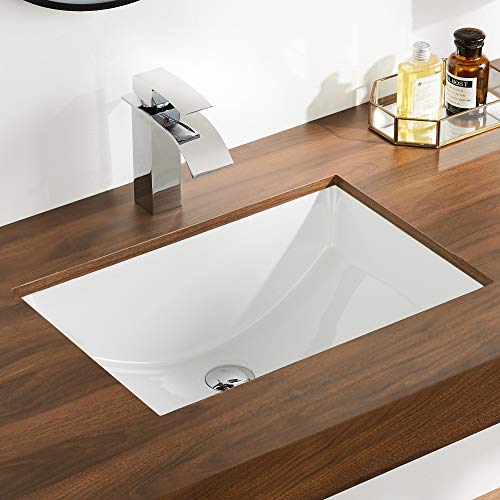
【Sleek Design & Universal Appeal】Crafted with beautiful curves and a glazed finish, this classic undermount bathroom sink adds a touch of modern elegance to any bathroom or bar vanity. Its versatile white finish seamlessly complements all decor styles, from contemporary to traditional.
4. Massicci by Marco Zito for Agape

Cast glass is not tempered glass, and the difference matters in a bathroom.
Tempered glass is pressed flat and uniform, then heat-treated for strength. Cast glass is poured molten into a mold, where it cools into a solid, subtly faceted volume.
Those facets are not cut after the fact; they emerge naturally as the material sets, which means no two Massicci basins carry the same light the same way.
That irregularity is where the shifting reflections come from. In a small bathroom, light bounces off those uneven planes and scatters across walls in ways a flat mirror or glossy tile never manages.
The space reads larger because the eye keeps catching movement, not because the room changes but because the surface refuses to sit still.
Care is the price of choosing Massicci. Cast glass is thick and heavy, but the surface is not hardened like tempered glass.
It will show water spots and fingerprints more readily than a ceramic or stone basin, and abrasive cleaners are out of the question. A soft cloth and a pH-neutral cleaner, used regularly, keep the facets clear without risking the finish.
I would place this in a powder room or guest bath where daily traffic is light and the drama of the piece gets the attention it deserves, not in a kid’s bathroom where toothpaste and toy boats win every time.
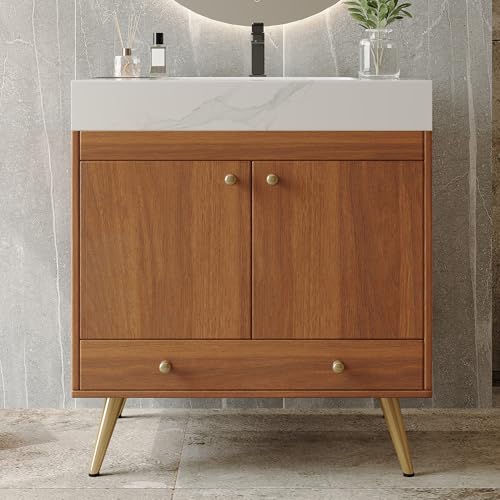
Elegant & Easy-Clean Top: Features a sintered stone countertop (faux marble look) paired with a glossy, seamless ceramic sink – sleek, modern, and simple to wipe down after daily use

100% Natural Marble, Hand-Finished: Each tray is crafted from solid, natural marble and meticulously hand-polished. No two pieces are alike—every marble tray features unique, elegant veining and a luxurious cool-to-the-touch feel, offering a one-of-a-kind statement for your home.

【Space-Saving Dimensions & Easy Setup】 - Diameter 15.7" x 33.8" H with a deep 4.72" (120mm) anti-splash basin, this compact square pedestal basin maximizes floor space in tight cloakrooms and half-baths. It stands independently on any flat floor surface, drastically simplifying installation compared to heavy wall-hung vanities.
5. Neolitico by Paolo Ulian for Antonio Lupi

Hand-carving means no two Neolitico basins share the same surface.
Paolo Ulian shapes each piece to evoke water slowly wearing away stone, so the texture varies with the marble’s own veining. You are buying the specific basin in front of you, not a prototype from a mold.
The texture changes how the marble lives in a bathroom. Polished marble reflects light and shows every droplet; this rougher surface breaks up reflections and makes water spots less visible at a glance.
Soap residue still collects, but it sits in the low points rather than filming across a shine, so the basin reads as naturally weathered rather than streaked.
I would clean it with a soft brush rather than a cloth, working with the grain of the carving rather than against it.
Maintenance against statement: that is the cost of Neolitico.
A polished basin wipes to a uniform gleam in seconds. Neolitico asks you to accept patina as part of the design, and at price on request, that acceptance costs more than the weekend projects this audience usually tackles.
For a powder room where guests see it briefly, the drama justifies the care. For a children’s bathroom or a rushed morning routine, I would skip it and choose something that forgives hurried cleaning.

Modern Floating Stylish Design: This floating bathroom vanity features a sleek, minimalist integrated design with smooth and neat lines, perfectly matching various bathroom decoration styles. The streamlined floating structure upgrades the overall elegant and modern look of the bathroom, optimizes spatial layering, and avoids the bulky feeling of traditional cabinets, combining exquisite appearance and practical functions perfectly.

Modern Floating Design: Adopted an integrated floating design, the modern vanity with nature vivid finish will solve the space occupation problem and maximize the utilization of bathroom space

6. Kanto by Andrea Parisio and Giuseppe Pezzano for Cielo

The asymmetric pentagonal form is what makes Kanto work in a corner that a rectangle would waste or a circle would crowd.
A rectangle leaves a dead triangle behind it in a corner installation; the pentagon fills that space instead, so the basin depth reaches toward the wall rather than stopping short.
The asymmetry tilts the usable depth toward one side, which means you gain a real basin where a symmetric corner sink often gives you a shallow puddle.
At 50 cm, Kanto is sized for powder rooms and tight en-suites where every inch of wall matters.
The rim asks you to choose. The shorter edge sacrifices landing space for a soap dish or a flat-mounted faucet, so you will want the faucet on the longer side or wall-mounted.
Cielo offers matching pentagonal shelves and a suspended cabinet in wood or Terre di Cielo finishes, plus a corner-angled mirror that keeps the geometry consistent rather than fighting it.
I would pick this for a true corner install where the door swings close and a standard vanity would block the path.
Skip it if your layout puts the sink on a flat wall; the shape is solving a problem you do not have, and the asymmetric rim becomes awkward without the corner to justify it.

Space-Saving U-Shaped Design: Designed to fit neatly under open pedestal sinks, this bathroom vanity cabinet maximizes unused space while expanding your storage options. U-shaped opening size: 7.9"L x 7.9"W. Perfect for small bathrooms and compact spaces.

U-Shaped CutOut Design: Designed with a 7.9"W × 6.7"D U-shaped cutout, the bathroom sink cabinet works seamlessly with most pedestal and wall-mounted sinks. It fully utilizes wasted under-sink room and hides unsightly plumbing lines to keep your space tidy. Tip: Measure your sink base dimensions before ordering to avoid mismatches.

【Pedestal Sink Cabinet】--The back of this bathroom cabinet has an open design so that the vanity can be assembled under or beside your pedestal sink. PLEASE NOTE THE SIZE FOR YORU SINK, size for the Faucet Hole of 7 9/16" X 8 7/16"(Width * Dia)
7. Otto by Mia Karlsson for Kast

The Otto basin by Mia Karlsson for Kast starts at £1,530 and reads like ceramic folded into fabric, though it is cast concrete.
The diagonal wraparound pleats give it the soft drape of a textile, but that same texture raises the practical question of whether dust or moisture collects in the ridges.
Concrete is porous enough that standing water matters more than surface dust; a quick wipe after use handles both.
At this price, the Otto sits below most custom concrete or stone basins, which typically run well past $2,000 once fabrication and shipping are factored in. The 28 color options help it compete with custom work on personalization without the custom markup.
I would surface-mount this with a wall tap to keep the pleated rim uninterrupted, and I would skip it only if the bathroom sees heavy traffic where the texture becomes one more thing to maintain.

1. Double Sink Convenience for Busy Households Designed for modern families, this 58-inch double sink bathroom vanity allows two people to use the space at the same time, helping reduce morning congestion and making daily routines more efficient. The spacious layout is ideal for master bathrooms, shared bathrooms, or couples who value both comfort and functionality. Dual ceramic basins provide plenty of washing space while maintaining a clean, symmetrical aesthetic. Whether preparing for work or winding down at night, this double vanity enhances convenience while elevating the overall bathroom experience with a balanced and practical design.


Sleek 30-Inch Design – This modern bathroom vanity offers a perfect fit for small to medium-sized bathrooms, combining space-saving functionality with a stylish, compact design.Bathroom Cabinet Dimensions:29.33*17.91*33.27 inch. Ceramic Basin Dimensions:29.92*18.5*6.89 inch .
8. Ohtake by Ruy Ohtake for Roca

The over-countertop placement of the Ohtake sits the basin partly recessed into the counter, so the rim rests on the surface rather than hanging below it like an undermount or perching entirely above like a vessel sink.
That middle position matters for a weekend install: you cut a hole, drop it in, seal the edge, and the weight does the rest. No clips fighting gravity from underneath, no pedestal taking up floor space.
Ruy Ohtake drew the curve from waves, horizons, eggs, natural forms that read as expensive even in porcelain.
The collection starts from £410, the entry point among these eight, and what you give up at that price is thickness and heft, not the line itself.
Roca ships the shape; you supply the counter that makes it look deliberate. I would pair it with a stone-look laminate rather than stretching to quartz, the basin is where the eye goes anyway.
The Red Dot 2019 win still holds, and Rodrigo Ohtake has since expanded the family, so replacement pieces or matching accessories stay findable.

👍【Ultra Fine Fireclay Undermount Bathroom Sink】Hugsleek white bath sink rectangle is made of high-grade natural fireclay by artisan, fired at extremely high temperature above 2300℉, advanced high-end material structure offers unmatched protection against impact and scratch that ensure the quality of sink, Hugsleek fireclay vessel sinks under counter offer superior strength and durability to withstand heavy use!

Premium Construction: The 21-inch undermount bathroom sink is crafted from high-quality ceramic with superior workmanship. Its smooth, glossy polished surface resists scratches, is easy to clean, and ensures long-lasting durability, making it perfect for bathrooms and powder rooms

Undermount Bathroom Sink, Best Sleek European inspired modern contemporary classic design,arc beautiful,elegant and generous,excellent technology and fashion aesthetic harmony
Materials That Hold Up

Porcelain still runs the market for a reason.
It costs the least, ships light, and shrugs off bleach and toothpaste stains. Drop a heavy ceramic jar in one, though, and you will find the chip fast.
Stone commands more, weighs enough to need reinforced cabinetry, and stains if you forget to seal it. Precision stone-cutting is where the premium lines separate themselves; the standard stuff relies on wider tolerances and plainer grain patterns.
Glass looks stunning until hard water etches the surface, and experimental glass casting, the kind that traps bubbles or layers color, drives the price up and the failure rate with it.
Concrete soaks up moisture without proper sealing, then cracks when your house settles. Enameled cast iron is nearly indestructible but clocks in at forty pounds or more, so plan your vanity support accordingly.
Reclaimed wood brings warmth I would want in a powder room, yet I would skip it for the bath the kids use; the cycle of wet and dry warps it inside two years.

Elegant Faux Marble Top & Ceramic Sink:Features a sintered stone countertop paired with a white ceramic sink, offering a smooth, scratch-resistant surface that is easy to clean and enhances modern aesthetics

Fits Various Styles: This bathroom sink is round with a grey marble texture design, offering understated luxury. It suits various bathroom styles, such as vintage, modern, and zen

【Space-Saving Dimensions & Easy Setup】 - Diameter 15.7" x 33.8" H with a deep 4.72" (120mm) anti-splash basin, this compact square pedestal basin maximizes floor space in tight cloakrooms and half-baths. It stands independently on any flat floor surface, drastically simplifying installation compared to heavy wall-hung vanities.
Installation Types and What They Need

Pedestal sinks hide every pipe behind a flared ceramic column, which reads vintage to me even when the basin itself is a clean oval.
They consume almost no floor depth, but you lose the storage a vanity would have given, and the footprint is fixed; you cannot nudge one closer to a wall without exposing plumbing.
Wall-mounted sinks flip that trade. The basin floats, so the floor stays clear and the room reads larger, though the drain and supply lines run exposed unless you open the wall.
A wall-mounted faucet pairs well here, and it can sit at any reasonable height you want for washing or for children.
The plumbing must live inside that wall, so an exterior wall in a cold climate is a risk; frozen pipes will undo the clean look fast.
Undermount sinks tuck beneath a solid countertop, which feels modern and makes wiping water straight into the basin simple. Over-countertop vessels do the opposite, sitting proud like a bowl on a table.
They demand a taller faucet and more frequent cleaning around the base where water collects. I would pick undermount for a main bath used daily, and save the vessel for a powder room where the drama is worth the wipe-down.

Space-Saving Wall-Mounted Design: Floating installation frees up floor space, making bathrooms feel more open and eliminating hard-to-clean bottom gaps. Adds a sleek, airy vibe to any space.

WALL MOUNTED RECTANGULAR SINK-Best Sleek European inspired modern contemporary classic design, arc beautiful, elegant and generous. Our 14.5x10 inch small white sinks are widely used in home bathroom, Cloakroom, restaurant, Office building, school, indoor or outdoor

Spacious Double Sink Design: With overall dimensions of 59.06" L x 18.90" W x 4.33" H and individual basin dimensions of 19.69" L x 12.01" W x 3.15" H, this bathroom sink provides ample space for shared use, making it ideal for family bathrooms or his and hers sinks.
Where the Trends Point in 2024

Sculptural forms are where bathroom sink design is moving fastest.
The Lavabo Norma by Elena Salmistraro for Flaminia shows the shift plainly: a cylindrical column in glossy plastic with a generously proportioned basin and an integrated surface for toiletries, available in single- or two-tone finishes.
I would pick the two-tone version for a small bath where the vertical line stretches the sense of height, but the monochrome read is safer if the rest of the room already carries pattern.
Rectangular sinks with clean lines still dominate the market, yet the edges are softening into something more architectural.
Reclaimed wood with epoxy resin inlays brings in natural texture and color variation that factory finishes cannot replicate. I like the warmth, though I would seal it obsessively; wood around a sink lives hard.
Sculptural concrete basins have pushed further than I expected, some incorporating live plants directly into the surround. The maintenance is real, but the effect is genuinely biophilic rather than decorative.
Hammered metal with intricate patinas and upcycled vintage vessels repurposed as sinks round out the unconventional options. Skip the vintage vessel unless you have the counter depth; most were never meant for modern plumbing and sit too shallow.
Smart technology integration is appearing in higher-end lines, though for a weekend project on a real budget, I would put the money into material before electronics that age fast.
Frequently Asked Questions
What sink shape is trending in 2024?
Sculptural forms and rectangular sinks with softened, architectural edges are both moving fast.
The Lavabo Norma by Elena Salmistraro exemplifies the sculptural direction with its cylindrical column and integrated shelf, while rectangular basins are evolving away from hard corners toward something more refined.
Reclaimed wood with epoxy resin, sculptural concrete with live plants, hammered metal with patinas, and upcycled vintage vessels round out the unconventional options gaining traction.
What is the modern design for a wash basin?
Modern wash basin design centers on sculptural forms that function as room-defining pieces rather than mere utilities.
Freestanding sinks with vertical emphasis and contrasting textures, asymmetric shapes like the pentagonal Kanto for corner installations, and integrated elements such as the Norma’s rim shelf all represent where the category is heading.
Materials have expanded well beyond porcelain to include cast glass, hand-carved stone, folded concrete, and wood-resin composites.
What are the pros and cons of undermount sinks?
Undermount sinks tuck beneath a solid countertop, giving a clean modern look and letting you wipe water straight into the basin without a rim catching debris.
The downside is that installation demands a finished counter material and proper sealing; you cannot drop one into a basic setup the way you can with an over-countertop vessel.
For a main bath used daily, the undermount’s ease of cleaning wins; save vessel sinks for powder rooms where occasional wipe-downs are acceptable trade-offs for visual impact.
What are parts of a bathroom sink called?
The core components are the basin or bowl that holds water, the faucet or tap that delivers it, and the drain with its stopper assembly that lets water out.
Beyond those basics, you have supply lines bringing hot and cold water to the faucet, a pop-up stopper or drain guard that traps debris, and often an overflow outlet to prevent flooding if the drain blocks.
Installation hardware varies by type: undermounts need clips beneath the counter, wall-mounted sinks require brackets inside the wall, and pedestal sinks hide plumbing behind a flared column.
How to measure a drop-in bathroom sink for replacement?
Measure the exterior length and width from edge to edge with a tape measure, then the height from top to bottom of the sink’s outside.
For the basin itself, measure depth from the deepest point to the top rim. When cutting the countertop hole, match the manufacturer’s template exactly; the sink’s weight and seal depend on that fit.
After shutting off water, apply waterproof sealant around the cut edge, lower the sink into place, install the drain with putty and caulk, connect supply lines, and let everything cure 24 hours before use.