

A modern kitchen faucet is a sink-mounted fixture that delivers water through a spout you can control for flow, temperature, and spray pattern.
The problem is that "modern" covers seven distinct mechanical designs, and the one that looks best in a photo often fights your actual sink depth or cabinet clearance.
The Kraus Bolden KPF-1610 stands 19 inches high with a 9-inch width, which fills a bay beautifully or blocks your window entirely depending on what you measured.
Pull-Down Gooseneck Faucets

A gooseneck faucet lives or dies on its arc height. The high-arching spout swings clearance for stockpots and sheet pans, and the pull-down hose extends that reach to every corner of a deep single or double basin.
Magnetic docking is the feature that separates the ones that last from the ones that sag after a year.
The magnet seats the spray head firmly, though the retraction still depends on a weight under the sink and enough hose travel to let it return without snagging.
Most premium pull-down models now run between 1.5 and 1.8 GPM, a noticeable drop from older 2.2 GPM fixtures that saves water without feeling underpowered for rinsing.
For scale, the Kraus Bolden KPF-1610 stands 19 inches high with a 9-inch width, so it fills a sink bay without crowding the window or upper cabinet above.
I would measure my sink-to-cabinet clearance before ordering any gooseneck, and I would skip models without a magnetic dock regardless of how the finish looks.
The arc is what you buy it for; the magnet is what keeps you from cursing it.

LAST 3X LONGER - Crafted from corrosion-resistant brass material, the stainless brushed nickel kitchen faucet can last triple as long as stainless steel faucet. Enhanced by Reach Technology, the easy-retract hose and coordinating finish swivel adapter provide unparalleled flexibility to flex, pivot, and reach around the sink

POWERFUL SPRAY: ShieldSpray Technology cuts through stubborn messes with a powerful stream of water inside a protective sphere that contains the splatter, so you can spend less time soaking and scrubbing with an average of 90% less splatter than a standard spray

Solid Brass Construction & Finishes: Crafted from durable solid brass with corrosion-resistant brushed gold or rose gold finishes for lasting beauty and reliability.
Semi-Professional Coil Faucets

The flexible spring coil wrapped around the spout is what sets these apart from any other modern kitchen faucet.
That coil lets the head pull down on a braided hose and snap back into place, giving you the high-pressure spray pattern you would expect from a commercial sink without the institutional look that used to come with it.
Early versions leaned hard into raw industrial styling, all exposed metal and utilitarian lines that felt at home in a restaurant but cold in a breakfast nook.
Manufacturers have softened that approach over the last few years, keeping the coil as a visual signature but pairing it with tapered spouts, warmer finishes like brushed bronze or matte black, and smoother docking mechanisms.
The result still reads as capable, but it no longer reads as borrowed from a back kitchen.
For someone who scrubs sheet pans or rinses produce in quantity, the coil design earns its counter space.
Weight is the real downside: these are heavier than standard pull-downs, and cheaper models can develop hose fatigue where the coil meets the wand.
If your sink cabinet is shallow or your water pressure runs low, the bulk probably is not worth it.
I would pick a coil faucet for a kitchen that sees daily heavy use, but skip it if the aesthetic draw is the only thing speaking to you.

POWER CLEAN SPRAY TECHNOLOGY: Provides up to 50% more spray power for faster cleanup of tough, stuck-on messes while minimizing splash
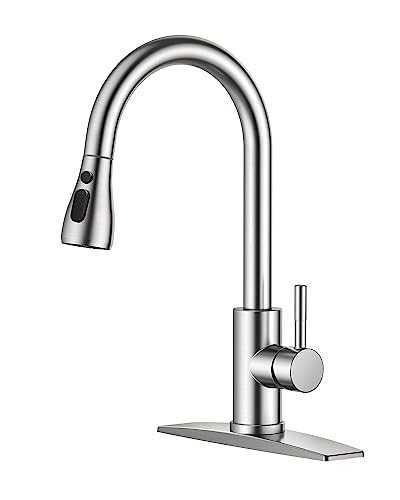
CERTIFIED BUILD FOR CONFIDENCE — Certified to cUPC & NSF/ANSI/CAN 61 standards and built to meet lead-free requirements, this kitchen faucet uses SUS304 stainless steel, heat-resistant PEX lines, and a drip-free ceramic cartridge for steady operation
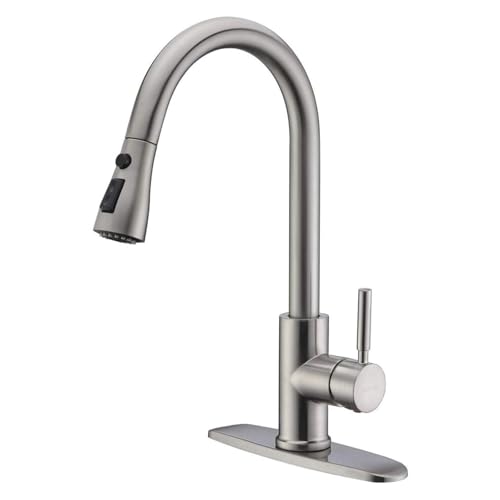
Sleek Design---Tulip kitchen faucet design make your kitchen room simple and fresh, easy to match most sink.
Smart and Touchless Faucets

Motion-activated sensors have finally reached the point where they work every time, not just most of the time.
The placement and responsiveness on current models avoid the old problem of the faucet firing when you walk past with a tray of dishes.
Power comes two ways: standard AA batteries that need swapping eventually, or a hardwired connection that removes that chore entirely.
The Moen Arbor MotionSense runs on the motion-sensing side, while Delta splits the field with touch activation on the Essa Touch2O.
Touch means you bump the spout or handle with a wrist or forearm when your hands are covered in raw chicken or bread dough, which can be more predictable than waving in tight spaces beside a wall or backsplash.
Hygiene and convenience drive most buyers toward either option, and the auto-shutoff after four minutes on Delta’s electronic models keeps water from running unnoticed.
The Delta Lenta Touch2O at $318.49 sits at the top of this tier, with magnetic docking for the sprayer and an LED temperature indicator that shifts from blue to red.
The Lenta also carries a lifetime warranty on the body and five years on the electronics, which matters because the circuitry is the part most likely to need attention down the road.

G 1/2 Connection, not NPT or 1/2 inch, suitable for the pull-out faucet hoses. Straight male threads, Connector O.D.: 0.8" (20.5 mm). Notice: Please check the connector size of your faucet before purchasing.

Simply unscrew your old shower head and replace it with your new one to transform your kitchen. It only sprays water when you squeeze the handle and only 1 function.

COMMERCIAL FAUCET DESIGN: Kitchen sink faucet with high-arc open-coil spring spout creates a professional modern look, and is sized to fit in any kitchen or laundry room with optimized 18 3/4” height
Fixed-Spout Deck-Mounted Faucets

A fixed-spout deck-mounted faucet is the simplest arrangement you can buy: a single spout rising from the deck with no spray head to pull down or extend out.
That minimalism works in small sinks where a tall gooseneck would swallow the basin, or in secondary prep areas where you rinse vegetables rather than scrub pans.
There is a real downside. A pull-down nozzle reaches every corner of a deep single-bowl sink and retracts securely when not in use; a fixed spout relies on its swivel range and your ability to angle dishes beneath it.
I would skip this style for the primary sink in any kitchen where the faucet sees daily heavy use.
The commercial models that borrow industrial lines, with single-handle control and 360-degree swivel, still top out at around $117 and deliver ample pressure, but without that movable spray head you are working around the faucet rather than with it.
For a rental refresh or a butler’s pantry, the savings and clean sightline justify the choice. For the main event, the functionality gap costs more than the price difference.

24 inch (2 Ft.) length faucet supply line connector for cold or hot water
16 inch (1.33 Ft.) length faucet supply line connector for cold or hot water

UNIVERSAL FIT - US standard 3/8" Female compression thread x M10 male connector, compatible with most standard size faucets.
Bridge Faucets
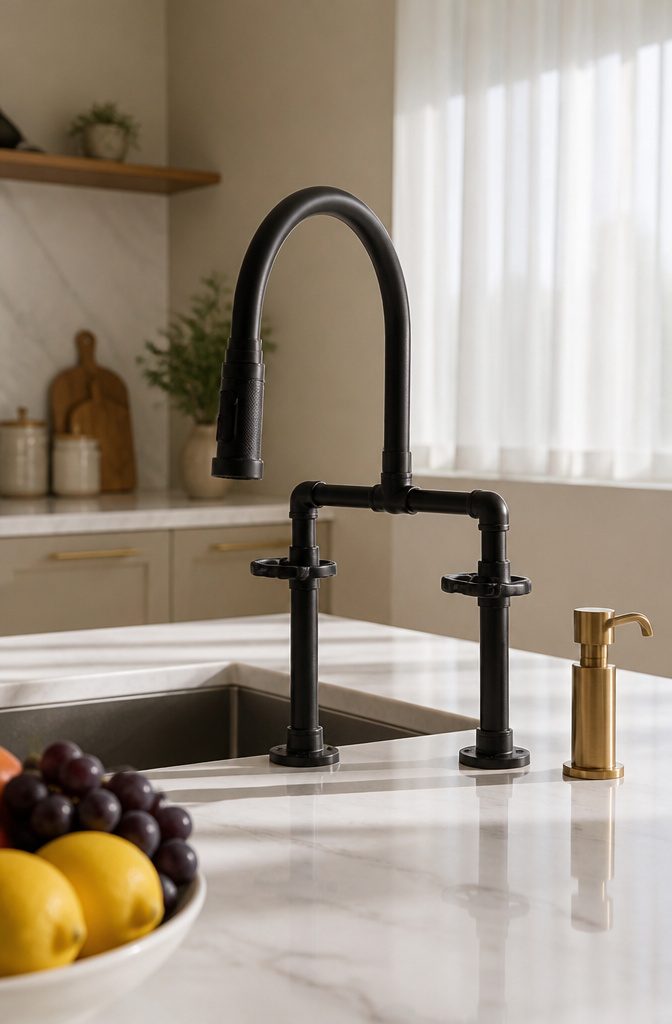
A bridge faucet carries its plumbing above the deck in an exposed line that links the hot and cold sides, and that visible piping is exactly why people buy it.
What started as a Victorian necessity now reads as deliberate structure in a modern kitchen, especially when the finish strips away nostalgia.
Matte black turns the bridge into a graphic linear element against light countertops, while brass warms it without slipping into period pastiche.
The separate controls demand more counter space than a single-post mixer, and you need to verify hole spacing and clearance before ordering because layouts vary enough that mounting style alone won’t tell you whether a given model fits your sink.
The Dilusso Wilson, for instance, comes in both chrome and matte black, but bridge-style models do not automatically include a pull-down spray head.
That exposed piping looks engineered rather than hidden, which is the appeal, though it also means more surface to wipe down.
I would pick matte black for the water-spot advantage over chrome, provided you do not mind chasing dust that shows more readily than you might expect on such a dark finish.

3 Modes Switching: The kitchen faucet head replacement, from gentle water flow to powerful jets, and then high-pressure rinse, simply a press, food debris? Bye bye! Simply press the button to change modes and meet your cleaning needs.

Dual-Function Sprayer: Hibbent kitchen faucet aerator with anti-leak design. Rotate the bottom to switch between soft aerated water and strong spray. 360° swivel supported. Compatibility Note: Fits only faucets with detachable aerators. Incompatible with pull-down faucets, filter-equipped models/devices, RV faucets

Almost Universal with 15 Adapters: This kitchen spray head comes with 15 adapters compatible with most types of faucets from American Standard Faucets, compatible with Kohler, Hansgrohe, Grohe, Moen, Delta and more; Not compatible with all faucets, please check the faucet size before ordering
Wall-Mounted Faucets

Wall-mounted faucets move the spout and controls off the counter entirely, which gives the cleanest sightline of any modern kitchen faucet style.
The plumbing runs through the wall instead of the deck, so this is not a direct replacement for a deck-mounted fixture.
For new builds, that is straightforward. For remodels, it means opening the wall, checking wall depth, and confirming access for future service before the tile goes up.
The installer needs to coordinate valve placement with the sink location and spout reach so the water actually lands where it should.
What you get back is counter space you do not have to work around and a kitchen that reads more minimal than anything sitting on the deck can manage.
I would only choose this if I were already gutting the kitchen or building from scratch. The extra labor and wall work on a working kitchen is not worth the look for a weekend project.

KITCHEN FAUCET WITH PULL DOWN SPRAYER – Advanced spray head docking system; elegant forward handle design underscores ergonomic function and helps where space behind the faucet is limited; includes decorative deckplate and coordinating soap dispenser

Antique and Patented Design Kitchen Faucet with Soap Dispenser -- The unique line design of DAYONE Pull down kitchen sink faucet makes your kitchen stand out from the others, leaving a deep impression to the visitor. Come with a soap dispense, every penny you spend is worth it.
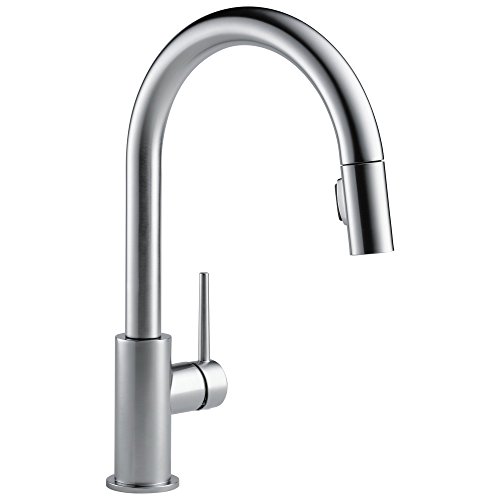
LASTS 2X LONGER: Patented DIAMOND Seal Technology reduces leak points and lasts twice as long as the industry standard—ensuring leak-free operation for the life of the kitchen sink faucet
Pull-Out Faucets

A pull-out faucet keeps a lower profile than the tall goosenecks that dominate kitchen trends right now. The wand extends horizontally toward you rather than dropping straight down, which matters more than it sounds.
In a shallow sink, that horizontal pull keeps water from splashing up the backsplash and gives you enough clearance to rinse a cutting board without tilting it vertical.
The compact form works best in kitchens where cabinets sit close to the window or where you simply do not want the faucet to read as the room’s centerpiece.
I would pick one for a galley layout or any counter where headroom already feels tight.
Reach is what you give up: you lose some of the overhead clearance that makes filling a stock pot painless, and the hose path can feel less intuitive until you adjust.
For renters swapping hardware on a weekend, the smaller footprint also means fewer surprises about what fits the existing deck plate.

Lead-Free SUS304 Stainless Steel Kitchen Faucet: Built with a SUS304 stainless steel spout and finished in brushed nickel, this kitchen sink faucet resists rust, corrosion, and fingerprints. With a maximum water flow rate of 1.8 GPM, it provides steady water output for everyday kitchen cleaning while maintaining a clean, modern look

High-Quality: Made of SUS304 stainless steel, CEC listed, safe and easy to clean. Adopting premium drip-free ceramic cartridges and high-temperature-resistant PEX hoses,that undergo a 500,000+ close and open test long-lasting

Product Specifications: The FORIOUS kitchen faucets has an overall height of 18.90 inches and a spout height of 8.27 inches. Its larger size is designed to meet the needs of kitchens with spacious sink
What the Finishes Actually Do

Matte black hides water spots and fingerprints better than polished chrome, which is why it has become the default modern finish.
The powder-coated surface on a quality faucet like the Kraus Oletto holds up to daily use without the constant wiping chrome demands. Brushed nickel offers the same forgiving texture in a warmer, more traditional tone that still reads contemporary.
Brass brings warmth too, though it sits at the opposite end of the maintenance spectrum: living finishes change over time, and even sealed brass will show wear patterns around the handle.
The real choice is between how much wiping you will do and what you are wiping away. Dust shows on matte black more than you would expect, so the low-water-spot win comes with a trade-off.
If you want the look of brass without the patina anxiety, a brushed gold gives you the tone with far less upkeep. Match the finish to your sink and hardware, but let your tolerance for daily maintenance break the tie.

COMMERCIAL FAUCET DESIGN: Kitchen sink faucet with high-arc open-coil spring spout creates a professional modern look, and is sized to fit in any kitchen or laundry room with optimized 18 3/4” height

Certified to CEC,DOE,cUPC, NSF 61, and lead-free standards, this kitchen faucet is constructed from SUS 304 stainless steel body. Surface layer drawing process,anti-fingerprint, anti-rust-resistant finishing. heavy-duty spring, and a superior-grade ceramic cartridge that can withstand a 500,000+ close and open test. Flow Rate: 1.8 Gallons Per Minute.

Product Specifications: The kitchen faucets has an overall height of 18.9 inches and a spout height of 6.89 inches. Its larger size is designed to meet the needs of kitchens with spacious sink. Certified to cUPC, NSF 61/372 and lead-free standards
Controls: Manual, Touch, or Motion

How you operate the faucet matters more than the style of the spout.
Manual handles give you direct control over flow and temperature with no batteries to fail. The Moen Adler Standard is a straightforward manual option at 14.5 inches high by 8 inches wide, the kind of basic fixture that just works.
Touch activation requires skin contact, not proximity.
A wrist or forearm tap turns the water on when your hands are messy. Fully touchless faucets use a sensor instead, waving your hand through the beam starts the flow.
Both need power. Battery models are simpler to install but need replacement eventually; hardwired units skip that chore but require an outlet under the sink and a bit more planning.
| Feature | Manual | Touch-Activated | Touchless |
|---|---|---|---|
| Power needed | None | Battery or hardwired | Battery or hardwired |
| Activation | Hand on handle | Skin contact anywhere | Proximity sensor |
| Best for | Reliability, tight budgets | Messy hands, no waving | Germ control, full hands |
I would pick touch-activated over touchless for most kitchens.
The sensor placement on early touchless models was unreliable, and while newer units have improved, touch gives you the same hands-free benefit with fewer misfires. Manual still wins if you want zero maintenance and the lowest upfront cost.

BRAIDED FAUCET CONNECTOR: Eastman flexible faucet supply line measures 60 inches in length and features 1/2 inch FIP x 1/2 inch FIP connections, compatible with most kitchen and bathroom faucets

Faucet Hose: Feature 1/2” to 1/2” FIP Female Thread. To determine the length of supply lines, measure the distance from the stub out to the water inlet on the faucet,add a couple inches to the measured distance.for example, the measurement length is 69", please order 72".

UNIVERSAL FLEXIBLE FAUCET CONNECTOR: The Eastman Compression Braided Faucet Connector is the standard in bathroom and kitchen sink faucet supply lines. This 12 in. faucet hose is equipped with 1/2 in. FIP and 3/8 in. compression connections
Budget and What It Buys

The WEWE A1001L pulldown at $61.22 gets you a faucet that looks more expensive than it is, with a brushed nickel finish and basic pull-down function.
What it does not get you is heavy-duty internals or a finish that will look the same in five years. For a rental or a quick weekend refresh, that trade-off is reasonable.
The Delta Lenta Touch2O at $318.49 buys solid brass construction, a ceramic disk valve, and finishes that resist spotting.
The touch-activation runs on electronics with a 5-year warranty, while the body itself carries lifetime coverage. Magnetic docking keeps the sprayer head in place, and the LED temperature indicator shifts from blue to red as the water warms.
Most readers here are working with a few hundred dollars and a Saturday.
That puts the decision in the middle: the WEWE works if the plan is to replace it again in a few years, or if the sink is in a rental where someone else will make the next choice.
The Delta makes sense if this is the faucet you want to live with, and if the extra $257 buys enough years of not thinking about it to matter.
I would spend the extra for the brass body and the longer warranty, but I would skip the touch feature if the budget is tight; the standard Lenta saves money without losing the build quality that matters.

17 Adapters for wide Compatibility with Hose: Including 17 adapters for various connections that is compatible with most of brand faucet hoses, cover American Standard.

Note : This spray head will fit standard hoses with adapters of 1/2” – 14 NPSM threads. This is a pullout spray head and not universal. We highly recommend to use the Danco pull-out replacement hose if they want the best fit when installing

Best Faucet Partner: The kitchen sink sprayer replacement is compact and be a perfect complement with high concentrated nozzle to clean hard-to-reach spots and smudge. Save time and energy.
Installation Before You Buy

- Measure counter thickness before ordering. Some modern kitchen faucets ship with mounting hardware that only fits standard thicknesses, and extra-thick counters or deep sinks leave you scrambling for extensions you do not have.
- Check your plumbing rough-in location. Deck-mounted faucets drop straight through the sink deck, but wall-mounted designs need valve bodies buried in the wall at the right depth and spout position. That is cabinet work and tile work, not just a swap of the fixture itself.
- Use plumber’s putty under the escutcheon plate instead of the factory gasket. The seal lasts longer and handles the vibration from daily use without weeping.
- Buy a basin wrench if you do not own one. Tightening the mounting nut above a deep sink with ordinary tools wastes an hour and skins your knuckles.
- Most modern kitchen faucets now use quick-connect lines that snap into place. The connection is straightforward when the rough-in lines are long enough and the shutoff valves turn freely, which is why I check those first.
Frequently Asked Questions
What kind of faucets are in style now?
Modern and minimalist faucets are trending right now, especially in matte black or brass finishes.
Matte black hides water spots and fingerprints better than polished chrome, while brass brings warmth without slipping into period pastiche. Touchless and touch-activated options have also moved from novelty to standard feature on many premium models.
Is Moen or Delta better?
Moen offers the Arbor MotionSense for motion-sensing operation, while Delta leads with touch activation on the Essa Touch2O and the Lenta Touch2O at $318.49 with magnetic docking and an LED temperature indicator.
The Delta Lenta carries a lifetime warranty on the body and five years on the electronics, which matters because the circuitry is the part most likely to need attention down the road.
What is the highest-rated brand of kitchen faucet?
The Delta Lenta Touch2O at $318.49 sits at the top of the smart faucet tier with solid brass construction, a ceramic disk valve, and a lifetime body warranty.
For tight budgets, the WEWE A1001L pulldown at $61.22 gets you basic pull-down function with a brushed nickel finish.
What kitchen faucets have the best reviews?
The Delta Lenta Touch2O at $318.49 earns top marks for its brass construction, ceramic disk valve, and 5-year electronics warranty alongside lifetime body coverage.
The Kraus Bolden KPF-1610 stands out among gooseneck models at 19 inches high with magnetic docking and a 9-inch width that fills a sink bay without crowding.
For budget buyers, the WEWE A1001L at $61.22 punches above its price point in appearance if not longevity.
Is a pull down or pull out faucet better?
A pull-down faucet wins for overhead clearance and filling stockpots, while a pull-out faucet keeps a lower profile that works better in shallow sinks or tight spaces.
The pull-down’s vertical drop gives you more reach into deep single-bowl sinks, but the pull-out’s horizontal extension reduces backsplash splashing and fits better under low cabinets or close windows.
Pick pull-down for a primary sink with heavy pot duty; pick pull-out for galley layouts or counters where headroom already feels tight.
Is Kohler or Moen a better kitchen faucet?
Moen gets specific mention for the Arbor MotionSense and the Adler Standard manual faucet at 14.5 inches high by 8 inches wide.
For buyers deciding between brands, the more important split is often manual versus touch versus touchless operation, where Moen and Delta both offer strong options.
Who makes kitchen faucets?
Major manufacturers include Moen, Delta, Kohler, Kraus, and WEWE, with each occupying different price tiers and feature sets.
Delta’s Lenta Touch2O represents the premium end at $318.49 with solid brass construction and smart features, while WEWE’s A1001L at $61.22 serves the budget segment with basic pull-down function.
Kraus specializes in modern finishes like matte black and bold gooseneck profiles, with the Bolden KPF-1610 and Oletto models noted for their powder-coated surfaces.