

A pot filler faucet is a wall-mounted tap with a hinged arm that extends over your stove to fill pots with cold water, then folds back against the wall when you are done.
The convenience is partial, not total: it saves you the trip to the sink with an empty stockpot, but you still carry that pot back to empty it.
Most residential models reach up to 22 inches and connect through a 1/2" NPS supply, with dual ceramic disc valves at the wall and spout to control flow and prevent drips onto your cooktop.
What a Pot Filler Faucet Is

A pot filler faucet is a wall-mounted tap installed above or near a range or cooktop, with an articulated arm that extends over the cooking surface to fill pots and folds back toward the wall when not in use.
It connects to a dedicated cold-water supply, usually with 1/2" NPS connections, and fills only with cold water.
The basic purpose is straightforward: it eliminates carrying an empty pot to the kitchen sink for filling.
That matters most with large stockpots or kettles that are awkward to position under a standard faucet. What it does not do is eliminate the return trip when the pot needs emptying, so the convenience is partial, not total.
Compared to a standard kitchen faucet, a pot filler is a single-purpose fixture at the cooking zone rather than a multi-use one at the sink.
It saves counter space in smaller kitchens by living on the wall, and the arm reach, up to about 22 inches on typical models, covers most burner layouts.
For renters, this is usually moot: the installation requires plumbing in the wall behind the range, which is a project for owners, not leaseholders.

Premium Quality Pot Filler: Made of Solid Brass material, it prevents corrosion and fingerprints, increasing the durability and reliability of the structure. Low-key in a pure black finish, resists corrosion and not easy to oxidize, for creating a classic kitchen decorating style

PATENTED ANTI-LEAK: The 6-layer waterproof design extends the service life by 2 times, without dripping or leaking

Effortless Pot Filling: Reach every burner on your cooktop with the dual-jointed 360° swing arm, extending up to 24" to fill pots of all sizes—from pasta pots to stockpots—without lifting heavy containers. When not in use, it retracts neatly against the wall to save valuable kitchen space.
1. Wall-Mounted Pot Fillers

Wall-mounted pot fillers sit on the backsplash above your stove, which is where most people picture a pot filler in the first place.
The arm folds back against the wall when you are not using it, so it does not hover over the cooktop like a piece of unused hardware.
That folded position matters more than it looks: it keeps the spout out of the grease zone and frees the visual space above your range.
Reach varies more than I expected before I started comparing. The Melrose Collection extends 15 inches from the wall, which covers a standard four-burner cooktop if your pot sits on a front or middle burner.
The Parma Collection pushes that to 22 inches, enough to hit a back burner on deeper ranges or leave room for a stockpot sitting off-center.
For most kitchens I would pick the longer arm; the extra seven inches costs more upfront but removes the small annoyance of twisting a full pot to catch the stream.
Both run cold water only through a 1/2 inch NPS connection, so you are not getting instant boiling water here.
Ceramic disc valves at the wall and at the spout tip keep the drip potential low, which matters because a slow leak at that height runs straight down your backsplash grout.

Automatic Chinese Wok Range Swing Faucet Mfg: Sunny USA

WOK RANGE FAUCET: The Krowne 13-222L Silver Series Wok Range Faucet with 12" Swing Spout is an essential commercial kitchen bar sink accessory designed for restaurants, cafeterias, hotels, catering services, and buffets. This faucet facilitates efficient water delivery and is crafted from NSF-certified stainless steel, ensuring compliance with stringent safety and sanitation standards.

Excellent engineering design & qualified-skilled craftsmanship inside and outside.
2. Deck-Mounted Pot Fillers

A deck-mounted pot filler sits on the countertop behind or beside the range, rising from the surface on a short post rather than extending from the wall.
That placement frees you from finding studs or opening the backsplash, which matters in older kitchens where wall plumbing would mean tearing out tile you actually like.
I would pick this route for a retrofit where the stove sits on an island or an interior wall with no water lines behind it.
You see the compromise right there on your counter. The base takes up a few inches of working surface, and in a small kitchen that space costs more than the cleaner look of a wall mount.
You will also wipe around it every time you clean, where a wall-mounted arm stays out of the way entirely.
For me, the decision hinges on whether the counter space behind the range is dead zone anyway. If you keep a spoon rest or oil bottle there, the post replaces that clutter with something functional.
If your counter run is shallow, under about 22 inches front to back, the deck mount can crowd your largest pots when you swing the arm out.

Hot and cold pot filler: It is worth mentioning that this stove faucet provides smooth both hot and cold water, which distinguishes it from other units that can only provide a single water stream. Dual handle design allows you to precisely control the water volume and temperature

Hot and cold pot filler: It is worth mentioning that this stove faucet provides smooth both hot and cold water, which distinguishes it from other units that can only provide a single water stream. Dual handle design allows you to precisely control the water volume and temperature

Lower lead BRASS: Premium brass body (with less than 0.25% lead content), good for drinking water, provides much higher performace (high heat-resistance and pressure-resistance), sturdy and durability than stainless steel ones. It can serve many years without leakage
3. Commercial Range Faucets

Commercial range faucets, sometimes called Chinese range or wok faucets, sit on a different end of the spectrum from the pot fillers most homeowners consider.
The Fisher models built for this purpose swing 10 inches with an 18-inch total extension, and they move at a flow rate of 2.2 GPM at 80 PSI.
That volume matters when you are filling a stockpot for a restaurant kitchen, not a Tuesday-night saucepan for two.
The real question is whether that power belongs in a home kitchen. The single wall backsplash mount and hot-cold index buttons are straightforward enough, but the hardware is overbuilt for residential plumbing and daily cooking loads.
A standard pot filler already spares you the walk from sink to stove; the commercial version adds capacity you will rarely touch and a visual footprint that reads industrial rather than resolved.
I would skip it unless your household actually cooks like a professional kitchen.
For most of us, the practical upgrade is a well-placed residential wall mount or deck mount pot filler in a finish that coordinates with the range hood and surrounding hardware.
Copper, brass, or oil-rubbed bronze can still give that wall above the stove a considered metal detail without the utilitarian swing arm and valve assembly of a line cook’s station.

✔ Pair of premium G 1/2" (basin) cartridges, solid M4 screws provided.

Drip-Free Function: Folding pot filler features independent on/off and volume controls, while the ceramic disc cartridges ensure drip-free performance and smooth operation

Drip-Free Function: Folding pot filler features independent on/off and volume controls, while the ceramic disc cartridges ensure drip-free performance and smooth operation
4. Articulated Spout Pot Fillers
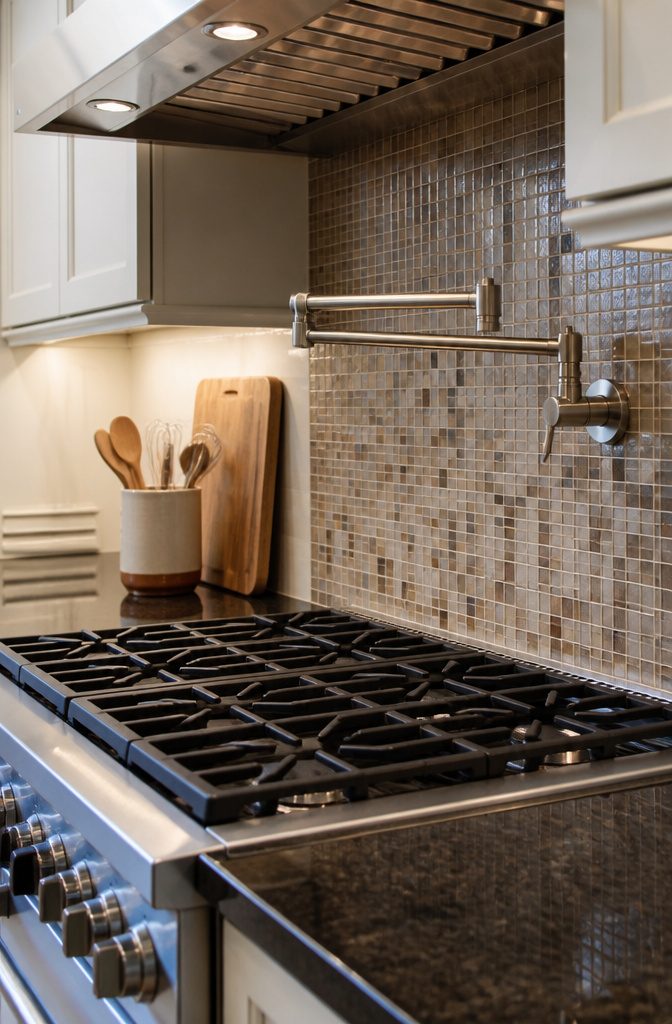
An articulated spout pot filler lives in the jointed arm that extends and retracts above your range.
Two segments connected by a hinge let you pull the faucet out over any front burner, then fold it flat against the backsplash when you are done.
The Parma Collection version extends up to 22 inches from the wall, which covers most standard cooktops without reaching so far that the arm sags.
That folding motion is the practical advantage over a fixed spout.
A rigid arm must stay put, so you position it over one burner and accept that it will block sight lines or cabinet space whether you are using it or not.
The articulated version disappears after the pasta pot is full.
Most use a cold-water hookup only, which keeps the plumbing simple and the cost down, and the better ones run ceramic disc valves at both the wall and the pot end for drip-free shutoff.
I would pick this style for any kitchen where the range sits against a wall rather than on an island.
The joint adds a moving part that will eventually wear, but the extra clearance you gain when the arm folds back makes that worth accepting.

【Premium Pot Filler Faucet】The core material of our kitchen pot filler is made of brass,which can be used for a long time. Matte black finishes are more in line with modern simplicity and are easy to clean.

【SOLID BRASS & POLISHED CHROME】This commercial sink folding faucet is made of solid brass, which is safe, reliable and durable. The polished chrome finish not only makes it easy to clean and anti-corrosion, but also adds a stylish and generous appearance to this faucet

【American standard design】: Water Use Information:1.78 Gpm 6.74L/Min, Fill the large pots or pans quickly; NPT 1/2" connecting thread, Fit for US Standard
5. Single and Dual Valve Pot Fillers

A single-valve pot filler gives you one shutoff point, usually at the wall, which means you walk the full spout length to stop flow at the source.
The dual-valve design adds a second control right at the outlet where water actually leaves the fixture.
That second valve matters most when a pot is already steaming on the burner and you need to cut water without reaching past the cooktop.
Both valves should be closed when the faucet is not in use. The outlet valve handles quick stops during filling; the wall valve handles the full shutoff you use when cooking is done for the day.
Neither arrangement eliminates the need for proper installation and routine inspection, especially since the fixture sits above your cooking surface and has no sink to drain into. For my own kitchen, I would spend the small premium for two valves.
The outlet control is what keeps you from reaching over open flame or a boiling pot to find the shutoff, and that safety margin is worth it on a weekend install you’ll live with for years.
You add one more gasket to check during annual maintenance, which takes about two minutes with a wrench.

Effortless Pot Filling: Reach every burner on your cooktop with the dual-jointed 360° swing arm, extending up to 24" to fill pots of all sizes—from pasta pots to stockpots—without lifting heavy containers. When not in use, it retracts neatly against the wall to save valuable kitchen space.

Premium Quality Pot Filler: Made of solid brass material, it prevents corrosion and rust, increases the durability and reliability of the structure. Luxurious in a brushed gold finish, will be an eye-catching highlight for your kitchen.

Perfect for Filling Pots: Faucet has 360° swing arm two handle design, can cover more than 4 stoves. GIMILI Pot Fillers are the perfect addition to any kitchen, can be quickly filled on the stove without having to walk from the stove to the sink
Installation Type Compared

Where the supply line lives decides the mount before you pick a style.
Wall-mounted units need a stub-out in the stud bay behind the range, which means the faucet rough-in and backsplash layout have to be finalized before tile or stone goes up.
The arm folds back flat when you are not filling a pot, so the range hood stays clear and the counter in front stays open.
Deck-mounted versions run through the countertop or cooktop surround instead; they work when the wall is finished stone, tile, or something you do not want to drill after the fact, or when the range sits on an island with no wall behind it at all.
| Attribute | Wall-Mounted | Deck-Mounted |
|---|---|---|
| Best for | Ranges against a finished wall | Islands, peninsulas, or solid backsplash surfaces |
| Space saved | Counter in front of range | Wall behind range |
| Rough-in timing | Before backsplash | Before countertop |
| Typical reach | Up to 22" | Varies by design |
| Folded profile | Flat against wall | Sits above counter |
I would go wall-mounted in almost every case where the plumbing allows it. The folded arm keeps the cooking zone cleaner, and you are not giving up counter depth to a base sitting behind your tallest stockpot.
Deck-mounted only wins when the wall is already a slab you cannot move or the range faces the room.
Either way, check the spout reach against your front-to-back burner layout before the plumber closes the wall; a faucet that cannot clear the front row is a faucet you will not use.

2-PACK PUMIE SCOURING STICKS, POWERFUL, CHEMICAL-FREE CLEANING SOLUTION – Eliminate tough stains and stubborn buildup with this 3-pack of Pumie Scouring Sticks. Perfect for removing hard water deposits, rust, and grime from toilet bowls, porcelain sinks, bathtubs, and tile surfaces. These heavy-duty pumice sticks clean deeply without harsh chemicals or scratching surfaces, making them ideal for both residential and commercial cleaning jobs. Whether you’re maintaining a spotless bathroom or tackling janitorial cleaning tasks, these pumice stones deliver professional results where traditional cleaners fall short.

PATENTED ANTI-LEAK: The 6-layer waterproof design extends the service life by 2 times, without dripping or leaking

Parts kit for Chinese wok range faucet.
Spout and Control Choices
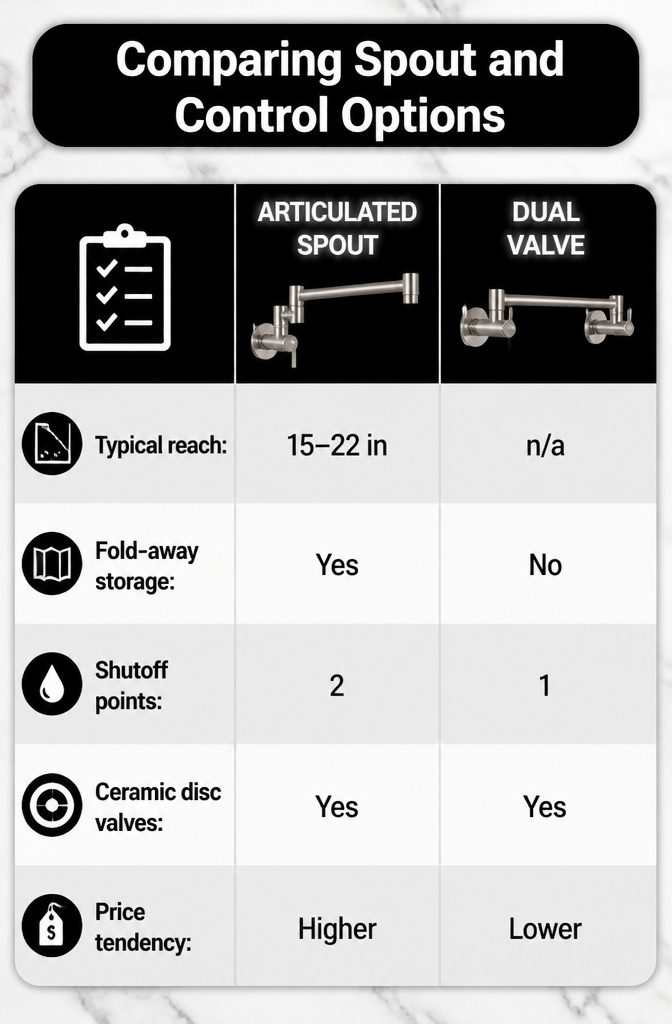
A pot filler’s spout either stays put or folds away, and that choice shapes daily use more than most buyers expect.
Fixed spouts cost less and have fewer joints to leak, but an articulated two-piece arm folds back against the wall when you are not filling a pot.
That clearance matters on a range where a protruding faucet blocks lids and tall pans. Articulated models like the Parma extend up to 22 inches to reach every burner, while simpler swing designs such as the Melrose stop at 15 inches.
The extra reach is not always better; it is only useful if your back burners see constant use.
Valves come single or paired.
A single valve near the wall controls flow at one point. Dual valves add a second shutoff at the spout outlet, which lets you stop water right over the pot without reaching back to the wall.
Both valves must close after use, so the dual design adds a step to your routine. Where durability counts, both Parma and Melrose lines use drip-free ceramic disc valves rather than compression washers.
Ceramic discs handle hard water better and seal tighter over years of use, which matters for a fixture mounted above your cooktop with no drain below.
| Feature | Fixed Spout | Articulated Spout | Single Valve | Dual Valve |
|---|---|---|---|---|
| Typical reach | n/a | 15–22 in | n/a | n/a |
| Fold-away storage | No | Yes | n/a | n/a |
| Shutoff points | 1 | 1 | 1 | 2 |
| Ceramic disc valves | Yes | Yes | Yes | Yes |
| Price tendency | Lower | Higher | Lower | Higher |
For my own kitchen, I would take the articulated spout with dual valves and pay the premium.
The folded arm keeps the cooktop clear, and the outlet valve means I am not stretching past a steaming pot to reach the wall.
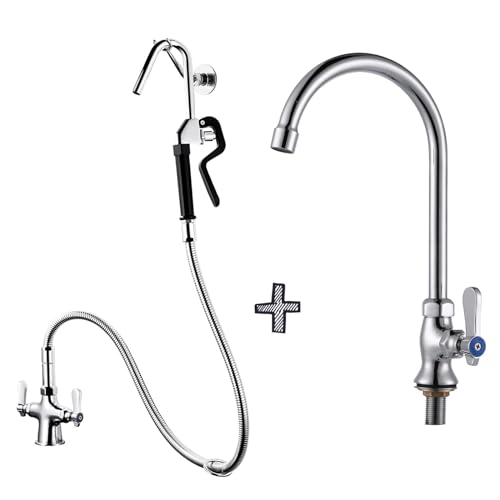
PREMIUM QUALITY COMMERCIAL POT FILLER: Made of Solid Brass Material, prevents corrosion, fingerprints and increases the durability and reliability of the structure. Low-key...
Material and Finish Options

Stainless steel, brass, and oil-rubbed bronze are the finishes I see most often on a stove water faucet, and each one reads differently against the cooking wall.
A polished chrome pot filler introduces a cooler, more reflective element that can brighten a dark backsplash, while black or oil-rubbed bronze creates definition against stone or tile.
I would skip trying to match every metal in the room. A related finish, like aged brass paired with warm cabinet hardware, creates continuity without looking like a showroom set.
A deliberate contrast, on the other hand, turns the pot filler into a secondary accent that draws the eye exactly where you want it.
The mounting position matters just as much as the color.
When the faucet sits beneath a decorative or copper range hood, its folded profile and extended reach need to work with the hood apron and the backsplash pattern, not fight them.
I think about the visible metalwork as a single composition: the range, the range hood, the lighting, and the main kitchen faucet all share that wall.
The pot filler is compact, but it occupies a highly visible position, so its finish should be chosen alongside those elements rather than as an afterthought.
A pot filler does not need to match the kitchen faucet.
It can, or it can stand apart. The decision that matters is whether the overall cooking wall feels intentional or accidental.

Timeless Design: A classic look with vintage-inspired detailing, this pot filler adds an elegant focal point above your stove—perfect for traditional and farmhouse kitchens.

Material: Ceramic and Rubber

Drip-Free Function: Folding pot filler features independent on/off and volume controls, while the ceramic disc cartridges ensure drip-free performance and smooth operation
What to Know Before Installation

A stove water faucet needs to be locked in before the backsplash goes up.
Tile, stone, and grout lines have to be drilled or cut around the supply connection, so changing your mind afterward means tearing finished work off the wall.
I would pull the product specification sheet for the exact faucet first thing, because the folded dimensions, reach, and control placement vary enough that eyeballing it leads to trouble.
There is no universal installation height. What clears a stockpot may splash over a saucepan, and what keeps a tall pasta pot from hitting the spout might put the handle in an awkward reach.
The range configuration, any hood above it, and the cookware you actually use all shift the math. The specification sheet gives the operating envelope; use it to mark the wall before the plumber opens the wall.
A qualified plumber should handle the rough-in and final hookup.
Local plumbing codes govern backflow prevention, pipe sizing, and shutoff placement, and the inspector will look for compliance whether the homeowner did the work or not. The cost of doing it twice is higher than doing it once.

【Brass Pot Filler】Made of 100% high quality brass material, it's more durable and ensure the health of every drop of water that passes through. Matte black finish resist fingerprint, scratches and corrosion, easy to create a classic and elegant home style.

【Upgraded upside down Design】This black pot filler maximum extension length is 19.9 inches. The folding wall mount kitchen faucet used for only cold water or only hot water, 1 hole Inlet wall mount, double swing joints that can rotate 360 degrees, dual valve control has greater flexibility when used.

✔✔✔ Upside Down Pot Filler***This is UPSIDE DOWN pot filler faucet.The water spout/output is below the water pipe. High Quality Stainless Steel Material,New design on the joints,without screw, avoid leaking at the joints.upside down style to fit for low cabinet and normal cabinet.Make sure the highest pot is fit for this faucet,the water spout is under the faucet body.
Water Supply and Flow Rate

Pot fillers tap into a dedicated cold-water supply, not the hot line. Running cold only keeps the fixture simpler and avoids the risk of scalding water hovering above your burners.
The final hookup has to follow the manufacturer’s specs and whatever your local code requires, so this is not a place to freestyle the plumbing.
Flow rate on many models tops out at 2.2 gallons per minute at 60 psi.
That figure matters more than it sounds. At that pressure and volume, a stockpot fills in roughly the time it takes to prep your aromatics, not long enough to stall the whole recipe.
Go lower and you are standing there watching water crawl up the sides while your onions brown without you.
The dual-valve setup most pot fillers use, one shutoff at the wall and another at the spout, adds a safety layer, but both need to be closed when you are done.
I would treat checking them as part of the cleanup routine, not an afterthought.
Price Range and Value

A basic wall-mounted pot filler starts around $250, with solid mid-range models from Kraus and Moen landing between $300 and $630. Once you move into Hansgrohe Axor or Rohl territory, prices climb past $1,100 and can top $1,700 for a single fixture.
That spread matters because the hardware cost is only part of the equation; you are also paying for a dedicated water line run inside the wall, which is not cheap if it is not already there.
Whether the expense holds up depends on how you actually cook.
If you fill a large stockpot or pasta pot several times a week, the convenience is real. The faucet sits right over the stove, so you are not hauling water across the kitchen.
For occasional use, it is harder to justify. I would skip it in a tight remodel budget and put that money toward a better sink faucet or a more powerful range hood.
The pot filler is a nice-to-have that becomes worth it only when the rest of the kitchen is already sorted.
Frequently Asked Questions
What is a pot filler faucet?
A pot filler faucet is a wall-mounted tap installed above or near a range or cooktop, with an articulated arm that extends over the cooking surface to fill pots and folds back toward the wall when not in use.
It connects to a dedicated cold-water supply and fills only with cold water. The basic purpose is to eliminate carrying an empty pot to the kitchen sink for filling, which matters most with large stockpots or kettles.
What is the water thing over the stove called?
The water fixture mounted over a stove is called a pot filler faucet, or sometimes a stove water faucet.
It is a single-purpose fixture at the cooking zone rather than a multi-use one at the sink. Some commercial versions are also called range faucets or wok faucets.
Is a pot filler faucet worth adding to a kitchen?
Its value depends on cooking habits, kitchen layout, and project priorities. If you fill a large stockpot or pasta pot several times a week, the convenience is real, but for occasional use it is harder to justify.
In a tight remodel budget, money is better spent on a better sink faucet or a more powerful range hood.
How high should a pot filler be installed?
There is no universal installation height; placement depends on the faucet’s dimensions and reach, the range configuration, and the cookware you actually use.
What clears a stockpot may splash over a saucepan, and what keeps a tall pasta pot from hitting the spout might put the handle in an awkward reach.
Pull the product specification sheet first and mark the wall before the plumber opens it.
Why do some pot fillers have two valves?
A two-valve pot filler provides water-flow control near the wall and near the outlet where water actually leaves the fixture.
The outlet valve lets you stop water right over the pot without reaching back past open flame or a boiling pot.
Both valves must be closed after use, so the dual design adds a step to your routine but provides a safety margin worth the small premium.