
The difference between a kitchen that looks expensive and one that feels it is what you hide, not what you show.
Every idea here assumes you are willing to edit: appliance garages swallow the toaster, toe-kick drawers reclaim six inches of dead space, and open shelving only works if you treat it like a gallery wall with strict rules.
The cost of that calm is discipline. A slab backsplash runs $5,000 or more where standard tile costs a fraction, and glossy white cabinets demand daily wiping, not weekly.
But the return is daily too: a kitchen that reads as designed rather than assembled. Quartz countertops give you the maintenance-free surface marble cannot; 42 to 48 inches of clearance around an oversized island separates luxury from crowded.
The single detail that proves this is not generic advice: Venetian plaster on a range hood, a centuries-old technique that turns ventilation into sculpture.
That choice costs more than stainless steel and shows every imperfection in the wall prep beneath it.
1. Minimalist Backsplash

A minimalist backsplash is where a sleek kitchen design modern luxury look actually starts.
Remove visual noise so the materials stand out. Large-format stone, subtle tile, or a single slab running behind the counter keeps the eye moving across clean lines instead of stopping on busy pattern.
I would skip small mosaic sheets and high-contrast grout entirely.
They read as clutter in a space meant to feel calm. Neutral but light colors work best here, letting the cabinets and countertops do the intentional work.
The luxury comes from quality, not decoration. Stone countertops gain presence when the wall behind them does not compete.
Match the backsplash material to the countertops so the surfaces read as one continuous plane. That continuity is what makes a kitchen feel designed rather than assembled.
A slab backsplash costs more than standard tile, and any single surface that large shows every imperfection in the wall prep. I would still choose it for a first home if the budget allows, because the return is daily.
A renter working with landlord-grade counters can fake the same quiet by painting existing tile in a tone that matches the counter as closely as possible.

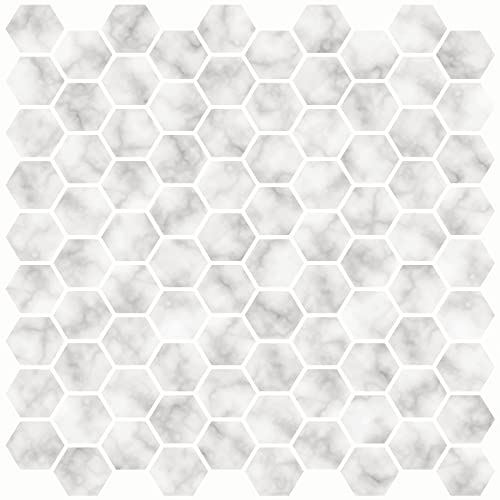
Size and coverage: each sheet measures 11.7’’x11.4’’x0.12’’, 1 pack contains 10 sheets totally covering 9.26 square feet.


Kit contains sixteen 5.9in x 23.6in easy peel and stick backsplash panels, no contractor required
2. Kitchen Island with Seating
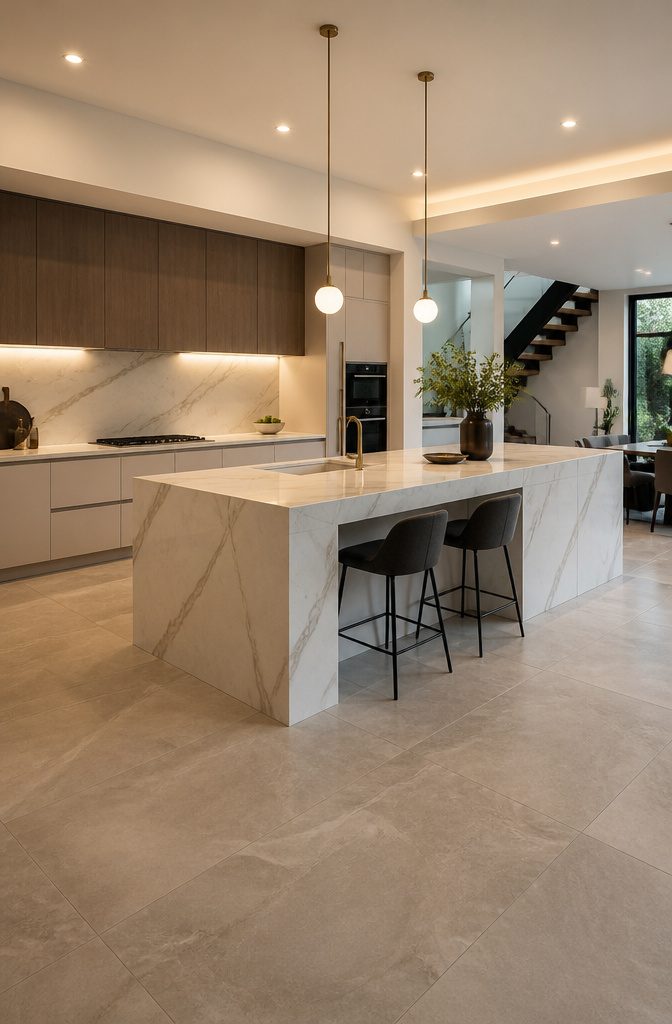
An island with seating redefines what a kitchen can be.
I would skip the breakfast nook every time: the same square footage, routed through an island, turns the cook into part of the conversation instead of someone ducking in and out of a separate room.
A modern kitchen earns its keep as a gathering place, morning coffee to homework to evening drinks, without ever feeling like a restaurant setup.
Keep the line clean. A waterfall edge in marble or quartz reads as one continuous plane, so the overhang for stools does not read as an afterthought bolted onto a box.
Handleless cabinetry on the island base helps, too; anything with protruding hardware breaks the visual sweep that makes a space feel designed rather than assembled.
I would plan for at least 12 inches of knee clearance per seat, more if the household skews tall, and keep the counter height to 36 inches unless you are doing a dedicated bar at 42.
Lower is more flexible; higher limits you to bar stools and leans tavern.
The island still preps, still stores, still anchors the room. It just also lets you sit down while the sauce reduces, and that is where the luxury lives.

DIMMABLE LED LIGHTING & MATTE TRAVERTINE TOP: Illuminate your kitchen with built-in dimmable LED lighting for perfect task visibility during meal prep or ambient...
3. Open Storage Solutions

Open shelving only works in a sleek kitchen if you treat it like a gallery wall with strict rules.
One or two shelves, not a whole wall. The rest stays behind closed doors.
Display neutral ceramics, a single row of cookbooks, or a stack of white plates. Hide the cereal boxes, the mismatched spice jars, anything with a barcode.
Cast-iron and artisan cutting boards earn their spot because they read as objects first, tools second. Red and black Oaxacan ceramics against light wood shelving pull off what plastic never will.
I would skip the urge to fill every shelf.
Negative space is what keeps the look expensive. A light, neutral laminate backing helps the eye rest, and a textile runner or linen towel nearby softens the hard edges so the kitchen does not feel like a showroom.
Open shelves collect dust and force you to keep them tidy. If you are not going to edit what sits out, go with cabinets and call it done.

HANDS-FREE OPERATION: This toe foot pull opener lets you open your kitchen trash cabinet drawer without using your hands, keeping things clean and convenient.

【Adjustable Length and Width】 Vtopmart top-expandable silverware organizer features both ways adjustment from 11.4" to 18.2" in width (W) and 14.4" to 19.3" in depth (D), height is 2", Please note that your drawers interior measure at least 11.4"W x 14.4"D x 2"H”. (Pls measure drawer size before ordering)

【 Easy Opening without Bending Over 】: Featuring a sensitive push-to-open drawer slide, it opens and closes smoothly and quietly with a gentle kick—no bending or hands required. Perfect for changing shoes, cooking, or whenever your hands are full, it delivers a truly hands-free experience
4. Quartz Countertops

Quartz countertops bring charm and grace to a kitchen in a way that reads as luxury without demanding constant attention.
They are practically maintenance-free, and their resistance to staining and scratching outperforms other materials. That matters in a busy household where the kitchen sees real use, not just styled photos.
I would pick quartz over marble for a rental or first home every time. Marble carries prestige, but it etches, stains, and asks more of you than most owners want to give.
Quartz gives you the clean, continuous surface that reads modern and high-end, and the color and pattern range means you are not locked into one look.
White with subtle veining still feels current, but warmer tones or concrete-look finishes work if the space needs softening.
Quartz cannot take a hot pan straight from the stove. A hot pan straight off the burner can damage the resin, so you still need trivets or at least discipline.
For me, that is a smaller burden than sealing stone twice a year or living with a stain you cannot fix.

3D Realistic Backsplash Tile for Kitchen Peel and Stick: These stone Peel and Stick Tiles Backsplash Panels have a matte finish with the marble look of octagonal tile,they are total 22 chips mounted on an adhesive backing.These tiles are 3 mm thick, so definitely NOT simple thin vinyl sticker

SIZE AND COVERAGE: 20 sheets self adhesive PVC tiles, 11.58"x11.35"x0.16" each, cover about 18.24 square feet which would usually covers a standard kitchen. Please consider cutting loss 3-5% in every DIY project. An added BONUS: comes with a pair of gloves protect your hands from dirty and injury

Premium Performance: Our peel and stick wall tiles are designed with high-performance Vinyl material,offering waterproof, heat-resistant, stain-resistant, and fadeless properties.Realistic 3D texture with a glossy finish.Each package includes 10 sheets of 11.6" x 9.0" peel and stick backsplash tiles.
5. Warm Wooden Elements
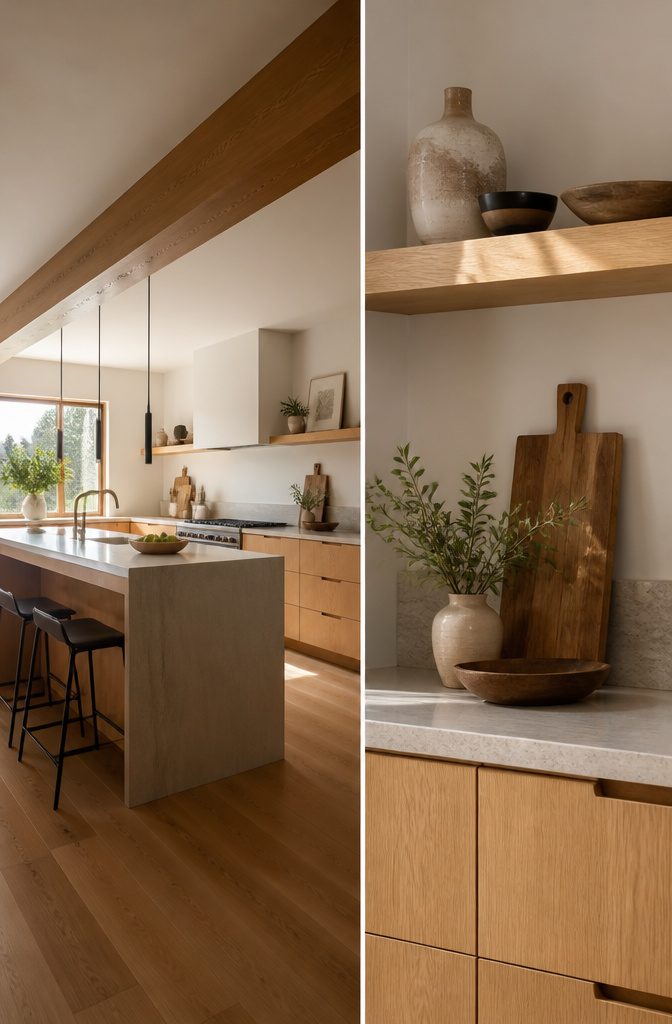
Wood gives a sleek kitchen design modern luxury an upgraded feel that metal and stone alone rarely match.
I would reach for light or medium-toned oak or walnut rather than anything heavily red or yellow; those cooler, quieter grains sit cleanly against neutral cabinets and stone surfaces without fighting for attention.
The warmth is there, but it is restrained.
Use wood where the eye lands naturally: the island face, open shelving, a ceiling beam running the length of the space. I would skip the floor-to-ceiling wood box; it reads rustic fast.
A single accent panel or a floating shelf is enough to soften the coldness of a modern layout without compromising the lines that make it sleek. Texture arrives, but not clutter.
The ceiling beam is the move I would make if the budget allows one splurge. It draws the gaze up, gives the room vertical structure, and ties an open kitchen to whatever sits beyond it.
If the beam is too much for the space, a wood island base does similar work at a lower cost and lower commitment.
Either way, the effect is the same: the kitchen feels designed rather than decorated, and the warmth reads as intentional, not accidental.

Waterproof and Fireproof: this stove backsplash splash guard is made of liquid silicone coated waterproof and fireproof material, which can effectively prevent oil stains, water droplets and splashes generated during cooking from damaging the kitchen walls, providing all-round protection to ensure your kitchen environment is clean and tidy

𝐓𝐫𝐢𝐩𝐥𝐞 𝐏𝐫𝐨𝐭𝐞𝐜𝐭𝐢𝐨𝐧: Your backsplash arrives in a protective film and corner protector, cushioned between pearl cotton, and packed in a hard cardboard box to ensure it is dent-and-scratch-free

Fashionable Appearance: Sized to fit standard household stoves, this stainless steel backsplash covers the full splash area. It helps keep your kitchen walls guarded from cooking splashes, leaving them looking refreshed, clean, and tidy
6. Glossy White Surfaces
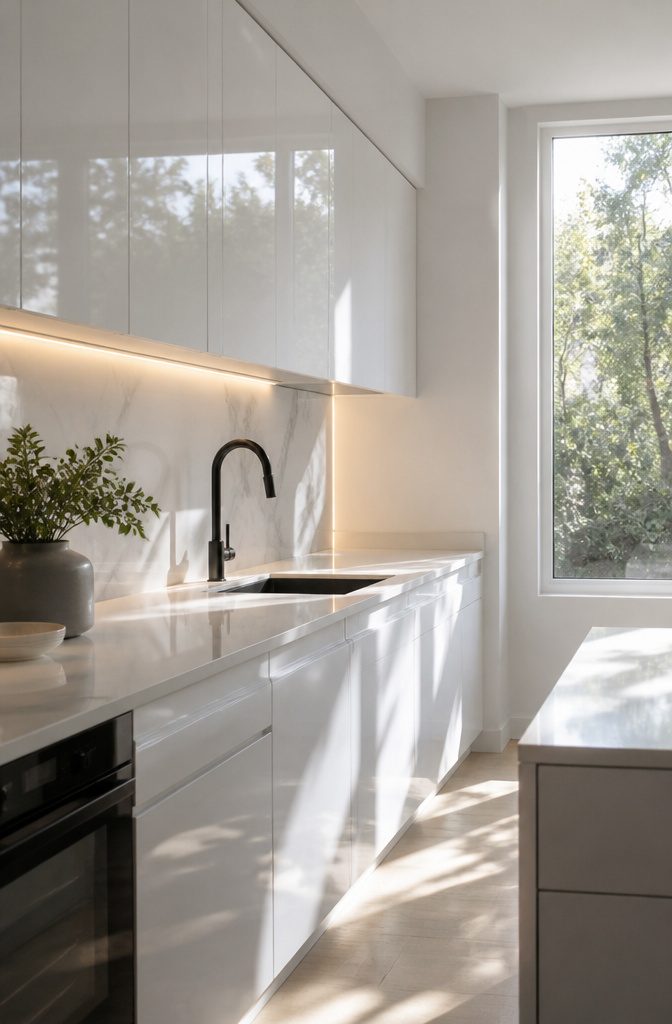
Glossy white surfaces do one thing better than any other finish: they move light around a room. In a compact kitchen, that reflection reads as extra square footage you did not pay for.
The effect is not subtle. Cabinets with a high-gloss lacquer or thermofoil face bounce daylight from window to wall, and under-cabinet lighting doubles back against the ceiling instead of dying at the counter edge.
I would skip semi-gloss paint on cabinet boxes; it reads flat by comparison and shows every brush stroke once the afternoon sun hits it.
The maintenance trade-off is real. Every fingerprint, water spot, and grease particle sits on that mirror-like surface like a headline.
I would plan on wiping down high-touch doors daily, not weekly, and I would keep a microfiber cloth on the sink rail rather than pretend I will hunt one down.
For renters, peel-and-stick glossy vinyl overlays exist, but the edges lift in steam. If I owned the place, I would invest once in a 2-pack polyurethane lacquer on MDF and call it done for years.
Pairing matters. Glossy white against glossy white feels sterile fast.
I would ground it with matte black hardware, a brushed brass pendant, or a single charcoal accent wall. The contrast keeps the look expensive instead of clinical.

Premium Peel And Stick Tiles - The Art3d peel and stick tiles are made of sustainable material, resistant to heat and moisture, easy wipe to remove the stains. Suitable for smooth and clean surfaces. Stick to wall without extra glue.

Material:Made of PVC composite laminate, anti-scratch, high impact, color fadeless, more durable and stronger than other plastic self-adhesive tiles. Textured surface finishing with realistic ceramic look, high waterproof and stain-resistant performance, protect the walls from splash and oil.

MODERN TERRAZZO STYLE: Made from a fine-gravel terrazzo and marble blend with a matte sandstone finish, this sleek vanity top adds timeless texture and depth to any bathroom. Its durable construction and minimalist design suit a wide range of interiors.
7. Statement Lighting Fixtures

Lighting makes or breaks a kitchen, and I would put more budget into fixtures than almost anywhere else in the room.
Pendant lights above the island are where the eye lands first: glass pendants, gold fixtures, sculptural designs, and linear arrangements all work, though I lean toward grouped or oversized pendants for actual task lighting rather than decoration alone.
The placement matters as much as the style.
Too high and you lose intimacy; too low and you block sightlines across the island. I hang them 30–36 inches above the countertop, which keeps the light functional without crowding the conversation.
Layering is non-negotiable. Recessed lights give you the clean, even base layer, but under-cabinet LED strips do the real work at the prep surface.
Slim profiles now hide the fixture entirely while throwing even light where you need it. Spend here first, then add the statement piece that reads as jewelry: a sculptural fixture or Art Deco piece with geometric lines and polished metal.
Smart systems that shift color temperature through the day are worth considering if the budget stretches, though I would skip them before I would skip quality pendants.
8. Bold Color Accents

Deep navy cabinets, emerald green islands, and saturated backsplashes each add personality to an otherwise restrained kitchen. The difference between a kitchen that reads as designed and one that reads as accidental is where the color stops.
I would limit bold color to one major element: the island, the lower cabinets, or a single backsplash wall. Pair that choice with gold or brass hardware and the richness lands without chaos.
Two approaches work. The first spreads color across a large surface, like deep blues on perimeter cabinetry, balanced by light countertops and neutral walls.
The second hides it almost entirely: inky cabinet exteriors with a surprise of custom color inside, visible only when you reach for a plate. The first makes a statement to every guest; the second rewards the person who actually cooks.
For a weekend project on a real budget, I would skip the full kitchen repaint and paint the island emerald or paper the backsplash wall in a saturated tile. The perimeter stays white or charcoal.
This keeps the sleek frame intact while the single bold element does the emotional work. Restraint is what makes it feel luxurious rather than loud.
【 Easy Opening without Bending Over 】: Featuring a sensitive push-to-open drawer slide, it opens and closes smoothly and quietly with a gentle kick—no bending or hands required. Perfect for changing shoes, cooking, or whenever your hands are full, it delivers a truly hands-free experience

【WHAT YOU WILL GET】You will receive 12 pieces of adjustable plinth clips in classic black and the quantity is sufficient enough to meet your daily needs and those of your family. The size of each one measures about 4x3.5cm.

Sliding basket for easy access in limited space
9. Integrated Smart Technology

Smart technology works best in a sleek kitchen when it disappears.
I would put money into a touchless faucet first; the hands-free operation is genuinely useful when your own hands are covered in dough or raw chicken, and it reads as premium without shouting for attention.
Voice-controlled lighting falls into the same category: set it once, and the kitchen adjusts to morning coffee or evening cleanup without anyone needing to touch a switch.
The integrations I would skip are the ones that solve problems I do not have.
A smart refrigerator that tracks grocery inventory sounds impressive until you realize you still have to load the data, and most households manage fine with a simple list.
Remote oven monitoring is more practical, though I would only trust it for preheating while I am finishing another room, not for unsupervised cooking.
JennAir’s Gourmet AI, which adjusts oven settings by dish, actually changes the experience for home cooks who want consistency without memorizing temperatures.
Motion sensor lighting under cabinets serves a real purpose: it turns on when you need it and stays invisible when you do not.
Wireless charging stations built into counters strike me as clutter disguised as convenience; a drawer with a cord hole achieves the same end for less money and no failed compatibility down the line.

𝐏𝐞𝐞𝐥 𝐚𝐧𝐝 𝐬𝐭𝐢𝐜𝐤 𝐛𝐚𝐜𝐤𝐬𝐩𝐥𝐚𝐬𝐡, 𝐤𝐢𝐭𝐜𝐡𝐞𝐧 𝐛𝐚𝐜𝐤𝐬𝐩𝐥𝐚𝐬𝐡 𝐭𝐢𝐥𝐞𝐬 𝐩𝐞𝐞𝐥 𝐚𝐧𝐝 𝐬𝐭𝐢𝐜𝐤
4 Tile Sheets Per Pack

100 sheets solid PVC tiles, 2.95"x5.9"x0.12" each, cover 12.11 square feet. This simple subway pattern is easier to install and plans the layout freely to your imagination.
10. Custom Cabinetry

Custom cabinetry is the element most often cited across luxury kitchen sources, and the gap between stock and bespoke matters less than where exactly the money goes.
At the entry level, custom means a local shop builds boxes to your room’s exact dimensions, usually in plywood with a veneer finish, and you pick from a set door style.
That alone eliminates the filler strips and awkward gaps that make stock cabinets look like an afterthought. The real leap comes with integrated appliance panels and hidden storage, which require precise millwork only custom shops reliably deliver.
Mid-range custom adds soft-close drawers, smooth interior finishes, and detailed millwork you touch daily.
These are the tactile moments that separate a polished kitchen from a photographed one. I would put money here before anything else.
A stock cabinet with quality Blum or Grass hardware gets you 80 percent of the daily experience at half the cost, but it will not hide a refrigerator or build a flush pantry wall.
Where I would skip is paying custom prices for standard sizes in a straightforward layout.
If your walls are plumb and your ceilings level, a good cabinetmaker can dress stock boxes with custom doors and end panels, then spend the savings on the hardware and interior fittings that actually get used.

Suitable Size and Versatility: our stainless steel backsplash not only promises a robust structure with its ideal dimensions of about 29.72 x 4.72 x 0.25 inches/ 75.5 x 12 x 0.64 cm but also ensures easy installation across various surfaces; It caters to customer needs for a hassle free setup, allowing for quick enhancements without the complexity

Kitchen Stove Backsplash: This high quality stainless steel backsplash adds brilliance to your kitchen with stove back splash protection for easy cleaning and daily maintenance.

PVD Copper Finish on 304 Stainless Steel:Made of premium 304Stainless steel(1.0mm thickness),finished with Physical Vapor Deposition (PVD) technology in a vacuum chamber. Real copper ions are bonded to the stainless steel at a molecular level, creating a hard, durable metallic surface that resists scratches, corrosion, and daily wear. It won’t peel, chip, or tarnish like painted finishes.
11. Statement Range Hoods

A range hood can anchor the whole kitchen composition if you treat it as sculpture rather than an afterthought. The three directions worth considering are stainless steel, plaster, and integrated designs that disappear into cabinetry.
Stainless reads as the safe default for a sleek kitchen design modern luxury look, and it works when the rest of the space already carries metal finishes you want to echo.
I would skip it in a warmer, texture-driven kitchen where it starts to look like an appliance warehouse.
Plaster is where I would put my own money, specifically a hand-finished treatment like Venetian plaster that softens the geometry and catches light unevenly. A decorative painter can coat a custom form so the hood becomes the room’s quiet artwork.
The custom range hood becomes a sculptural focal point thanks to decorative painter Jeanne Shemilt, who coated it in Venetian plaster—a centuries-old technique that adds depth and softness to the space.
What this means practically: the technique is old, but the result reads as intentional luxury rather than trend, and it pairs with either modern or transitional cabinets.
Integrated hoods that blend into surrounding cabinetry keep the sight lines clean for smaller kitchens or open plans where a protruding form would break the flow.
Without a statement hood you lose that focal anchor; what you gain is visual quiet.
For a galley or single-wall layout, integrated usually wins. For an island cooktop with nothing but ceiling above it, a plaster or shaped stainless hood becomes almost mandatory to give the eye somewhere to land.
12. Floor-to-Ceiling Cabinetry

Floor-to-ceiling cabinetry draws the eye upward and gives the illusion of a larger space, which is why it reads as luxury in a kitchen.
I would run cabinets the full height on at least one wall, but break the run with a single open shelf or a section of countertop to keep the wall from feeling like a corridor.
The continuity creates one smooth visual line and eliminates the awkward gap where standard cabinets stop short.
For the sleekest finish, handle-less cabinets or slim handles keep the plane uninterrupted. High-gloss finishes bounce light and add to the airy feel, though rich wood tones work if you want warmth without sacrificing the clean vertical line.
The full height adds usable square footage that stock cabinets waste. Custom sizing helps here, since stock units rarely fit a ceiling exactly and filler strips break the effect you are paying for.
13. Artistic Backsplash

Patterned tiles, metallic finishes, and designer laminates turn the backsplash into something worth looking at rather than merely wiping down.
I would skip the small mosaic sheets unless the kitchen has enough neutral surrounding them; the kaleidoscopic effect works best when cabinetry and countertops stay quiet.
For a sleek kitchen design modern luxury that still feels livable, bold tile behind the range paired with restraint everywhere else gives you the gallery moment without the visual noise.
The simpler glass-sheet backsplash wins in tighter spaces or when the counters already carry veining or color; it protects the wall and reflects light without competing.
I would choose the artistic route when the kitchen layout offers a single natural focal point, typically the wall behind the cooktop, and keep the remaining backsplash areas subdued.
14. Large Kitchen Islands

An oversized island reads differently from one built around stools.
The scale itself is the statement: a single mass that fills the center of the room and gives you 42 to 48 inches of clearance on every side for movement and for multiple people to work without bumping hips.
Anything tighter and you lose the flow that makes a large kitchen feel luxurious rather than crowded.
A honed or leathered marble surface, maybe with a waterfall edge where the slab continues down the sides, gives you the visual weight without the high-gloss formality that reads cold in a home kitchen.
Keep the island body quiet, maybe a fluted wood base if the budget allows solid wood, and let the stone do the talking.
Where I split from the island-with-seating trend is simple: seating turns the workspace into a dining table that happens to have a sink.
A true work island keeps the top clear for prep, for spreading out projects, for the kind of unhurried cooking that benefits from acres of counter.
If you need a place to eat, add a table elsewhere. The island is for doing, and the luxury is in that uninterrupted surface.
15. Natural Stone Surfaces

Natural stone continues to reign supreme in luxury kitchens, with marble and quartzite leading the trend.
These materials offer unique veining patterns that create one-of-a-kind surfaces, and at this level, the slab you select matters as much as the species you choose.
I would spend my Saturday in the stone yard with a flashlight, not online, because the difference between a good slab and a great one is movement you cannot see in a photograph.
Marble carries the prestige and the risk.
It etches. It stains.
Sealing helps but does not erase the maintenance, and I think too many people discover this after the fact. Quartzite offers similar drama with better hardness, though the premium slabs can cost more than marble and still need protection.
For daily living, quartz is the smarter choice if your priority is use over performance. Stain resistance and low maintenance matter more than most admit when they are standing in a showroom seduced by Calacatta.
I would put marble in a kitchen I photographed for resale and quartz in the one where I actually cooked breakfast.
16. Hidden Storage Solutions

The sleek kitchen design modern luxury look depends on what you never see. Appliance garages sit at counter level behind lift-up or sliding doors, swallowing the toaster, stand mixer, and coffee maker that otherwise colonize every flat surface.
I would hide those three without hesitation; they are tools you use daily but do not need to look at. The espresso machine stays out if it cost real money and has clean lines, because some appliances read as intentional.
Toe-kick drawers turn the dead zone under base cabinets into shallow storage for baking sheets, linens, or pet bowls. They add perhaps six inches of height and pull out with a toe tap, no hardware visible.
In a rental you probably cannot install them, but a first-home owner finishing a kitchen should spec them into the cabinet order; the cost is modest against the gain.
Pocket doors, whether they slide into adjacent cabinets or retract upward, handle the larger items: the microwave, the dish rack, a compact pantry.
They keep the wall plane unbroken, which is what reads as luxury. The push-to-open mechanism some cabinets use serves the same purpose, eliminating pulls that catch light and attention.
What deserves to stay visible? A single good knife block, a wooden cutting board with grain worth looking at, maybe one ceramic canister.
Everything else fights the calm these kitchens are built to deliver. Hide the work, show the material.
17. Indoor-Outdoor Connection

A kitchen that opens directly to a patio or garden reads as luxury because it expands the usable square footage without expanding the foundation.
The move that makes it work is folding or sliding glass walls that stack away completely, not French doors that still frame a barrier.
In Arizona and Southern California, where indoor-outdoor living is expected, large sliding panels or pass-through windows let the kitchen become part of the entertaining flow rather than a service zone behind it.
The material choice seals the illusion.
Matching the kitchen flooring to the patio tile, or running the same cast-concrete counters from the prep area straight through to an outdoor serving ledge, keeps the eye moving instead of stopping at the threshold.
Custom wood screens that filter daylight can reinforce the same indoor-outdoor rhythm without requiring the wall to disappear entirely.
Climate is where this idea lives or dies.
In the desert Southwest, the overlap works most of the year. In the upper Midwest or Northeast, the same opening becomes a heat hole for six months, and the folding hardware needs to seal well enough to matter.
I would spend the money on the wall system only where the outdoor season runs long enough to justify it; everywhere else, a generous fixed window with a matching material palette outside gets you most of the visual effect without the thermal penalty.
18. Unique Flooring Options

Large-format tile lays the flattest visual plane for a sleek kitchen, and that uninterrupted surface is what reads as luxury first.
Porcelain in a 24-by-48 format with rectified edges shrinks grout lines to almost nothing, though the material is unforgiving underfoot; I would not choose it for a household that stands for long prep sessions without a cushioned mat.
Poured concrete ranks highest for durability, accepting decades of traffic and the occasional dropped cast-iron pan without complaint, but it demands professional installation and a month-long cure that most weekend timelines cannot accommodate.
Wide-plank engineered wood brings warmth that concrete and tile withhold, and the engineered construction handles kitchen humidity better than solid hardwood, yet it dents and it will show water damage if a leak sits unnoticed.
For resale, I would put engineered wood first in markets where buyers expect residential softness underfoot, concrete first in urban settings where industrial references sell, and tile first everywhere else for its imperviousness to almost every kitchen disaster.
My own pick for a real kitchen used daily is the engineered wood with a matte oil finish; it loses the pristine look fastest but gains character in return, and that trade is worth more to me than the maintenance-free alternatives.
19. High-End Appliances

Appliances in a sleek kitchen design modern luxury space have to earn their panel space.
Sub-Zero, Wolf, and Cove still set the standard for integration: Sub-Zero’s dual-evaporator systems keep separate humidity levels in the refrigerator and freezer sections, which actually extends freshness past what conventional units manage.
That is the feature I would pay for if I cook with produce more than twice a week.
Wolf’s professional-grade ranges run multiple high-BTU burners with precise temperature control, and the specialized cooking functions matter if you use them. For most weeknight cooking, a mid-range range has caught up on burner output.
The gap left is in the feel of the controls and the longevity of the ignition system, which is harder to advertise and easier to notice at year five.
Cove dishwashers hit noise levels low enough to forget they are running, with customizable racks that fit actual mixed loads.
Miele performs in the same tier; the choice between them comes down to which handle profile sits cleaner against your cabinet face.
Wine refrigeration with separate temperature and humidity zones is where the luxury tier still outpaces mid-range options, but only if you keep bottles worth the climate control.
Otherwise that budget buys a better sink faucet you will touch a hundred times a week.
20. Personal Touches in Decor

The hardest part of a sleek kitchen is knowing when to stop adding.
I have seen too many otherwise clean spaces collapse under the weight of "personality": ceramic roosters, vine lettering above the door, every countertop appliance left in the open because it cost money and someone feels guilty hiding it.
In a modern luxury frame, only the object that earns its visual weight stays.
A single stone or textured feature wall behind the cooking area does the work of ten accessories.
It creates drama without needing extra decor, and the surrounding surfaces stay simple to balance it. That is the trade I would make every time: one strong gesture instead of scattered small ones.
For smaller moments, I would pick a unique bar stool set or one standout faucet finish over art that fights the backsplash.
Patterned tiles or a metallic backsplash already function as a personal statement; hanging something in front of them just competes. The same rule applies to appliance panels.
Custom cabinetry built to exact dimensions lets the kitchen feel polished precisely because nothing individual is shouting. I would rather invest in hidden storage that keeps the counters bare than display a collection.
What I would edit out: anything that reads as cute, anything duplicated, anything that lives on the counter because no one decided where else it goes. One bold design element, chosen deliberately, outlasts a dozen half-measures.
Frequently Asked Questions
What are the latest trends in luxury modern kitchen designs?
Minimalist layouts with hidden storage, mixed materials like stone and wood veneer, integrated smart technology, and layered lighting define current sleek kitchen design modern luxury.
Open shelving with strict editing and soft neutral tones dominate the palette, while bold accents appear as single controlled elements rather than scattered color.
What lighting options work best for luxury kitchens?
Layer three types: recessed ceiling lights for even base coverage, under-cabinet LED strips for actual prep work, and grouped or oversized pendants above the island hung 30–36 inches from the countertop.
Spend on the functional layers first, then add a sculptural or Art Deco statement piece as jewelry.
Which color schemes are trending in high-end kitchen interiors?
Neutral foundations in cream, beige, soft taupe, or crisp white pair with one bold accent: deep navy cabinets, emerald green islands, or forest green focal points.
Gold or brass hardware adds richness without chaos; the rule is to let color stop at one major element.
What are some ways to maximize storage in a modern kitchen?
Run floor-to-ceiling cabinetry on at least one wall, adding toe-kick drawers beneath base cabinets for baking sheets and linens.
Appliance garages at counter level hide daily-use items behind lift-up doors, while pocket doors or upward-retracting panels conceal microwaves and dish racks to keep wall planes uninterrupted.