

The right spice rack organizer idea depends on whether you own the walls or rent them.
A Lazy Susan or tiered shelf works for homeowners willing to retrofit, but renters often do better with magnetic jars on a fridge side, a drawer insert, or a door-mounted rack that leaves no holes to patch.
One detail that trips up even careful buyers: not all stainless steel refrigerators actually hold a magnet, so test yours before ordering a magnetic system.
1. Lazy Susan
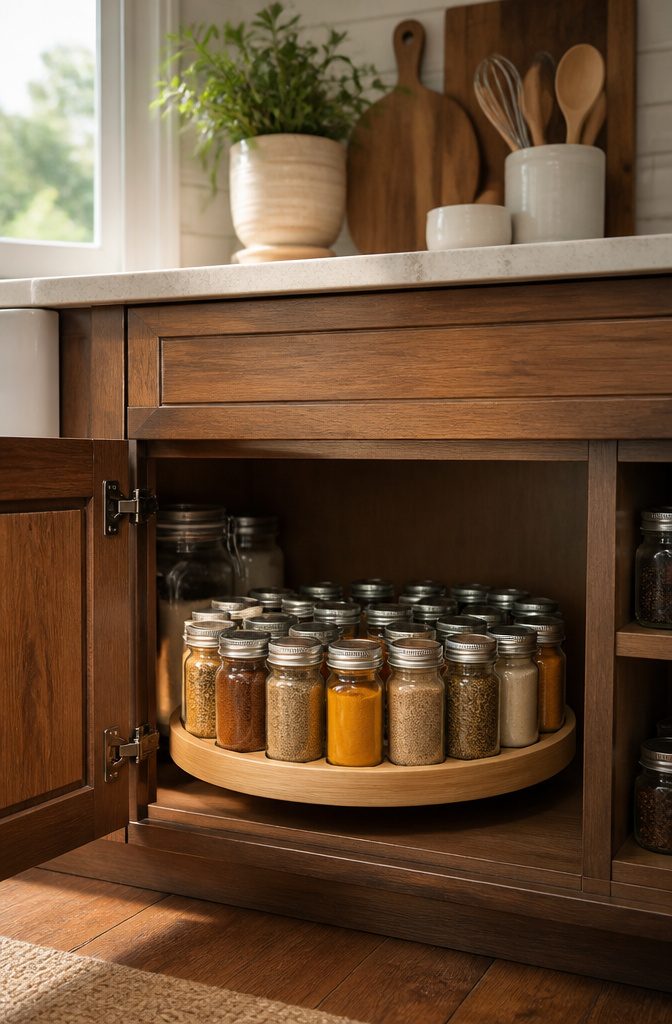
A Lazy Susan turns the back row of a deep cabinet into the front row with a quarter turn, which is why I keep one in the corner cabinet where my baking spices live.
Wood wins over plastic for the base; the weight keeps it from shifting when you spin it, and the short rim on a bamboo model contains spills and stops small bottles from tipping.
Diameters range widely, so measure your shelf depth before buying, and expect to spend under $25 for a single-tier unit. Double-deckers exist if you want to stack, though in a tall cabinet a Lazy Susan leaves vertical space unused.
It works best on countertops or inside deep shelves and corner cabinets where reaching the back otherwise means unpacking half the contents.
I would skip it for a shallow upper cabinet; there, the rotation adds bulk without solving a real access problem.

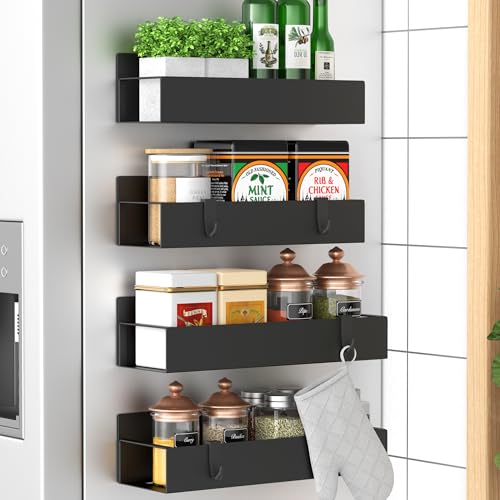
[HEAVY-DUTY MAGNETS] Strong magnetic grip holds securely on any metal surface – no drilling, no assembly. Just unpack and stick to your fridge, microwave, or tool cabinet.
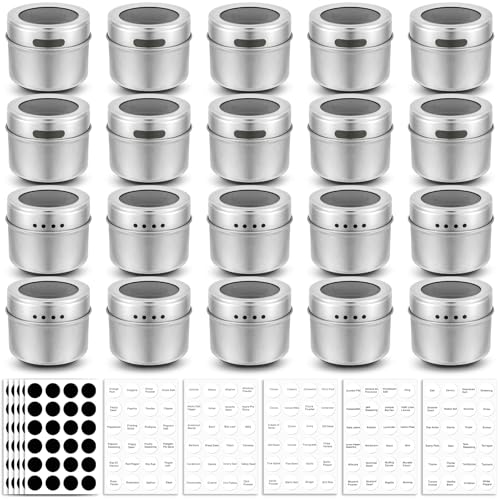
Each 3-ounce magnetic spice tin measures 2.4 inches in diameter and 2 inches in height. With convenient see-through lid with magnetic backing
2. Wall-Mounted Spice Rack

A wall-mounted rack turns the gap between cabinets or the side of a fridge into storage that does not cost you a drawer or a shelf.
I would mount it at eye level near the stove, where you can grab a jar without stepping away from a simmering pan.
Magnetic strips and screw-mounted rails both work here; the magnetic route saves you drilling tile, but the jars need steel lids or a metal band to stick, and a full jar of bay leaves weighs more than one of paprika.
Inside a cabinet door, the same hardware hides the spices completely.
Standard cabinet doors are 3/4 inch thick, which is enough for small screws if you pre-drill. The risk is the swing: a jar on a door rack can clip the edge of a fixed shelf when the door closes.
I leave a 2-inch gap between the rack face and the shelf line, or I skip the top tier on that door.
Magnetic jars inside a door need a steel plate or strip screwed to the wood; the door itself is not magnetic.

Maximize Your Space: Our 9-Tier over the door pantry organizer is designed to make the most of your storage space, allowing you to store more items in a smaller area such as spice and some jars. Perfect for small kitchens or those with limited storage space.

Measure Before Purchase: Overall Dimensions: 18"W x 50"H x 5"D. Ensure enough depth for the pantry: >5.2 inches, and door gap >0.06 inches. Please measure pantry depth and factor in obstructions (dividers, compartments, etc.) Our over the door spice rack features door hooks sized 1.6“ (Recommended door thicknesses<1.6”)

Durable 4 pack Spice Rack: Built with sturdy powder-coated metal, this wall mount rack won’t bend or warp under long-term heavy loads. It stays rigid in humid kitchens and with everyday use, free from sagging or deformation. Ideal for home and commercial spaces alike.
3. Pull-Out Spice Rack

A pull-out spice rack organizer turns the narrow gap beside your stove or sink into usable storage, often fitting openings as slim as 3 to 6 inches.
I would measure the cabinet opening before ordering anything, since even a quarter inch off means the slide mechanism binds or the face frame gaps.
Retrofit kits mount to your existing cabinet floor and ceiling, which suits renters or anyone avoiding a full remodel.
New-build installations let you choose full-extension slides over partial ones. Full-extension brings every jar into view and reach; partial slides save a few dollars but leave the back row half-hidden, and I would skip them for that reason.
Most of these units hold 8 to 12 standard jars. Install yours beside the stovetop or prep area if the layout allows; the fewer steps between spice and pan, the more you will actually use what you own.

【Perfect for Narrow Cabinets】This 3 tier narrow wood pull out spice rack can be installed kitchen cabinets, fits 5½ inches wide cabinets. Dimensions: 5"W x 20½"D x 21½"H. For a proper fit, your cabinet should have a minimum internal width (from the hinge to side) of at least 5½ inches, an internal depth of no less than 21 inches, and an internal height of at least 22 inches.

4 Tier Slim Pull out Wire Basket: The slide out design of OCG 4 tier pull out slim storage baskets can easily reach for items in narrow spaces.

MORE SPICES IN LESS SPACE - Easy slide out spice rack organizer that holds a large number of spices in the small area. No more tip-overs of front items. This sliding spice rack gives your easy access to all seasonings stored in your cabinet. This is also a great cabinet organizer.
4. Magnetic Spice Jars

Magnetic jars keep spices visible and off the counter, which matters most in a kitchen where every inch counts.
The system comes in two forms: jars with magnetic lids that grip a steel plate you mount, or steel-lidded jars that stick to a magnetic strip.
Both work, but I prefer the steel plate approach. It gives you a flat surface to arrange against, and you are not locked into whatever width the strip manufacturer chose.
Not all stainless steel refrigerators actually hold a magnet. Some grades are non-magnetic, so test your fridge side before you buy.
A thin steel sheet mounted to the wall or cabinet end solves this cleanly, and it lets you place the rack where you cook, not where the appliance happens to stand.
Standard jars run 4 oz or 6 oz. The smaller size suits most home spice volumes and keeps the row from creeping too far across the wall.
Label the lid, not the side; you read from above when the jar is stuck flat, and a top-down label saves you from pulling each jar to check.
Hexagonal jars nest closer than rounds, though any shape works if you leave a finger-width gap for grabbing.

Cool D-Shape Design Save Space: As the character 'D' shows, the front side of the D-shape lazy susan fit flush against the door. compared with other round lazy susan, our D-shape spice racks will maximize the storage space for your wall-mounted cabinet, fridge, or pantry.

Adjustable Height Lazy Susan: This 2 tier lazy susan organizer with adjustable height which can perfect fit with different height seasoning bottles,spices,snacks,bathroom essentials etc. 2 tier design providing more storage capacity , Making the most use of the limited space in your home to keep things neat and organized.
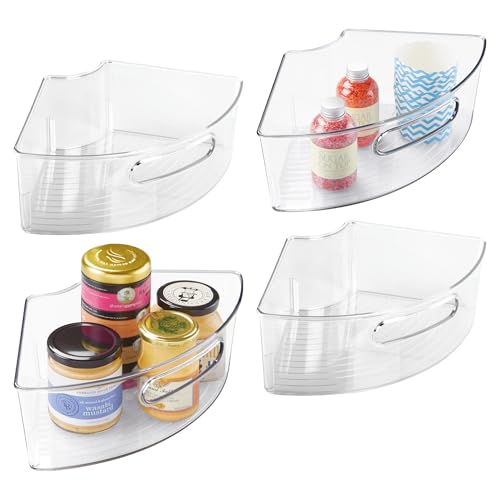
STORAGE FOR CORNER CABINETS - Eliminate storage pain points with the iDesign 4-Piece Lazy Susan Wedge Bin Set; This 4-piece set makes a complete circle, creating accessibility and visibility in corner cabinets where things can be hard to reach; Set of 4
5. Tiered Spice Organizer

A tiered spice organizer turns a deep cabinet into something you can actually read at a glance.
The back row sits on a step raised 2.5 to 3 inches above the one in front, so labels stay visible even on a 3-tier unit.
I would pick the stepped kind if my cabinet width is fixed and unlikely to change, since the fixed shelves feel sturdier when I pull a jar from the back row.
Expandable tiers make more sense for anyone renting or planning to move the organizer between kitchens, though the sliding mechanism adds a little wobble.
Acrylic tiers let light pass through, which matters in a dim lower cabinet, but the surface scratches faster than I would like from sliding metal lids across it.
Coated wire lasts longer and holds heavier glass jars without complaint; the mesh blocks sightlines from above, so you are reading labels from the front rather than looking straight down.
For my own cabinet, I would take the wire and add a small battery light to the underside of the shelf above it.

Stable Guardrail & Wider Adhesive Stickers - Our spice rack organizer for cabinet door added side guards and improved two-in-one wider adhesive stickers for increased safety and stability. The adhesive spice racks have guard rails prevent spice from falling, while the wider and stronger stickers provide extra protection and peace of mind in your busy kitchen

Adjustable Distance:15.7"L x 3.5"D x 2.7"H. You can control the distance between the spice rack as needed, allow for more items with different sizes to stored or organized. Meet the different storage need. Keep spice bottle, jars, condiments and spices within easy sight and reach when cooking or baking

Stable Guardrails & Wide Adhesive Strips: Raised edges keep jars secure, while strong adhesive strips ensure worry-free installation on smooth surfaces
6. Countertop Spice Rack
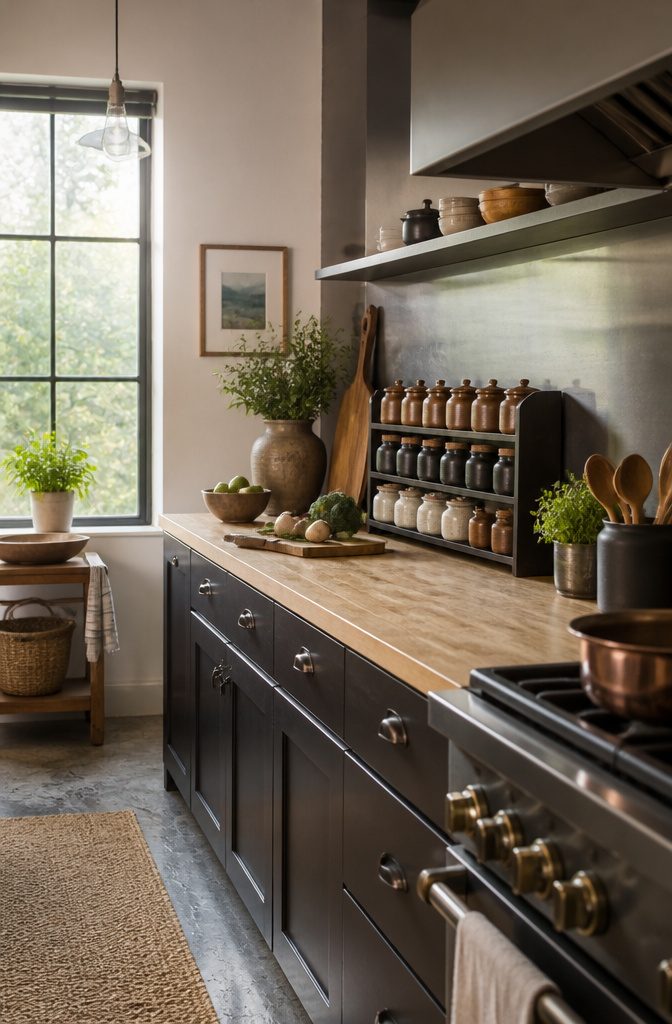
A countertop spice rack puts every jar in arm’s reach while you cook, which is why it tends to win for anyone who seasons by instinct rather than by recipe.
I would reach for one only if the counter space is truly spare; a footprint that holds more than 12 to 16 jars starts to crowd the prep zone and earns its keep as decor rather than storage.
Wood stands warm a kitchen but pick up oil and turmeric stains that need wiping down; steel wipes clean in a pass but shows water spots; ceramic looks finished from day one and carries more weight than you’d expect for its size.
The real limit is light. Direct sunlight fades paprika and dried herbs faster than a dark cabinet will, so I would skip the counter rack entirely if the only spot sits under a window that gets morning sun.
For large kitchens with shadowed corners near the stove, the extra reach is worth it.
Small kitchens already sacrificing every inch of counter? A wall-mounted or pull-out option keeps the same jars accessible without giving up the space where you chop.
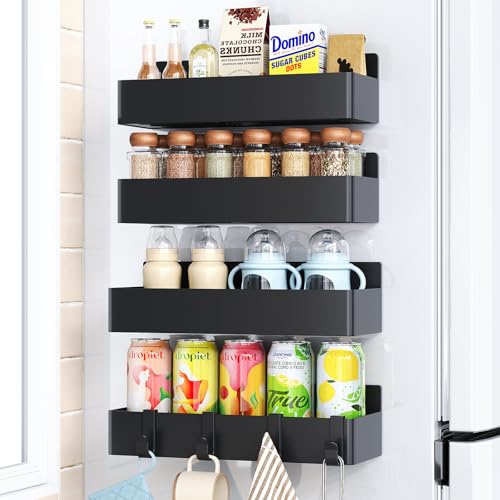
Magnetic Design: Innovative magnetic spice rack attaches securely to refrigerator doors, keeping spices organized and within easy reach.

Perfect Space Saving Solution: Aufworld magnetic basket is a great way to store spices, which hold free up countertop & cabinet space and keep them clear of clutter. Our Magnetic Spice Rack for Refrigerator comes with 6 separate shelves and 12 extra moveable hooks. Practical moveable hooks can be hung with various laundry supplies and kitchen utensils.

Perfect Space Saving Solution: Aufworld magnetic basket is a great way to store spices, which hold free up countertop & cabinet space and keep them clear of clutter. Our Magnetic Spice Rack for Refrigerator comes with 4 separate shelves and 8 extra moveable hooks. Practical moveable hooks can be hung with various laundry supplies and kitchen utensils.
7. Spice Drawer Organizer

A spice drawer organizer turns an ordinary deep drawer into a hidden pantry that holds 60 or more jars when fully expanded.
The drawer itself sets the limit: you need at least 2.5 inches of depth to clear standard jars lying flat, and many kitchen drawers fall short.
You will choose between two layouts.
Angled inserts tilt the jars so labels face up, readable in one glance from above. Flat inserts with raised labels keep everything level but force you to read across the tops.
I would take the angled setup every time; the flat arrangement looks tidy until you are hunting for marjoram at 6 p.m. with a pan already smoking.
This option wins in kitchens where drawer space exists but cabinet depth does not. A drawer to the right of the stove puts spices at arm’s reach and off the counter entirely.
The Expand-A-Drawer from The Container Store runs under $20, fits snugly without tools, and protects the drawer bottom from the turmeric dust that inevitably escapes.
If your drawer is wider than the insert, drop plastic drawer liners in the gap for foil and wrap storage.
I would skip this if every drawer is already claimed. It is low commitment, but it is still commitment: a drawer you cannot spare is a drawer you cannot spare.

【Large Capacity】Compared with most products on the market, our spice rack has a larger capacity and two different sizes to meet your different needs. There are a total of 6 separate shelves, which can not only place 90 4OZ seasoning jars, 81 6OZ seasoning jars, or 72 8OZ seasoning jars, but also big bottles and cans. All items are arranged neatly and clearly, make your kitchen look neater

Large 8-Tier Storage Capacity: Maximize your vertical storage space with this 8 tier over the door pantry organizer. Designed to help you efficiently store spices, cans, snacks, and daily essentials, keeping your kitchen, pantry, or cabinet neatly organized and easy to access.

ADJUSTABLE SHELF HEIGHTS FOR VERSATILE STORAGE: Our over the door organizer boasts 8 baskets with an adjustable height of 1.8 inches, ideal for accommodating variously sized spice jars, snacks, and other items. Additionally, it features 4 sturdy support bars designed to hold taller items securely and prevent them from tipping over.
8. DIY Spice Rack

Three builds have held up long enough that I trust them. A reclaimed wood plank with mason jar clips gives the most control over spacing, and the clips cost less than a finished rack of the same width.
The IKEA BEKVÄM spice rack hack works if you paint it to match your cabinets; the raw birch reads as temporary, but a coat of cabinet paint makes it look intentional.
The simplest route is an L-bracket shelf with uniform jars, and this is where I would put my money. The real savings come from skipping the branded jar, not the rack itself.
A basic square jar with a plain lid runs a fraction of what matching sets sell for, and once they are lined up the visual effect is the same.
For any wall-mounted build, a drill, level, and stud finder are the minimum tools. I would not trust adhesive strips with glass and a full jar of cumin; find the stud or use a proper wall anchor.

ONE-OF-A-KIND CABINET SPICE ORGANIZER WITH OUR EXCLUSIVE PATENTED PROGLIDE PLUS 2 SLIDE ADJUSTS TO FIT THE VARIOUS DEPTHS OF UPPER CABINETS giving you easy access, vertical storage, and organization for all your bottles and spice jars
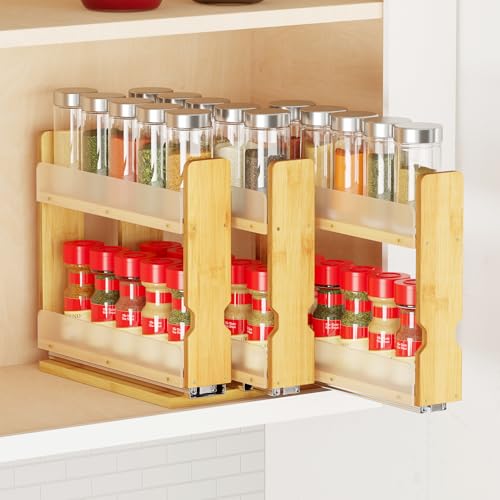
MEASURE CABINET SIZE - Please measure the interior dimensions of your kitchen cabinet first; It is recommended for cabinets that are 12" tall and 10.60" deep; This is the version of 3 Drawers(2" Wide), 2-Tier; Overall Product Size: 7.6"W x 10.6"D x 9.6"H

MEASURE BEFORE ORDERING – This spice rack organizer for cabinet use requires at least 12"H x 11"D x 5"W of clear interior space and is not suitable where a cabinet face frame blocks the slide-out path. Each unit measures 4.5"W x 10.5"D x 8"H, so check the opening, hinges and cabinet lip before purchase.
9. Multi-Spice Box
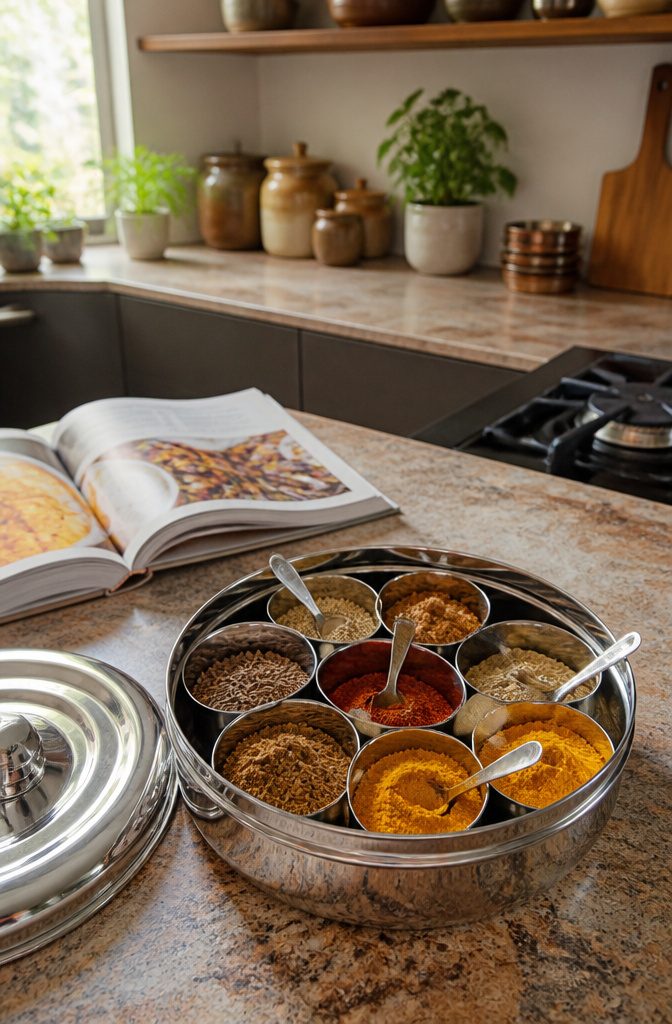
A masala dabba holds seven to nine daily-use spices in one round stainless steel box with a tight lid, each compartment with its own tiny spoon. That spoon matters more than you might think.
Hinged-lid versions trade the spoon for a flip-top you open with a thumb, which keeps dust out better but slows you down when you are cooking fast and need three spices in thirty seconds.
I would take the spoon style for everyday Indian cooking and the hinged box only if the rack sits open on a counter near a window.
Stainless steel costs a little more than aluminum but resists turmeric staining in a way aluminum simply does not. After a year of reaching for turmeric and Kashmiri chili daily, an aluminum box looks tired; stainless still reads clean.
Neither option belongs in a drawer, they are meant for the counter where the cooking happens, so budget the space before you budget the purchase.
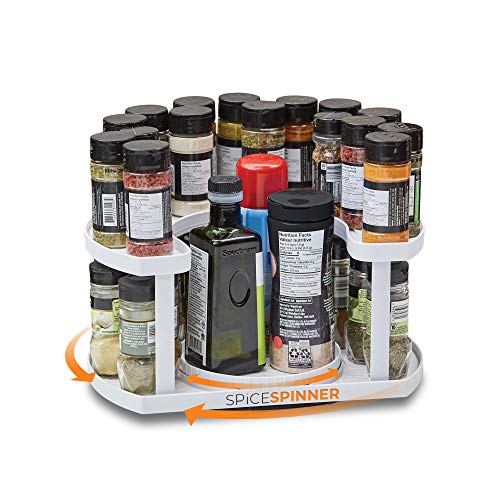
DUAL SPIN LAZY SUSAN – Built-in turntables keep all your spices at your fingertips with a simple spin. Makes everything visible and provides storage for taller items. Reclaim unused space in your cabinets and keep everything in view!

Maximize Vertical Space: This spice rack organizer fit for narrow cabinet because 2 tier design that doubles storage capacity without occupying additional horizontal space. This small lazy Susan Improves the utilization of compact space and stores more items in a limited area

USE IN EVERY ROOM: This 12 inch two-tier turntable brings order to your kitchen countertops, bathroom shelves, refrigerator, pantry, closet, home office, laundry room, garage, and craft room - one organizer that works everywhere you need it
10. Floating Shelves

Wall-mounted shelves keep spices off the counter and in view, but the hardware choice matters more than the look. True floating shelves hide a metal cleat inside the wall and the shelf itself slides over it.
The look is cleaner, yet the weight limit drops sharply once you load twenty or thirty glass jars. A standard bracketed shelf with visible L-brackets carries more, and for a spice collection I would take the brackets every time.
A full 4 oz jar runs roughly half a pound, so a row of fifteen jars is already pushing eight pounds before you count the shelf itself.
Depth is the other place I would draw a hard line.
Keep the shelf at 4 inches deep or less. Anything wider and jars migrate to the back row where you forget them; open storage only works when you can see what you own.
A shallow ledge or lip along the front edge stops sliding when you bump it reaching for the stove, and that small detail costs nothing extra at the lumber yard.
Paint or stain the shelf to match cabinetry if you want it to disappear, or leave it raw for contrast. Either way, mount into studs, not drywall anchors, or you will find your spices on the floor one morning.

Rustic style single-layer spice rack. Purchase double or triple layers to freely adjust distance. Can be installed horizontally side by side or vertically stacked for flexible arrangement. Natural style single-layer spice rack, available in double or triple layers with adjustable distance, can be installed horizontally or vertically. Black walnut wood storage rack with beautiful natural wood grain texture, not easy to deform, stable and sturdy

NOTICE: Spice Jars Not Included. ( The spice jars pictured are 110mm (4.3 inches) high and 40mm (1.57 inches) in diameter. )

Adjustable Distance: This wall mounted spice rack 13.4"L x 3.2"D x 2.5"H. Customize the wall spice rack shelf spacing to accommodate bottles of varying sizes, offering tailored storage for your condiment collection
Labels and Jars That Make Any System Work

Clear labels decide whether an organizer actually saves time or just moves the clutter around.
I would put the name on the lid for drawer systems and on the front face for shelf or wall setups; the angle your eyes hit first matters more than any design rule.
Uniform jars do more than look tidy. Square containers store more per inch than round ones, which matters when a drawer or shelf is already tight.
Glass holds freshness longer than plastic and keeps flavors from bleeding between spices, so I transfer everything even when the original jar is decent.
The ten minutes it takes to refill a set of matching containers pays back every time I reach for cumin and find it on the first try.
A basic label maker runs about $20 and earns that back fast.
Handwritten tags smudge near a stove; printed ones stay legible through steam and handling. Alphabetical order works for me, but the real win is consistency: pick a system, label the same way every time, and stop reading jars twice.
Small Kitchen Strategies

In a tight kitchen, the move is to pair systems rather than blow the budget on one custom unit.
I would start with a door-mounted rack plus a tiered shelf inside the same cabinet: the door holds the daily drivers where labels stay visible, and the tiered shelf behind it catches the backup jars that would otherwise disappear into the back row.
The Expand-A-Drawer insert runs under $20 at The Container Store, so the whole two-part setup stays well below a hundred dollars and leaves no holes to patch when you move.
Magnetic jars on the side of the refrigerator suit renters even better, since the only requirement is a flat metal surface. The jars stay visible, stay off the counter, and travel with you.
Capacity takes the hit: once you own more than a dozen spices, the fridge side starts looking like a control panel and you will need a second home for duplicates.
The single drawer with an angled insert is what I would pick for a galley kitchen with literally no wall space. It hides everything, protects the drawer bottom from spills, and keeps spices in arm’s reach of the stove.
You give up a drawer, which in a small kitchen is a real loss. Two of these three systems beat one expensive built-in every time for anyone who does not own the walls.
Keeping Spices Fresh
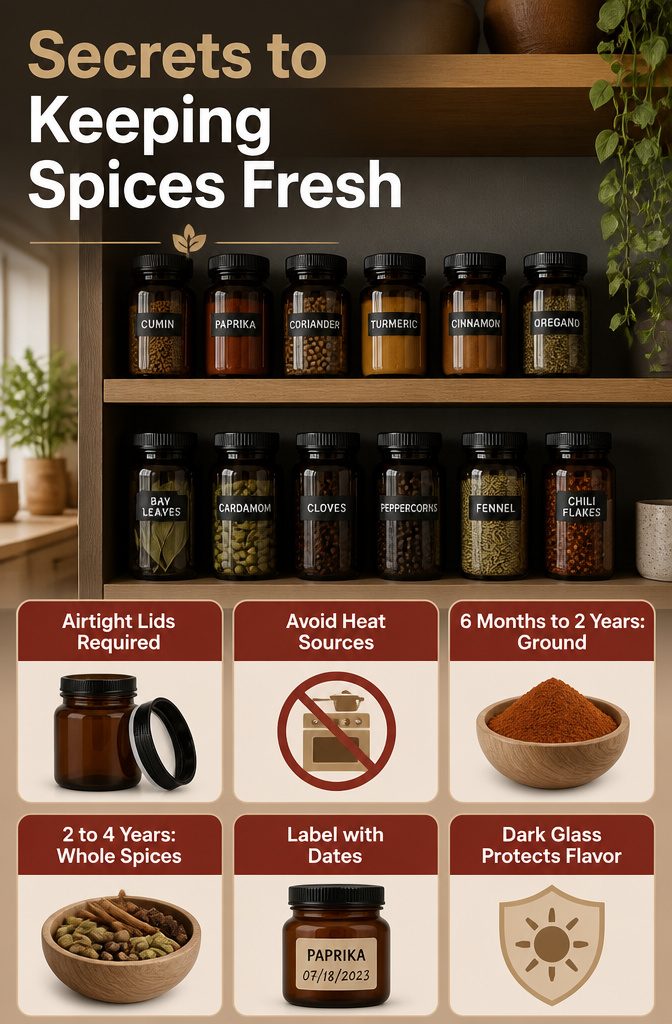
A spice rack organizer idea only works if the spices are still worth cooking with.
Airtight means a lid with a gasket or a tight screw top that seals out moisture and air; a loose cap or a snap-on shaker lets flavor leak out fast.
Heat is the other enemy, and it comes from exactly where most people stash their spices: above the stove, beside the dishwasher, or anywhere the sun hits.
I would not put my everyday cumin on a windowsill or a shelf over the range hood.
Ground spices fade in about 6 months to 2 years; whole spices hold on for 2 to 4 years. That range is wide because it depends on how well you seal them and how hot their spot gets.
When I transfer a spice into a new jar, I date the label. Memory is not reliable, and a faded jar of paprika you bought three summers ago is not doing your chicken any favors.
"As a general rule, glass containers with airtight lids are your best bet… They keep moisture out, preserve the flavor longer, and are easy to clean… amber or dark glass protects the spices from light — great if they’re stored out in the open."
That last point matters for open shelving or countertop racks: clear glass lets you see what you have, but dark glass buys you time if the shelf gets any daylight.
For a drawer or a cabinet, clear is fine and cheaper.
Frequently Asked Questions
What is the best way to organize spices?
The best approach pairs two systems rather than relying on one. A door-mounted rack plus a tiered shelf inside the same cabinet works well: daily spices stay visible on the door, while backup jars sit on stepped tiers behind it.
For small kitchens, magnetic jars on the refrigerator side or a single drawer with an angled insert keeps spices accessible without sacrificing counter space.
How do you store spices to keep them fresh?
Store spices in airtight containers with gasket lids or tight screw tops, and keep them away from heat and light. Avoid spots above the stove, beside the dishwasher, or on sunny windowsills.
Ground spices fade in about 6 months to 2 years; whole spices last 2 to 4 years. Date the label when you transfer a spice into a new jar.
What are some DIY spice rack ideas?
Three builds have proven durable over time. A reclaimed wood plank with mason jar clips gives full control over spacing at low cost.
The IKEA BEKVÄM rack looks intentional once painted to match your cabinets. The simplest and most reliable option is an L-bracket shelf with uniform square jars; skip branded matching sets and buy basic jars with plain lids instead.
For any wall-mounted build, use a drill, level, and stud finder; do not trust adhesive strips with glass and a full jar of cumin.
How to organize a spice cabinet?
Start with a tiered organizer so labels on the back row stay visible above the front row.
Stepped fixed shelves work best if your cabinet width is stable; choose expandable tiers if you rent or plan to move the organizer between kitchens.
Add a small battery light under the shelf above if the cabinet is dim. Pair this with a door-mounted rack for daily-use spices to avoid losing jars in the back row.
What are some good sliding spice racks for kitchen cabinets?
A pull-out spice rack organizer fits narrow gaps as slim as 3 to 6 inches beside the stove or sink.
Measure the cabinet opening before ordering, since even a quarter inch off causes the slide mechanism to bind. Choose full-extension slides over partial ones; partial slides leave the back row half-hidden.
Retrofit kits mount to existing cabinet floors and ceilings, which suits renters. Most units hold 8 to 12 standard jars.
How to organize spices at IKEA?
The IKEA BEKVÄM spice rack works as a hack if you paint it to match your cabinets; the raw birch finish looks temporary, but cabinet paint makes it look built-in.
For storage inside IKEA cabinets, pair it with a tiered organizer or a drawer insert. The BEKVÄM costs less than most finished racks of the same width, and the flat design takes paint well.