
Pull out cabinet kitchen organizers are sliding shelves and drawers that mount inside existing cabinetry to bring contents out to you.
They only work as promised if you match the weight rating to the load: standard kits handle 50 pounds per shelf, while custom builds like ShelfGenie’s dovetail units rate to 100 pounds with full-extension rails.
A 36-inch base cabinet can hold a KitchenAid and Instant Pot side by side, but only on the heavy-duty tier.
Sliding Pull Out Cabinet Drawers and Shelves
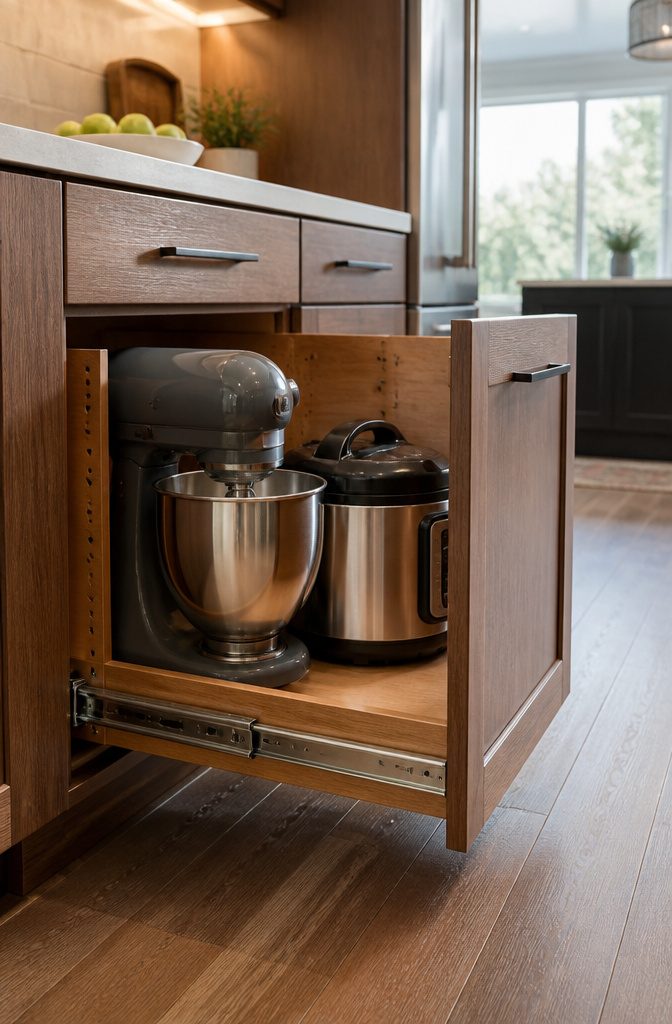
The width range on most sliding pull out cabinet drawers runs 13" to 21" adjustable, which matters more than people think.
A 36" base cabinet can swallow a KitchenAid and Instant Pot side by side on one of these, but only if you buy the heavy-duty tier rated to 50 pounds per shelf. Standard ball-bearing rails handle that load fine for daily use.
For something sturdier, ShelfGenie builds theirs to 100 pounds with full-extension rails and dovetail joinery.
I would go that route if I were storing a stand mixer I never want to lift again, or if the cabinet sees constant traffic from multiple cooks.
You give up the weekend-project ease: their install takes less than a day, but you are scheduling a crew rather than drilling four screws yourself.
The DIY option I used elsewhere in my kitchen took twenty minutes with a screwdriver. The rails were smooth enough, and the adhesive backing was an option I skipped for screws into the cabinet floor.
For a renter or a first home where you are not sure you will stay five years, that lighter 50-pound kit is the smarter money.
If this is the house you are aging into, the 100-pound custom build pays for itself in not having to replace it.

[🔝 WARM TIPS]: Please note that this pull out cabinet organizer suitable for cabinets with internal width exceeding 13" and depth exceeding 21". This pull out drawer for cabinets with Upgraded Raising Pads are compatible with both frameless cabinets and framed cabinets with edge heights up to 0.4 inches. It is essential to carefully measure your cabinet's dimensions before installation to ensure compatibility.

IMPORTANT NOTICE: Our cabinet pull out shelves are not suitable for cabinets with lips.Before ordering, please measure your cabinet dimensions correctly using the method shown in the picture.If your deep cabinet has a lip, please choose from our other drawers options designed for cabinets with a lip available in the store
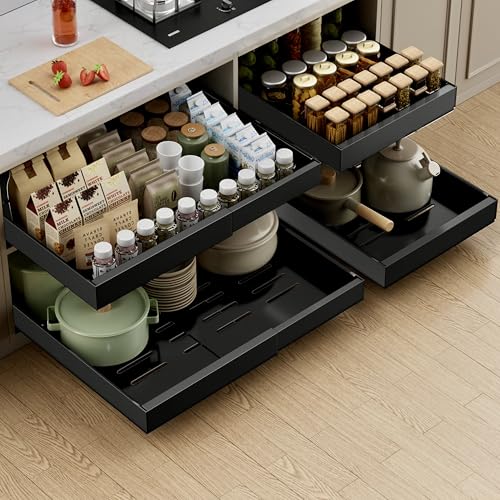
[🔝 WARM TIPS]: Please note that this pull out cabinet organizer suitable for cabinets with internal width exceeding 13" and depth exceeding 21". This pull out drawer for cabinets with Upgraded Raising Pads are compatible with both frameless cabinets and framed cabinets with edge heights up to 0.4 inches. It is essential to carefully measure your cabinet's dimensions before installation to ensure compatibility.
2-Tier Pull Out Drawer

A 2-tier pull out drawer makes the full cabinet height reachable without the stacking problem that wastes space in deep base cabinets.
The top tier sits at counter height for lids and smaller items; the bottom tier takes the weight of pots and pans at a level where you are not crouching to lift.
That second tier matters more than it sounds. In a single-tier pullout, anything stored below knee level ends up buried, so you either leave the bottom half empty or you stack, which defeats the purpose of pulling out.
I would put one of these in a bathroom vanity before I would add another kitchen shelf. The same 12 to 18 inch cabinet depth that holds cleaning bottles under a sink works better as two shallow drawers than one cavernous one.
Rev-A-Shelf’s chrome versions run from about $149 for a basic two-tier base unit up to $265 for a three-tier with independent shelves, and the heavier frames with 100 lb rated ball-bearing slides are what I would look for if the load is real cookware rather than toiletries.
What you lose is vertical clearance. Two tiers in a standard 34-1/2 inch base cabinet leaves each drawer shallow, so a stock pot with a lid on top may need the three-tier model or a different cabinet entirely.

LYNK PROFESSIONAL, THERE IS NO SUBSTITUTE! MAKE YOUR LIFE EASIER FEELING LIKE A PROFESSIONAL COOK with the joy of having everything at your fingertips

This cleverly designed, chrome-plated steel organizer offers 2-tiers of spacious storage compartments crafted fit multiple pieces of cookware and bakeware; Equipped with an easy-mount full-extension ball bearing sliding top and base

✅【LARGE CAPACITY】Stackable Sliding Basket Organizer adopts a mesh basket storage design, which can store seasoning bottles, cans, cups, food, beverages, toiletries and some small accessories, etc. It is very suitable for kitchens, cabinets, living rooms, bathrooms, offices, etc.
Pull Out Pot and Pan Organizer

A two-tier pull out pot and pan organizer handles the full cookware set in one motion: the top tier lines up lids vertically so they stop sliding around, and the bottom tier drops adjustable dividers between the actual pots and pans.
That separation matters because a generic drawer solution leaves everything in one flat layer; lids wedge under rims, you stack heavy on heavy, and the thing you need is always at the bottom.
The independent shelves on something like Rev-A-Shelf’s 5CW2 move separately, so pulling the lower tier for a Dutch oven does not disturb the lid rack above it.
Chrome-plated wire and 100 lb-rated ball-bearing slides mean the weight sits on the slides, not on your wrists. The soft-close action is worth having if you cook with any frequency; a slamming cookware rack gets old fast.
I would skip a setup that forces door mounting only. Side and rear mounting options give you the sturdiness for cast iron without the door hardware fighting the frame.
For renters, this is where the project gets tricky: the mounting holes are cabinet-specific, and you will want to check your interior depth before ordering.

Anti-corrosion & Anti-rust:LONTAN drawer slides are made of high grade cold-rolled steel with zinc plated finish,Which makes it can not only to prevent corrosion and rust, but also to extend the service life

CONCEALED BOTTOM MOUNT DESIGN FOR FRAMELESS CABINETS: Designed for frameless cabinets, these concealed drawer slides mount beneath the drawer for a clean, low-profile appearance. The hidden design keeps the hardware out of sight while providing reliable support for everyday storage

【Heavy Duty 100 lb Capacity】 BAIDICE full extension drawer slides are built with 1.0mm cold-rolled steel and dual industrial-grade ball bearings, supporting up to 100 lbs—40 lbs more than standard slides. The precision ball bearing mechanism ensures smooth gliding even under heavy loads, while the built-in rubber crash pad keeps operation as quiet as 35 decibels.
Pull Out Food Storage Container Organizer

The adjustable pegs and dividers on a pull out food storage container organizer are what separate it from a fixed rack that never quite fits your collection.
I would take one with wooden pegs over wire every time: the pegs move in slots to create whatever grid your containers need, and a taller soup container does not have to share air with a flat sandwich box meant for a different shelf entirely.
Before buying, measure the interior width of your cabinet opening at the frame, not the door.
Pull-out hardware needs that bare width to clear the hinges, and a half-inch here is the difference between smooth travel and a bracket that grinds on the face frame every time you extend it.
The Rev-A-Shelf system runs $589.99 to $657.99 for the 18-inch and 24-inch versions, which tells you this sits at the investment end of cabinet organizing, not the impulse-buy aisle.
A soft-close slide matters more here than on a pot rack, because these drawers carry light plastic that rattles and tips.
Blumotion slides, the kind Rev-A-Shelf ships with, let you nudge the drawer shut with one elbow while your hands hold a wet lid.
I would still test the full extension weight before loading it; dovetail construction holds up, but a drawer of packed containers runs heavier than it looks.
Rev-A-Shelf can help restore some sanity with this unique storage solution.
That line is marketing, but the idea holds. If every morning starts with a lid avalanche, a pegged pull-out ends it.
What you give up is the price and the install time; for a rental kitchen, this is probably more project than you want, but for a first home you plan to stay in, it pays back in daily calm.

HEAVY-DUTY KITCHEN PULL OUT DRAWERS: Our pull out drawers for cabinets is designed for standard kitchen and bathroom cabinets wider than 13" and deeper than 21". Perfect as a kitchen adjustable pull out shelves, sliding drawer organizer, cabinet drawers slide out, cabinet organizer, under sink pull out organizer
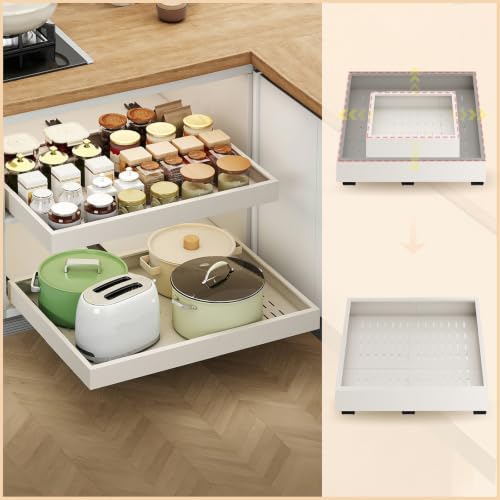
IMPORTANT NOTICE:Our cabinet pull out shelves are not suitable for cabinets with lips.Before ordering, please measure your cabinet dimensions correctly using the method shown in the picture.If your deep cabinet has a lip,please choose from our other drawers options designed for cabinets with a lip available in the store

Wider & Deeper Adjustability:Our pull-out cabinet organizer features 4-way adjustable sizing, extending from 11.4" to 18.9" in width and 16.3" to 21.6" in depth, ensuring a perfect fit for most base cabinets. Unlike standard organizers with limited adjustability, this versatile design adapts to your storage needs, whether for pots, pans, spices, or small appliances.
Pull Out Kitchen Cabinet Spice Rack Organizer
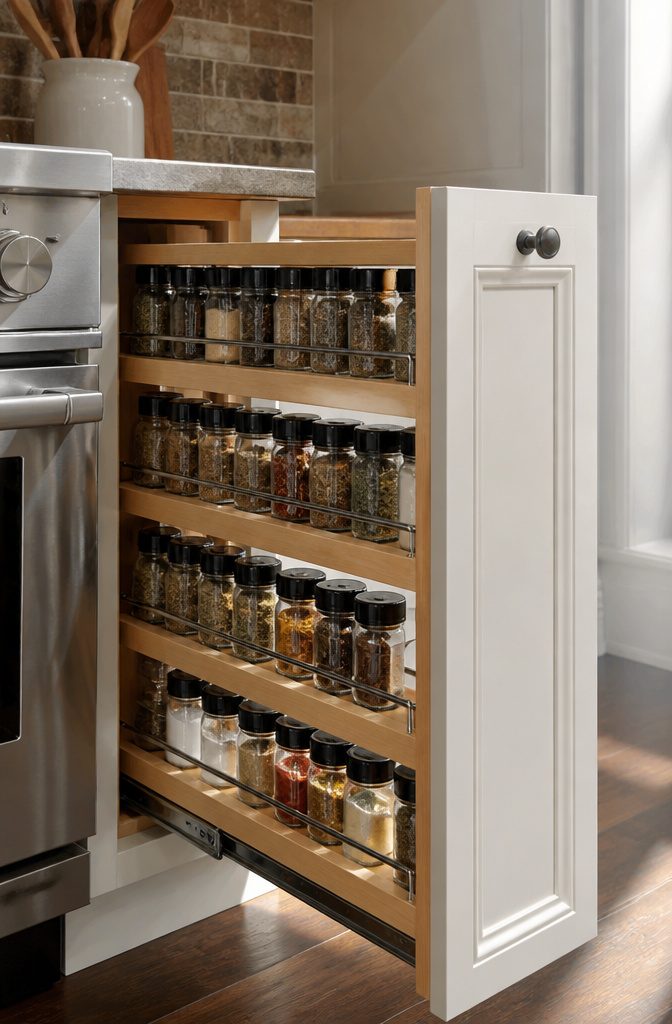
A pull out kitchen cabinet spice rack organizer comes in six widths, which matters more than it sounds.
Most kitchens have at least one narrow cabinet, often the awkward gap beside a range or between banks of drawers, that ends up as dead space or a graveyard of forgotten bottles.
The slim sizes let you claim that three- or four-inch void instead of leaving it to a filler board.
Spice storage differs from other pull-outs in two ways. The bottles are small and uniform, so the rack can be shallow, around two inches deep, and still hold a full collection.
That shallow depth means the slide mechanism travels a shorter distance, which keeps the action smooth even in a tight cabinet.
Access pattern matters too: you are reaching for one specific bottle while cooking, not browsing like you might with a pantry pull-out.
The vertical tiers need to show labels at a glance, which is why I would pick a stepped or tiered design over a flat shelf. What you give up is capacity.
A stepped rack holds fewer bottles than a flat one of the same footprint, and tall containers, like bulk spice jars, may not fit the upper tiers. For most home cooks, the speed of finding the cumin wins that trade.

5/8" Solid Beechwood & No-Assembly: Say Goodbye to Soft Pine---Crafted from premium 5/8" (15mm) thick solid beechwood, this drawer offers superior density and dent-resistance compared to common soft pine. It arrives fully assembled with slides pre-installed. Skip the tedious DIY wood puzzles—simply secure it to your cabinet base for a professional-grade upgrade in minutes.

5/8" Solid Beechwood & No-Assembly: Say Goodbye to Soft Pine---Crafted from premium 5/8" (15mm) thick solid beechwood, this drawer offers superior density and dent-resistance compared to common soft pine. It arrives fully assembled with slides pre-installed. Skip the tedious DIY wood puzzles—simply secure it to your cabinet base for a professional-grade upgrade in minutes.

Heavy Duty Steel Construction: Basket can hold up to 70lbs
Pull Out Pantry Basket
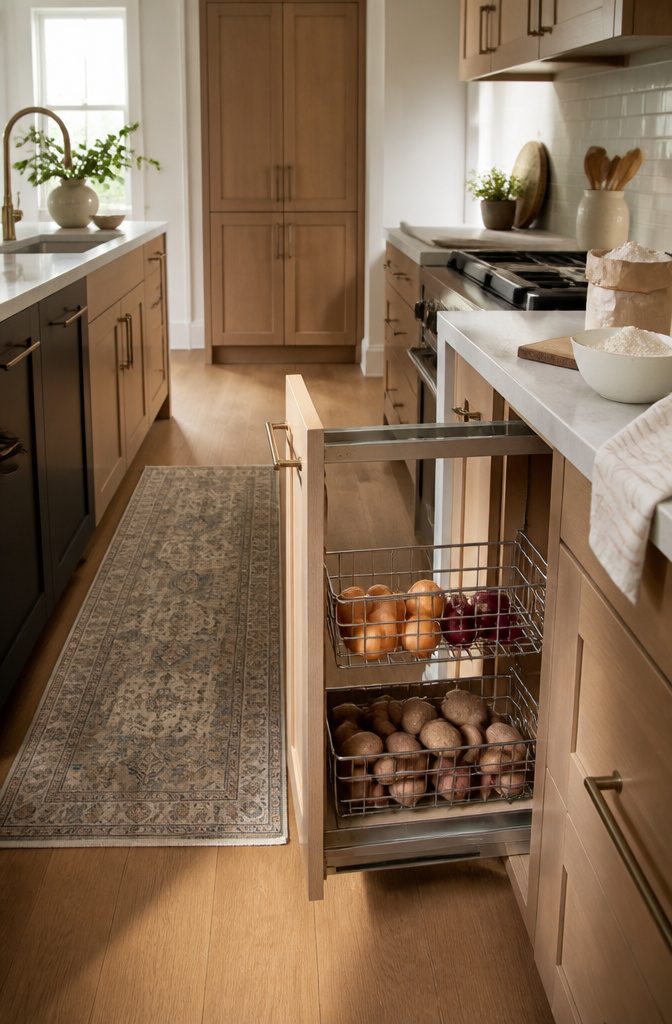
A pull out pantry basket shines for the items that ruin standard drawers: onions, potatoes, winter squash.
Wire or mesh construction lets air move across the whole surface, which matters more than most people realize until they lift a plastic bin and find sprouts growing through condensation.
The ventilation keeps the skin dry and firm for weeks longer than a sealed container allows.
Weight capacity is where this choice earns its keep. These units typically run strongest in the 20–22 inch depth range, the standard base cabinet box, where the frame can anchor properly to the side walls.
Deeper cabinets risk the basket pulling off track once you load in five pounds of potatoes and the weight shifts.
I would skip the full-extension soft-close slides here; the basket does not need to clear the counter, and the heavier-duty partial-extension hardware handles load better without the upcharge.
What you lose is visibility. A solid pull-out drawer hides clutter but traps moisture; the basket exposes everything to light and dust.
For root vegetables, that exchange is worth it. For anything else, I would look elsewhere in the cabinet.

IMPORTANT NOTICE:Our cabinet pull out shelves are not suitable for cabinets with lips.Before ordering,please measure your cabinet dimensions correctly using the method shown in the picture.If your deep cabinet has a lip,please choose from our other drawers options designed for cabinets with a lip available in the store

✔️Maximized Storage Capacity: Designed to fit cabinets with dimensions of 16"W x 22"D, our cabinet roll out drawers offer generous storage space (15"W x 21"D x 4"H), perfect for keeping your kitchen or pantry organized and clutter-free.

Drawer Size & Total Width: The pull out cabinet drawer body measures 14" W × 21" D × 3.2" H,Including 2 slide rails,The total installed width is 15".
Pull Out Kitchen Cabinet Divider

Vertical storage for cutting boards and baking pans only earns its keep in cabinets deep enough to hide the clutter but shallow enough that items stand without tipping.
I look for a minimum 18-inch cabinet depth before I would bother installing a pull-out divider over a simple countertop rack. Anything less, and the dividers crowd the contents instead of sorting them.
The Craftsman Collection base cabinet pullout with tray divider and foil-wrap holder runs in 5-, 6-, 8-, and 9-inch widths, which tells me the real application: narrow base cabinets that would otherwise become dead zones for long boxes and sheet pans.
The soft-close BLUM slides and matte black wire accents are nice, but the geometry matters more. A 5-inch-wide unit organizes foil and wrap upright; the 8- and 9-inch widths handle cutting boards and half-sheet pans without the stack-and-dig routine.
I would skip this entirely in a cabinet wider than 12 inches. At that point, a basic wire pullout shelf at $114.99 does more useful work per dollar, letting you stack and see everything.
The divider is a specialty play for the 6- to 9-inch cabinet you inherited beside the stove, the one too slim for pots but perfect for the boards you reach for twice a day.

LYNK PROFESSIONAL, THERE IS NO SUBSTITUTE! MAKE YOUR LIFE EASIER FEELING LIKE A PROFESSIONAL COOK with the joy of having everything at your fingertips

This cleverly designed, chrome-plated steel organizer offers 2-tiers of spacious storage compartments crafted fit multiple pieces of cookware and bakeware; Equipped with an easy-mount full-extension ball-bearing sliding top and base
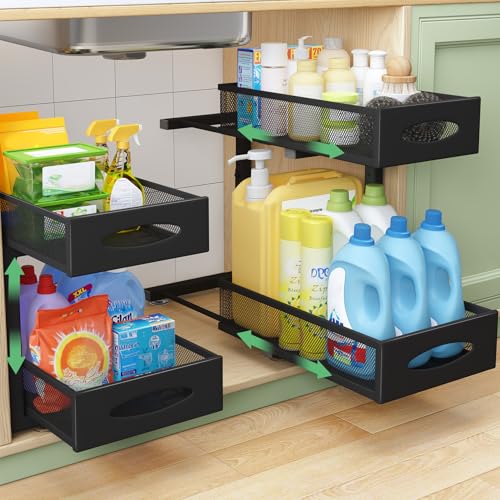
2-Tier Mesh Sliding Drawers: The under sink organizer feature upgraded round rails with plastic pads for a smooth, quiet sliding experience—no metal-on-metal noise. Both upper and lower drawers slide out effortlessly, making it easy to access items stored deep in your lower cabinet
Installation Basics

Most pull out cabinet kitchen hardware ships ready to drop in. The adjustable sliding drawers expand from 13 to 21 inches and install with four screws, no adhesive needed, which I prefer for anything holding 50 pounds of stand mixer.
Some wooden options arrive fully assembled with soft-close rails already mounted; you slide the unit in and fasten it at the face frame.
A basic screwdriver and half an hour covers the majority of installs. The pilaster systems that support multiple tiers run more involved, though even those are designed for door-mounted or full-height base cabinets without visible holes afterward.
If you are already replacing drawers or reconfiguring a pantry stack, a carpenter can knock out the job in under a day, and several brands keep installers on call for exactly that.
I would only pay for pro help on a custom pilaster kit running past $700, where mis-measured holes waste real money. For a single pull-out shelf under $150, doing it yourself beats waiting on a contractor’s calendar.

Soft-Close Mechanism with Hydraulic Damper & Noise Reduction: Equipped with a built-in hydraulic damper for gentle, silent self-closing action. The double spring design minimizes operational noise during opening and closing, ensuring a quiet and comfortable home environment

【Heavy Duty 100 lb Capacity】 BAIDICE full extension drawer slides are built with 1.0mm cold-rolled steel and dual industrial-grade ball bearings, supporting up to 100 lbs—40 lbs more than standard slides. The precision ball bearing mechanism ensures smooth gliding even under heavy loads, while the built-in rubber crash pad keeps operation as quiet as 35 decibels.

[Choose The Size Wisely] To ensure you select the correct size for your dresser drawer slides, measure the depth of your drawer and make sure there is an extra 0.5 inches of space on both sides for mounting. These slides are suitable for drawer depths ranging from (depth range)
Sizing and Customization
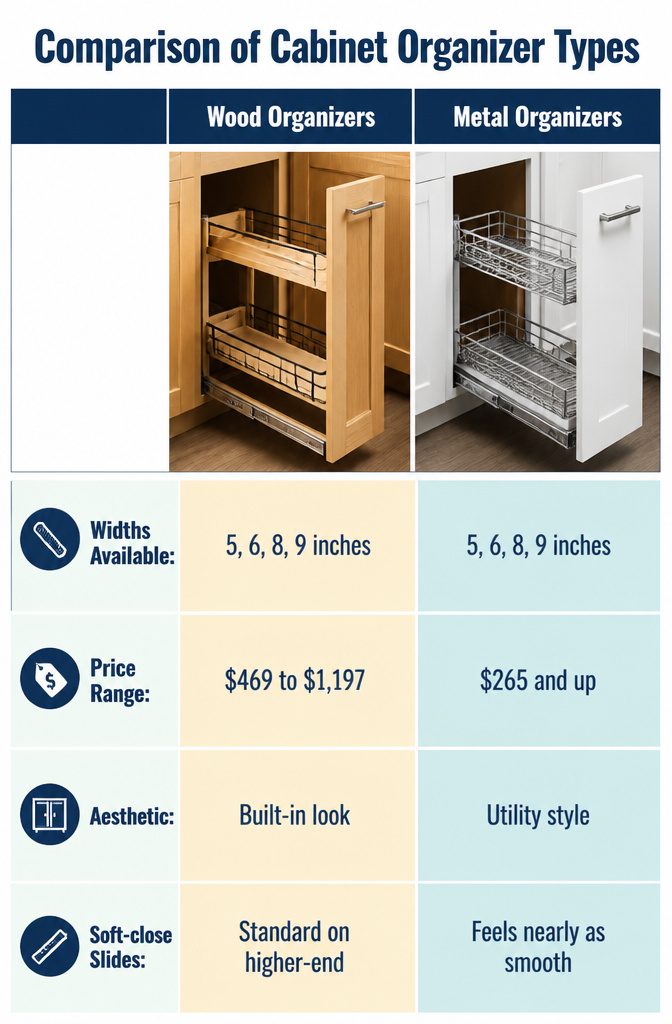
Most pull out cabinet kitchen organizers come in fixed widths at 5, 6, 8, or 9 inches, though a few lines offer limited adjustability after installation. I would measure the inside of the cabinet box, not the door opening, before ordering.
A 9-inch unit in a 10-inch space leaves a gap you notice every time you reach in. A 6-inch unit crammed into a 5.5-inch space means the slides bind.
Wood versus metal frames the real choice.
Solid wood construction with black wire accents, as in the Craftsman Collection, runs $469 to $1,197 depending on the configuration. Chrome-plated wire alternatives like the Two-Tier Cookware Organizer start closer to $265.
The wood looks built-in; the wire reads utility. For matching existing cabinetry, I would skip trying to stain a new wood organizer to an old cabinet face.
The maple or grey shelving surfaces that some contemporary lines offer are easier to coordinate than they are to match exactly. If your cabinets are already a dated honey oak, the chrome wire disappears visually where wood would compete.
Soft-close slides are standard on the higher-end units now, and worth specifying even on a budget build. The 100 lb rated ball-bearing slides on the chrome models feel nearly as smooth as the BLUM hardware on the wood ones.
Where I would save money is on the adjustable dividers: peg systems for food storage containers sound flexible, but in practice most people set them once and never move them again.

4-WAY EXPANDABLE DESIGN: Optimize your cabinetry with this expandable drawer organizer. Adjusting seamlessly from 13" to 21" inches wide and 17" to 24" inches deep, it provides a tailored fit for any deep drawer organizer setup.

4-WAY EXPANDABLE DESIGN: Optimize your cabinetry with this expandable drawer organizer. Adjusting seamlessly from 13" to 21" inches wide and 17" to 24" inches deep, it provides a tailored fit for any deep drawer organizer setup.

ADJUSTABLE WIDTH FOR DIFFERENT CABINETS:Each pull out cabinet organizer adjusts from 13 to 21 inches wide and is designed for cabinets deeper than 21 inches. The expandable design helps maximize storage space in kitchen cabinets, pantry shelves, bathroom vanities, and under-sink areas.
Accessibility and Daily Use
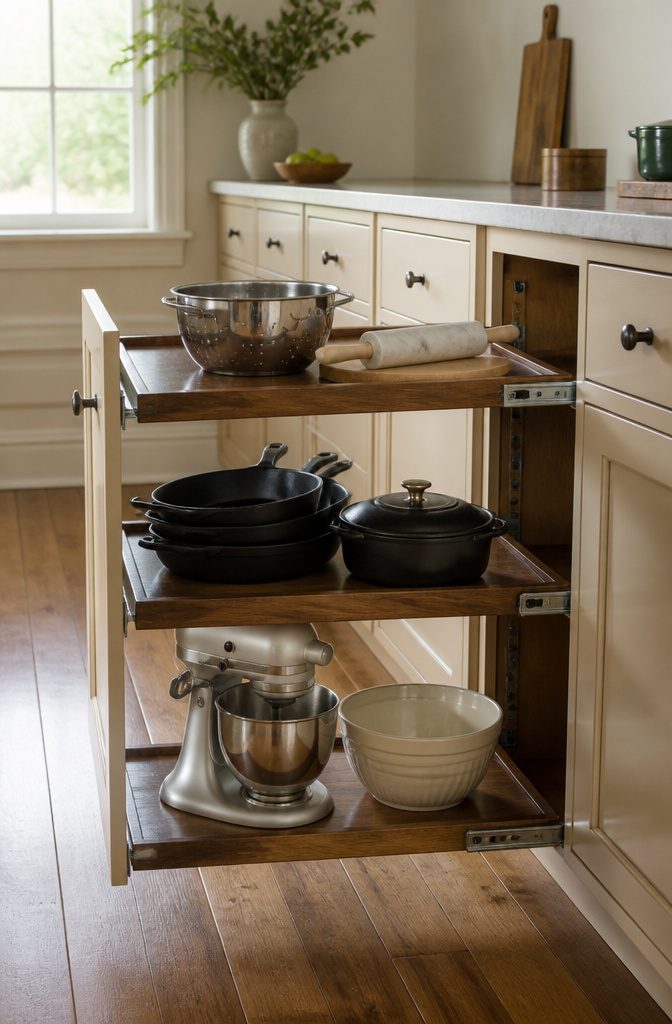
Deep cabinets waste motion. You crouch, you reach past the first row of pots, and you still end up buying a second colander because the first one is buried behind the roasting pan you use twice a year.
Pull-out organizers fix this by bringing the entire shelf to you on full-extension rails.
I would put these in every base cabinet before I spent money on upper-cabinet upgrades, because the bending and blind reaching is what actually makes daily cooking feel like work.
The rails I would look for are rated to at least 100 lbs, which handles a loaded shelf of cast iron or a mixer without complaint.
For renters, this matters more than it might seem: the hardware mounts inside existing cabinets with no structural change to the box, so you take it with you or leave it as a selling point.
A 24-inch-deep cabinet becomes fully visible; nothing hides behind anything else, so you stop accumulating duplicates and you stop excavating.
The cost lands in the same range as a few hours of professional organizing, but the time saved is daily, not one-time.
I think the better comparison is to the frustration of cooking around clutter. For a few hundred dollars and a Saturday morning with a drill, the kitchen starts working with your body instead of against it.

5/8" Solid Beechwood & No-Assembly: Say Goodbye to Soft Pine---Crafted from premium 5/8" (15mm) thick solid beechwood, this drawer offers superior density and dent-resistance compared to common soft pine. It arrives fully assembled with slides pre-installed. Skip the tedious DIY wood puzzles—simply secure it to your cabinet base for a professional-grade upgrade in minutes.

5/8" Solid Beechwood & No-Assembly Required: Crafted from premium 5/8" (15mm) thick solid beechwood, this drawer offers superior density and dent-resistance compared to common soft pine. It arrives fully assembled with slides pre-installed. Skip the tedious DIY wood puzzles-simply secure it to your cabinet base for a professional-grade upgrade in minutes

Heavy Duty Steel Construction: Basket can hold up to 70lbs
Frequently Asked Questions
What are the benefits of pull-out kitchen cabinets?
Pull-out cabinet kitchen organizers bring the entire shelf to you on full-extension rails, so nothing hides behind anything else in deep base cabinets.
You stop accumulating duplicate tools and you stop excavating for buried items. For a few hundred dollars and a Saturday morning with a drill, the kitchen starts working with your body instead of against it.
How do I install pull-out cabinet organizers?
A basic screwdriver and half an hour covers most installs, with four screws into the cabinet floor and no adhesive needed.
Some wooden options arrive fully assembled with soft-close rails already mounted; you slide the unit in and fasten it at the face frame.
I would only pay for pro help on a custom pilaster kit running past $700, where mis-measured holes waste real money.
What types of pull-out organizers are available?
The main types are sliding pull-out drawers, 2-tier pull-out drawers, pot and pan organizers with adjustable dividers, food storage container organizers with wooden pegs, stepped spice racks, ventilated pantry baskets for produce, and vertical dividers for cutting boards and baking pans.
Each solves a specific storage problem rather than working as a generic shelf.
Are pull-out cabinets worth it?
Yes, if you cook daily in deep base cabinets where you currently crouch and reach past the first row of pots.
The cost lands in the same range as a few hours of professional organizing, but the time saved is daily, not one-time.
For renters, the hardware mounts inside existing cabinets with no structural change, so you take it with you or leave it as a selling point.
What is a pull-out cabinet called?
The same unit goes by several names depending on its function: pull-out shelf, sliding drawer, pull-out organizer, roll-out tray, or pull-out basket.
A narrow unit designed for the gap beside a range is sometimes called a filler pull-out, since it replaces the filler board between cabinets.